Top Rated Pre-Emergent Weed Killers for a Lush Green Lawn
Why Choosing the Best Pre-Emergent Weed Killer for Lawns Matters
The best pre emergent weed killer for lawns stops weeds before they ever break the surface — saving you time, money, and a lot of frustration. Here are the top picks at a glance:
- Scotts Halts Crabgrass and Grassy Weed Preventer - Best overall; covers 5,000 sq. ft.; contains Pendimethalin
- The Andersons 0.48% Barricade - Best for Bermudagrass; professional-grade Prodiamine; covers 5,800 sq. ft.
- Quali-Pro Prodiamine 65WDG - Best liquid concentrate; trusted by lawn pros for crabgrass prevention
- Preen Lawn Crabgrass Control - Best dual-action; pre- and early post-emergent with Dithiopyr; covers 5,000 sq. ft.
- Espoma Organic Weed Preventer - Best organic option; corn gluten meal; pet-friendly
Every spring, millions of weed seeds lying dormant in your soil are just waiting for the right moment to sprout. Once they do, they compete with your grass for water, sunlight, and nutrients — and they spread fast. The frustrating truth is that by the time you see weeds, it's already too late for prevention.
That's exactly where pre-emergent herbicides come in. Applied at the right time, they form a chemical barrier in the top layer of soil that stops weed seeds from establishing roots — before a single blade of crabgrass or chickweed ever appears. Miss the window, and you're fighting a much harder battle all season long.
For Ohio homeowners especially, timing and product selection can make or break your lawn's appearance for the entire year.
I'm Andrew Day, owner of Advanced Quality Lawn and a lawn care professional with over 30 years of experience helping homeowners across Northeast Ohio choose and apply the best pre emergent weed killer for lawns for their specific grass type and conditions. In this guide, I'll walk you through the top-rated products, when and how to use them, and what to avoid so you get the weed-free results you're after.
Understanding the Best Pre Emergent Weed Killer for Lawns
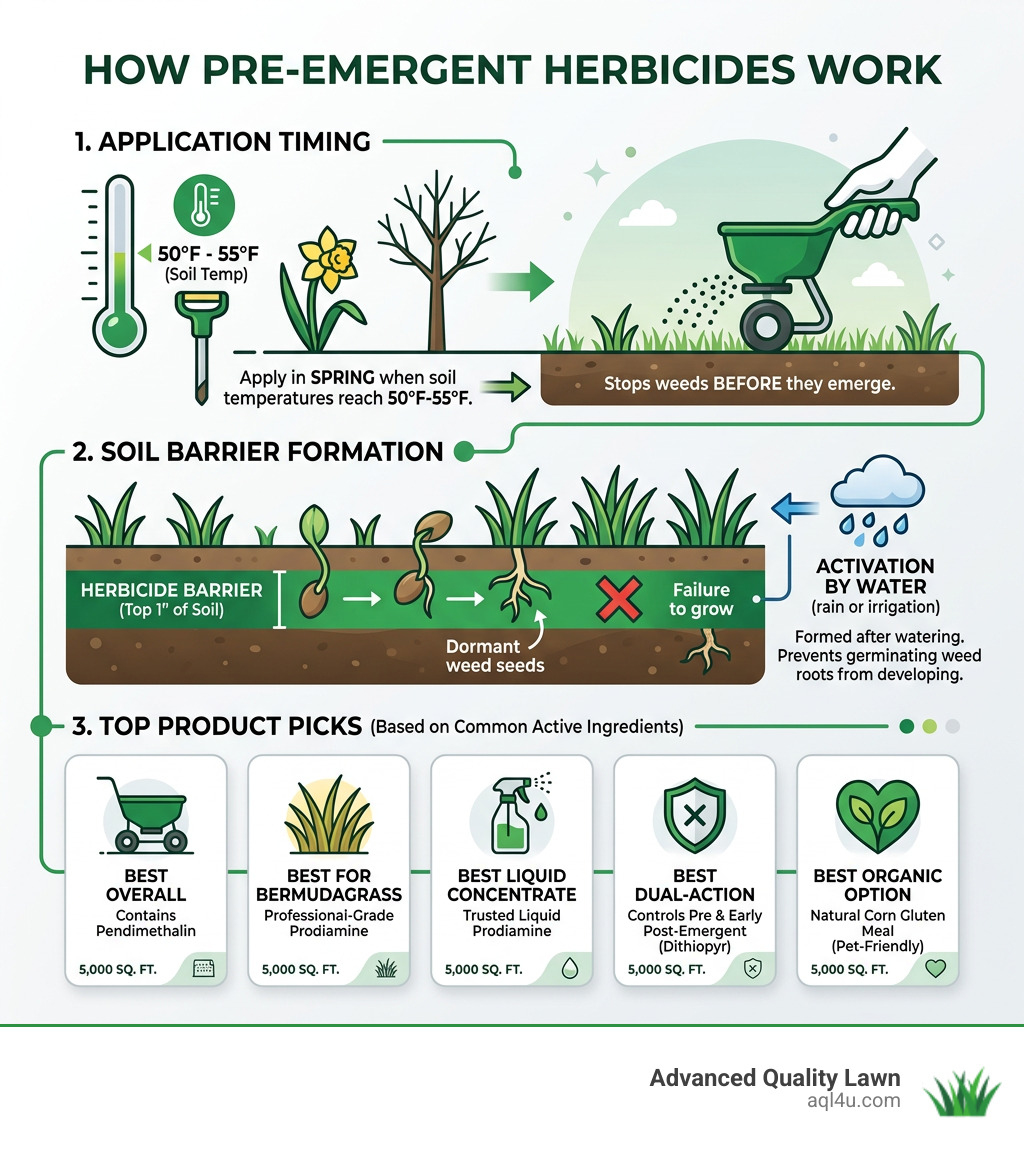
To choose the right product, we first need to look at the science of weed prevention. A pre-emergent herbicide isn't actually a "seed killer." Instead, it’s a root inhibitor. When you apply these products to your lawn and water them in, they create a vapor barrier in the top inch of soil. When a weed seed begins to germinate and sends out its first tiny root (the radicle), it hits that chemical barrier and stops growing.
In Northeast Ohio, our lawns are primarily made of cool-season grasses like Kentucky Bluegrass, Perennial Ryegrass, and Tall Fescue. Because our weather can jump from a freezing morning to a 70-degree afternoon in a heartbeat, understanding the active ingredients in your herbicide is vital.
Key Active Ingredients to Look For
Different chemicals target different weeds and offer varying lengths of protection. Here are the "Big Three" you'll find in the best pre emergent weed killer for lawns:
- Prodiamine (Barricade): This is often considered the gold standard by professionals. According to Scientific research on Prodiamine, it is highly effective at low use rates and has a very long residual life—meaning it stays active in the soil longer than most other options. It’s excellent for controlling crabgrass and many annual grasses.
- Pendimethalin: Found in popular consumer products like Scotts Halts, this ingredient is a workhorse. Scientific research on Pendimethalin shows it is highly effective against a wide range of grassy weeds and some broadleaf weeds. It’s a reliable choice for spring applications in Cleveland and Akron.
- Dithiopyr (Dimension): This is a unique "dual-action" ingredient. Not only does it prevent seeds from sprouting, but it can also kill very young crabgrass that has already emerged (up to the three-leaf stage). This is a lifesaver if you're a week or two late with your application.
- Isoxaben: While the others focus on grasses, Scientific research on Isoxaben highlights its strength in preventing broadleaf weeds like white clover and dandelion. We often see it used in landscape beds or in combination products.
By understanding these ingredients, we can better tailor our approach to the specific yard weeds plaguing your property.
Top Rated Products for Every Lawn Type
Choosing the best pre emergent weed killer for lawns depends on your grass type, the size of your yard, and your preferred application method (liquid vs. granular). Below is a comparison of some of the top-performing products currently on the market.
| Product Name | Active Ingredient | Best For | Coverage (per bag/bottle) |
|---|---|---|---|
| Scotts Halts | Pendimethalin | General DIY Use | 5,000 sq. ft. |
| The Andersons Barricade | Prodiamine | Professional Results | 5,800 sq. ft. |
| Quali-Pro Prodiamine 65WDG | Prodiamine | Large Lawns (Liquid) | Up to 1+ Acre |
| Preen Lawn Crabgrass Control | Dithiopyr | Late Starters | 5,000 sq. ft. |
| Espoma Organic | Corn Gluten Meal | Organic Lawns | 1,250 sq. ft. |

Best Pre Emergent Weed Killer for Lawns: Overall Performance
When it comes to consistent, reliable results for the average homeowner, Scotts Halts Crabgrass and Grassy Weed Preventer remains a top contender. It is specifically designed for crabgrass prevention and provides season-long control with a single spring application.
One of the reasons we like this product for our local area is its resilience. It isn't easily washed away by the heavy spring rains we often get in Summit and Cuyahoga counties. A 10.06 lb. bag covers 5,000 sq. ft., making it a cost-effective option for most suburban lots. If you’re dealing with a mix of dandelions and crabgrass, this product sets the foundation by eliminating the grassy competition early on.
Best Pre Emergent Weed Killer for Lawns: Professional Grade
For those who want the same results the pros get, The Andersons 0.48% Barricade is the way to go. Containing Prodiamine, this granular product offers professional-grade weed removal and prevention.
While it is often marketed for Bermudagrass in the south, it is perfectly safe and highly effective for our cool-season grasses here in Ohio. The 18 lb. bag covers 5,800 sq. ft. and prevents over 30 types of grassy and broadleaf weeds. Its "life-changing" reputation among lawn enthusiasts comes from its long residual—it can keep your lawn protected for up to four months, which is usually enough to get us through the entire crabgrass germination window.
Best Liquid and Organic Options
If you prefer spraying over spreading, Quali-Pro Prodiamine 65WDG is a professional favorite. This is a water-dispersible granule (WDG) that you mix with water in a pump or backpack sprayer. It is incredibly concentrated; just 0.4 ounces dissolved in half a gallon of water can cover 1,000 sq. ft. This offers the best value for those with larger properties in places like Medina or Portage County.
For homeowners in the "Southern" transition zones or those with specific grass types like St. Augustinegrass, BioAdvanced Southern Weed Preventer is a solid choice, though we generally recommend sticking to Prodiamine or Pendimethalin for our Northern Ohio fescues.
If you are looking for a natural approach, Espoma Organic Weed Preventer is the best pre emergent weed killer for lawns in the organic category. It uses corn gluten meal to inhibit root development while providing a mild nitrogen boost for greening. It’s a great option for dandelion treatment in a chemical-free program, though it does require more frequent applications and covers a smaller area (1,250 sq. ft. per 25 lb. bag) compared to synthetic options.
Application Timing and Best Practices
You can buy the most expensive herbicide in the world, but if you put it down at the wrong time, it won't do a thing. In Northeast Ohio, timing is everything.
The 55-Degree Rule
The general rule of thumb is to apply your pre-emergent in the spring when soil temperatures reach 55 degrees Fahrenheit for three consecutive days. This is usually the exact moment that crabgrass seeds begin to wake up.
How do you know when the soil is 55 degrees? You can use a soil thermometer, but nature provides its own clues. In our area, when you see the yellow Forsythia bushes beginning to bloom, that is your signal to get your spreader ready.
Steps for a Successful Application:
- Check the Weather: You want a calm day with no heavy rain in the immediate forecast (though a light rain can actually help).
- Mow First: Mow your lawn at its normal height and clear away any heavy debris or fallen leaves so the granules can reach the soil.
- Spreader Settings: Ensure your spreader is calibrated correctly. For example, Scotts Turf Builder Halts typically requires a setting of 2¼ on a broadcast spreader.
- Uniform Coverage: Walk at a steady pace. We recommend doing a "header strip" around the perimeter first, then filling in the middle with parallel passes.
- Water It In: Most pre-emergents need to be "activated" by water. If it doesn't rain within 24–48 hours, give your lawn about a half-inch of water to move the chemical into the soil. This is essential to prevent weeds effectively.
Common Mistakes and Safety Tips
Even the most seasoned DIY-ers can run into trouble. Here are the most common pitfalls we see at Advanced Quality Lawn:
- Applying Too Late: If the crabgrass has already sprouted, a standard pre-emergent won't kill it. You'll need a post-emergent product for crabgrass removal.
- The Seeding Conflict: This is a big one. Pre-emergents don't know the difference between a weed seed and a grass seed. If you plan to overseed your lawn this spring, you cannot use most pre-emergents. They will stop your expensive grass seed from growing just as effectively as they stop the weeds. Typically, you must wait at least four months after application before you can successfully plant new grass.
- Disturbing the Barrier: Once the product is down and watered in, try not to do any heavy raking or aerating. Breaking that soil "crust" can allow weed seeds to find a gap and sprout.
- Safety First: We are often asked about pet and kid safety. Most modern herbicides are safe once they have been watered in and the lawn is completely dry. Always check the label, but a 24-hour wait period is a good standard. For dandelion removal and general weed control, keeping the "dust" down is key.
Frequently Asked Questions about Pre-Emergent Herbicides
Can I apply pre-emergent if I plan to overseed?
Generally, no. Most pre-emergents (like Prodiamine and Pendimethalin) will prevent your new grass seed from germinating. If you must seed and prevent weeds at the same time, look for a product containing Mesotrione (like Scotts Turf Builder Triple Action), which is one of the few chemicals that allows for grass growth while blocking weeds. Otherwise, we recommend waiting until the fall to overseed.
How long does pre-emergent protection last?
It depends on the product and the application rate. Most consumer-grade products last about 2 to 3 months. Professional-grade options like Barricade can last up to 4 or 5 months. Factors like heavy rain and high soil microbial activity can break down the barrier faster.
Is it safe for pets and children after application?
Yes, provided you follow the label instructions. For granular products, you should water the lawn and wait for it to dry completely before letting pets or children back onto the grass. This usually takes 24 hours. If you're concerned about chemicals, consider an organic corn-gluten-based preventer.
Conclusion
Achieving a "golf course" lawn in Northeast Ohio isn't about working harder; it's about working smarter. By using the best pre emergent weed killer for lawns and hitting that critical spring window, you can stop 90% of your weed problems before they even start.
Whether you're in Hudson, Medina, Solon, or right here in Akron, we know that lawn care can be a daunting task. Between the soil temperatures, spreader calibrations, and the "will it rain?" guessing game, it’s a lot to manage.
If you’d rather spend your weekends enjoying your yard instead of treating it, Advanced Quality Lawn is here to help. We provide expert lawn care services across Summit, Cuyahoga, Medina, and Portage counties. With our full-program guarantees and decades of local experience, we can ensure your lawn stays lush, green, and—most importantly—weed-free all year long. Give us a call today for a free estimate!