One Spray to Rule Them All and Kill Your Crabgrass and Nutsedge
Two Weeds, One Spray: The Fastest Way to a Weed-Free Ohio Lawn
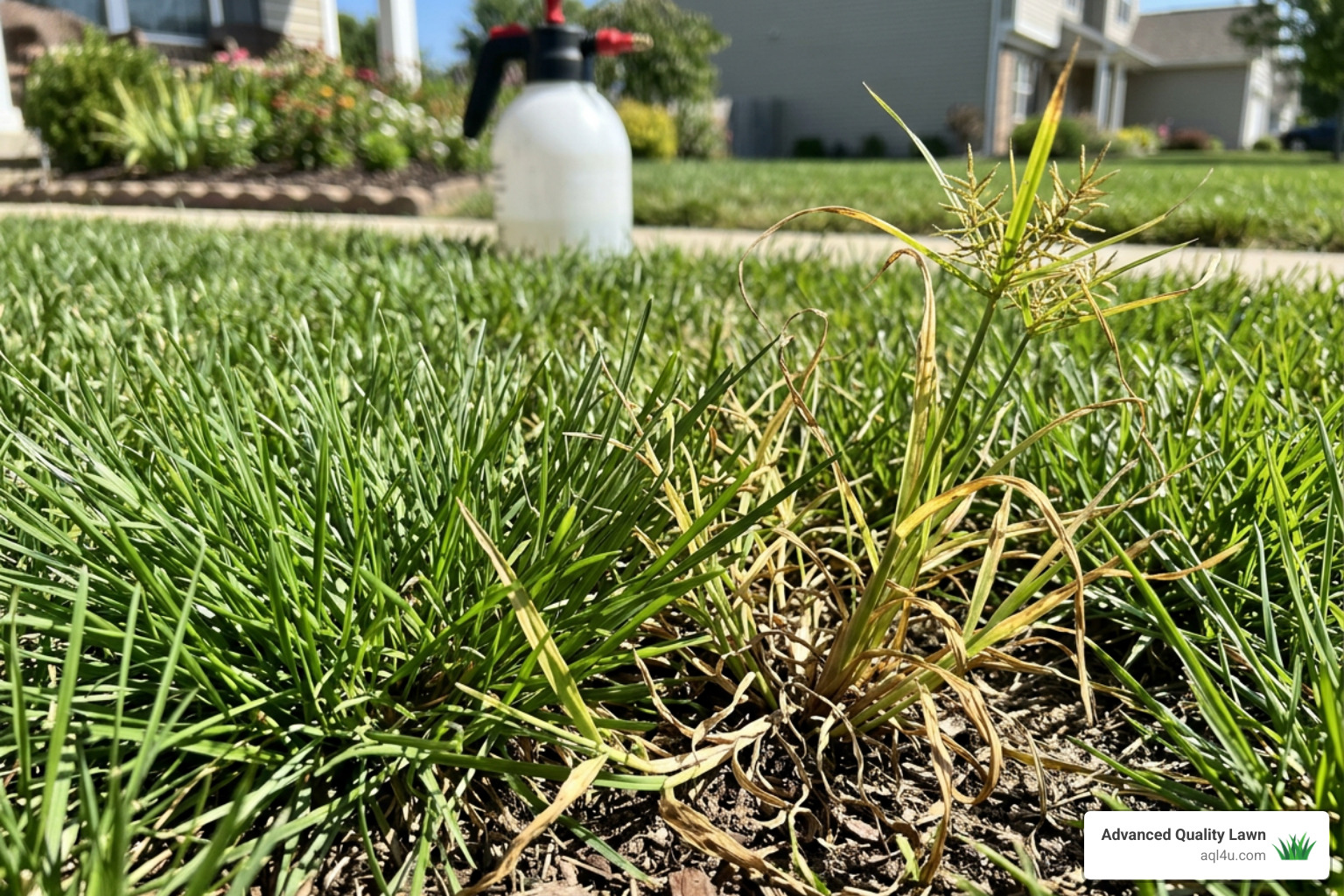
The best weed killer for nutsedge and crabgrass tackles both weeds in a single application using a dual-action formula that kills on contact and at the root.
Quick answer — top dual-action options:
| Product | Key Active Ingredients | Best For |
|---|---|---|
| IMAGE All-in-One | Sulfentrazone + Quinclorac | Most lawn types, both weeds |
| Q4 Plus | Quinclorac + Sulfentrazone + 2,4-D + Dicamba | Cool & warm season, broadleaf too |
| Spectracide Weed Stop Plus | Quinclorac + Sulfentrazone + 2,4-D | Budget-friendly, fast results |
| Sedgehammer + Tenacity | Halosulfuron + Mesotrione | Cool-season lawns (fescue, bluegrass) |
| Certainty | Sulfosulfuron | Warm-season lawns (Bermuda, Zoysia) |
Here's the problem most Ohio homeowners don't realize: nutsedge and crabgrass are completely different plants that resist different herbicides. A product that kills crabgrass may do nothing to nutsedge — and vice versa.
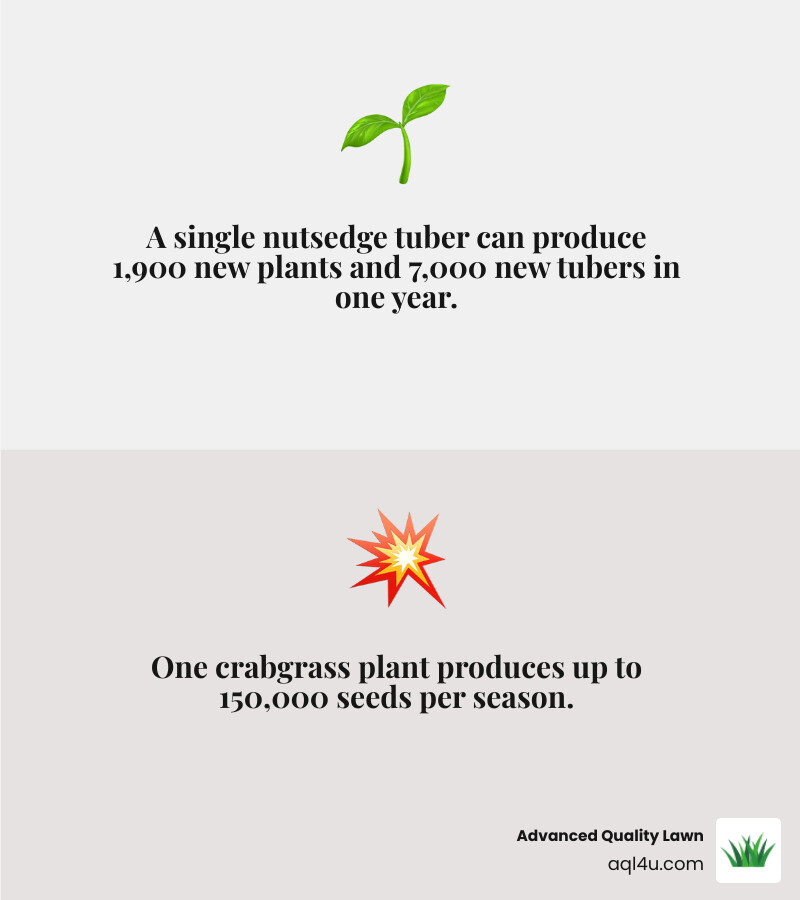
Crabgrass is an annual grassy weed that explodes in summer heat, producing up to 150,000 seeds per season. Nutsedge isn't even a grass — it's a sedge. And it's far more stubborn. A single nutsedge tuber can produce 1,900 new plants and 7,000 new tubers in just one year. Standard broadleaf and grass killers won't touch it.
That's why you need a formula that targets both — at the same time.
I'm Andrew Day, owner of Advanced Quality Lawn, with over 30 years of hands-on lawn care experience in Northeast Ohio, where I've helped hundreds of homeowners find the best weed killer for nutsedge and crabgrass without guessing or wasting money on the wrong product. Let's break down exactly what works.
Identifying the Enemy: Nutsedge vs. Crabgrass
Before we can eliminate the problem, we have to know exactly what we’re looking at. In Northeast Ohio—from Akron and Hudson up to Cleveland—we see these two invaders constantly, but they require different strategies.
What is Nutsedge?
Many homeowners mistake nutsedge for a fast-growing grass. However, Yellow Nutsedge is actually a sedge. The easiest way to identify it is by the "Rule of Threes." If you cut a cross-section of the stem, it is triangular and solid, whereas grass stems are typically hollow and round or flat.
Nutsedge leaves are thicker and shinier than most turfgrasses. It grows much faster than your lawn, often standing several inches above the grass just days after you mow.
- Yellow Nutsedge: Most common in Ohio. It has light green to yellowish leaves and produces yellow-brown seed heads.
- Purple Nutsedge: Known as the world’s worst weed because it is incredibly resistant. It has darker leaves and purple-tinged flowers.
Nutsedge is a perennial that spreads through underground rhizomes and "nutlets" (tubers). These tubers can stay dormant in your soil for years, waiting for the right moisture levels to explode. One single plant can produce 90,000 seeds in a season, but the real danger is underground, where it can produce 7,000 tubers in a single year.
What is Crabgrass?
Unlike nutsedge, Crabgrass is an annual grass. It doesn't survive the winter, but it leaves behind a legacy. A single plant can drop 150,000 seeds that sit in your soil until the ground warms up the following spring. It grows in a prostrate, sprawling habit that looks like a crab's legs reaching out from a central point. It loves the hot, dry spells we get in July and August, thriving when your Kentucky Bluegrass or Fescue starts to go dormant.
Understanding these differences is vital because Weeds like these have "backup plans." If you only treat for one, the other will simply move into the vacant space.
The Best Weed Killer for Nutsedge and Crabgrass: Top Product Picks
When searching for the best weed killer for nutsedge and crabgrass, you are looking for specific active ingredients. To kill crabgrass, you generally need Quinclorac. To kill nutsedge, you need Sulfentrazone or Halosulfuron-methyl.
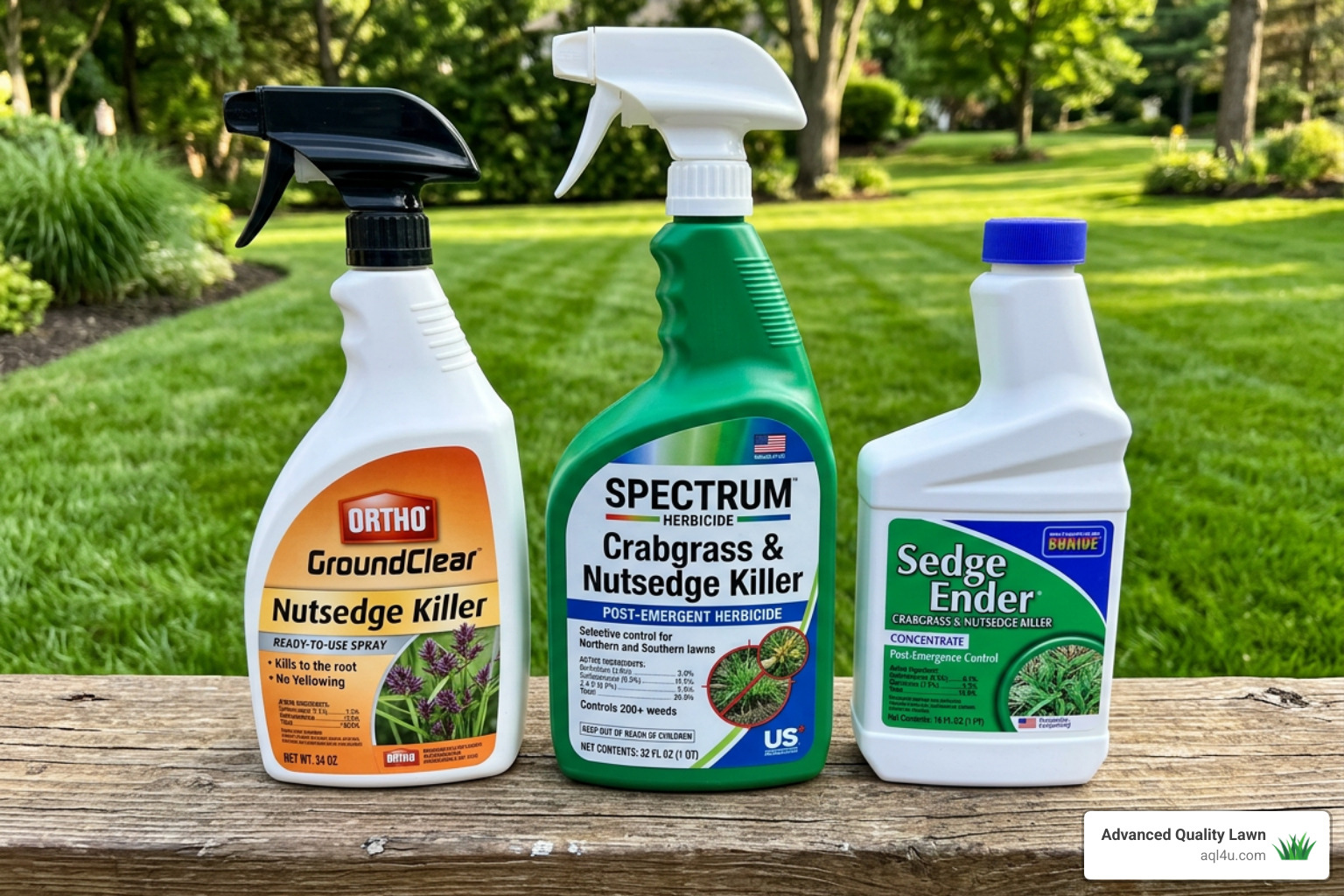
The most effective modern products combine these into a "one-and-done" solution. This is much more efficient than trying to tank-mix different chemicals yourself, which can lead to lawn injury if the ratios are off.
| Active Ingredient | Target | Action |
|---|---|---|
| Quinclorac | Crabgrass, Foxtail | Post-emergent; absorbed by leaves and roots. |
| Sulfentrazone | Nutsedge, Broadleaf | Fast-acting; causes rapid drying (desiccation). |
| 2,4-D & Dicamba | Dandelions, Clover | Classic broadleaf control found in Dandelions and Crabgrass formulas. |
| Mesotrione | Crabgrass, Sedge | Found in Tenacity; turns weeds white. |
Using a selective formula is key. A "selective" herbicide is designed to target the weed's physiology while leaving your specific grass type unharmed. This is the gold standard for crabgrass+removal.
Why IMAGE All-in-One is the Best Weed Killer for Nutsedge and Crabgrass
For the average homeowner in Northeast Ohio, IMAGE All-in-One Weed Killer is often the most accessible and effective choice. It utilizes a potent combination of Sulfentrazone and Quinclorac.
What makes it stand out for weed+removal is its dual-action approach: it kills on contact through the leaves and also moves down into the root system and the nutlets. A 24-ounce bottle of concentrate can treat up to 6,000 square feet. You’ll often see visible results—the weeds turning yellow or brown—in as little as 24 hours.
Choosing the Best Weed Killer for Nutsedge and Crabgrass in Cool-Season Lawns
If you live in Solon, Brecksville, or Medina, your lawn is likely a mix of Kentucky Bluegrass, Tall Fescue, or Perennial Ryegrass. These "cool-season" grasses have specific tolerances.
- Sedgehammer (Halosulfuron-methyl): This is the "nuclear option" for nutsedge. It is incredibly effective but works slowly. It may take 10-14 days to see the weed die, but it is very safe for cool-season turf.
- Tenacity (Mesotrione): This is a favorite for many DIYers because it can be used during overseeding. It targets crabgrass and some sedges by stopping chlorophyll production, turning the weeds a ghostly white before they die. It's a great choice for dandelion+treatment as well.
- Q4 Plus: This is a professional-grade favorite. It contains four active ingredients (Quinclorac, Sulfentrazone, 2,4-D, and Dicamba). It is highly selective and provides a massive "knockdown" effect on almost everything that isn't grass.
High-Performance Options for Warm-Season Turf
While less common in the North, some areas or specific athletic turfs use warm-season grasses like Bermuda or Zoysia.
- Certainty (Sulfosulfuron): This is a premier choice for these grass types. It offers excellent control of both purple and yellow nutsedge. However, be warned: it can be restrictive or harmful if applied to certain cool-season grasses, so always check your lawn type first to avoid yard+weeds becoming a dead lawn.
Application Strategies for Maximum Kill Rate
Even the best weed killer for nutsedge and crabgrass will fail if applied incorrectly. We see this all the time in Northeast Ohio—homeowners spray during a 95-degree heatwave and end up scorching their grass while the weeds survive.
Timing and Temperature
The "Sweet Spot" for application is when temperatures are between 65°F and 85°F.
- The 90-Degree Rule: Never apply these herbicides when temperatures exceed 90°F. The heat stresses your lawn, making it susceptible to the herbicide, while the weeds often "shut down" their pores to conserve moisture, meaning they won't absorb the poison.
- Rainfastness: Most quality products like Ortho or Spectracide are rain-fast within 2 to 6 hours. However, for the best results, we recommend a 24-hour window of dry weather.
- Mowing: Do not mow for 2 days before or 2 days after application. You want plenty of leaf surface on the weed to catch the spray, and you want the chemical to have time to move down to the roots before you cut the top off.
Equipment and Mixing
For spot treatments, a standard handheld pump sprayer works fine. For larger infestations, a backpack sprayer with a foliar spray tip provides the uniform coverage needed.
- Surfactants: Some products, like Sedgehammer, often require a "non-ionic surfactant" (basically a sticker). This helps the herbicide break through the waxy coating on nutsedge leaves. Without it, the spray might just bead up and roll off.
- Spot vs. Broadcast: If you only have a few patches, spot treat to save money and reduce chemical load. If your lawn is more weed than grass, a broadcast spray is necessary.
Note for our neighbors near the New York border: Be aware that states like New York and regions like Long Island have much stricter regulations on herbicides like Sedgehammer due to groundwater protection. Always check local ordinances if you are outside our primary Northeast Ohio service area. For dandelion+removal, local regulations may also vary.
Long-Term Prevention and Cultural Practices
The best weed killer for nutsedge and crabgrass is a thick, healthy lawn. Weeds are opportunistic; they fill gaps where the grass is thin or stressed.
Pre-Emergent: The First Line of Defense
For crabgrass, prevention is much easier than a cure.
- The 55-Degree Rule: Crabgrass seeds begin to germinate when soil temperatures hit 55°F for several consecutive days. In Northeast Ohio, this usually happens around the time the Forsythia bushes bloom (late March to mid-April).
- Products: Using a pre-emergent like Dimension or Scott's Halt creates a chemical barrier that stops crabgrass before it ever pokes through the soil. This is the cornerstone of weed+prevention.
Cultural Habits
- Mowing Height: Set your mower to 3.5 or 4 inches. Tall grass shades the soil, keeping it cooler and preventing weed seeds (especially crabgrass and dandelions) from getting the sunlight they need to sprout.
- Deep Watering: Instead of watering for 10 minutes every day, water deeply (1 inch) once or twice a week. This encourages deep grass roots. Nutsedge loves "wet feet," so overwatering or having poor drainage will practically invite it to move in.
- Aeration and Overseeding: Every fall, we recommend core aeration to break up compacted soil. Follow this with high-quality seed to fill in bare spots so prevent+weeds becomes a natural process for your lawn.
Frequently Asked Questions about Nutsedge and Crabgrass Control
Is it safe for my pets to walk on the grass after treatment?
Yes, but only after the product has completely dried. Most water-based formulas are safe for pets and children once dry, which typically takes 1 to 2 hours depending on humidity. We always recommend keeping pets off the treated area for at least a few hours to be safe. Dealing with weeds shouldn't come at the cost of your furry friends' safety.
Why does pulling nutsedge by hand make the problem worse?
It’s tempting to pull that one tall crabgrass or nutsedge plant, but with nutsedge, it’s a trap. When you pull the plant, the underground rhizome usually breaks, leaving the "nutlets" (tubers) behind. This triggers a survival mechanism in the plant, causing those dormant tubers to sprout. Pulling one nutsedge plant can result in five or ten new ones taking its place. Unless you can dig out a massive chunk of soil to get every single tuber, chemical control is much more effective.
How long does it take to see results after spraying?
It depends on the product.
- Spectracide Weed Stop: Can show visible wilting in as little as 5 hours.
- IMAGE All-in-One: Usually shows yellowing within 24-48 hours.
- Sedgehammer: Is a "slow kill." You might not see anything for a week, but the plant stops growing almost immediately. A full kill—where the plant turns brown and shrivels—usually takes 10 to 14 days. If the weed is particularly stubborn, a second application 14 days later is often required.
Conclusion
Taming a lawn overrun by nutsedge and crabgrass isn't an overnight process, but with the right tools, it is entirely possible. By choosing the best weed killer for nutsedge and crabgrass—like IMAGE All-in-One or Q4 Plus—and applying it with the proper timing, you can reclaim your backyard from these stubborn invaders.
At Advanced Quality Lawn, we’ve spent decades perfecting the science of weed control in Northeast Ohio. From Akron to Cleveland and everywhere in between, we pride ourselves on excellent customer service and a full-program guarantee. If you're tired of fighting the "weed war" on your own, we’re here to help.