
How to Pick the Best Bermuda Grass Seed and Fertilizer Combo
Why Choosing the Right Bermuda Grass Seed and Fertilizer Combo Matters
Bermuda grass seed and fertilizer work best together when you match the right seed type to a fertilizer with the right nutrients for your lawn's stage of growth. Here is a quick overview of the top-rated combos to know:
| Product | Best For | Coverage | Key Feature |
|---|---|---|---|
| Scotts Turf Builder Rapid Grass Bermudagrass | New lawns | 1,495 sq. ft. | Grows 2x faster than seed alone |
| Pennington Smart Seed Bermudagrass | Overseeding | 5,000 sq. ft. | Germinates in 10 to 14 days |
| Scotts Turf Builder Thick'R Lawn | Thickening thin lawns | 1,200 to 4,000 sq. ft. | 3-in-1 seed, fertilizer, soil food |
| Hancock Highlander Turf Bermuda | Bulk/high-traffic | Varies | Farmer-direct, multiple coatings |
| Pennington One Step Complete | Patch and repair | 60 sq. ft. | Includes mulch for moisture retention |
Bermuda grass is one of the toughest warm-season grasses you can grow. It thrives in full sun, handles heat and drought well, and bounces back fast from heavy foot traffic. But getting it established from seed takes more than just tossing seed on the ground. The fertilizer you choose, and when you apply it, can make or break germination.
Most homeowners either skip fertilizer at seeding time or apply it at the wrong stage. Both mistakes slow growth and leave your lawn vulnerable to weeds filling in the bare spots first.
I'm Andrew Day, owner of Advanced Quality Lawn, and with over 30 years of lawn care experience serving Northeast Ohio homeowners, I've seen how the right bermuda grass seed and fertilizer pairing leads to faster, thicker establishment. In the sections below, I'll walk you through everything you need to pick the best combo for your lawn.
Essential Guide to bermuda grass seed and fertilizer
Getting a perfect lawn starts with understanding the biology of the plant. Bermuda grass is a sun-loving powerhouse that requires at least 8 hours of direct sunlight daily to stay thick and vibrant. If your yard has heavy shade from oak trees or buildings, this might not be the right choice for you. However, for those wide-open spaces in Northeast Ohio that bake in the summer sun, Bermuda is a champion.
Timing is the most critical factor for success. You cannot plant Bermuda grass seed in the early spring like you might with Kentucky Bluegrass. Bermuda needs heat. We recommend waiting until the soil temperature consistently reaches 65 to 70 degrees. This usually happens in late spring or early summer. If you plant too early, the seed will just sit in the cold, damp ground and rot or become a snack for local birds.
Soil chemistry also plays a huge role. Bermuda grass prefers a pH level between 5.8 and 7.0. If your soil is too acidic or too alkaline, the grass cannot "eat" the nutrients you provide through fertilizer. We always suggest a soil test before you start. This ensures you aren't wasting money on products that your lawn can't actually use.
According to U.S. Department of Agriculture research on starter fertilizers, these products are specifically designed to stay near the soil surface. This is vital because tiny new roots have a limited reach. A high-quality starter fertilizer provides the phosphorus necessary for those roots to anchor deep into the earth. For more tips on finding the right products for your specific soil type, check out our guide on the Best fertilizer for lawn care.
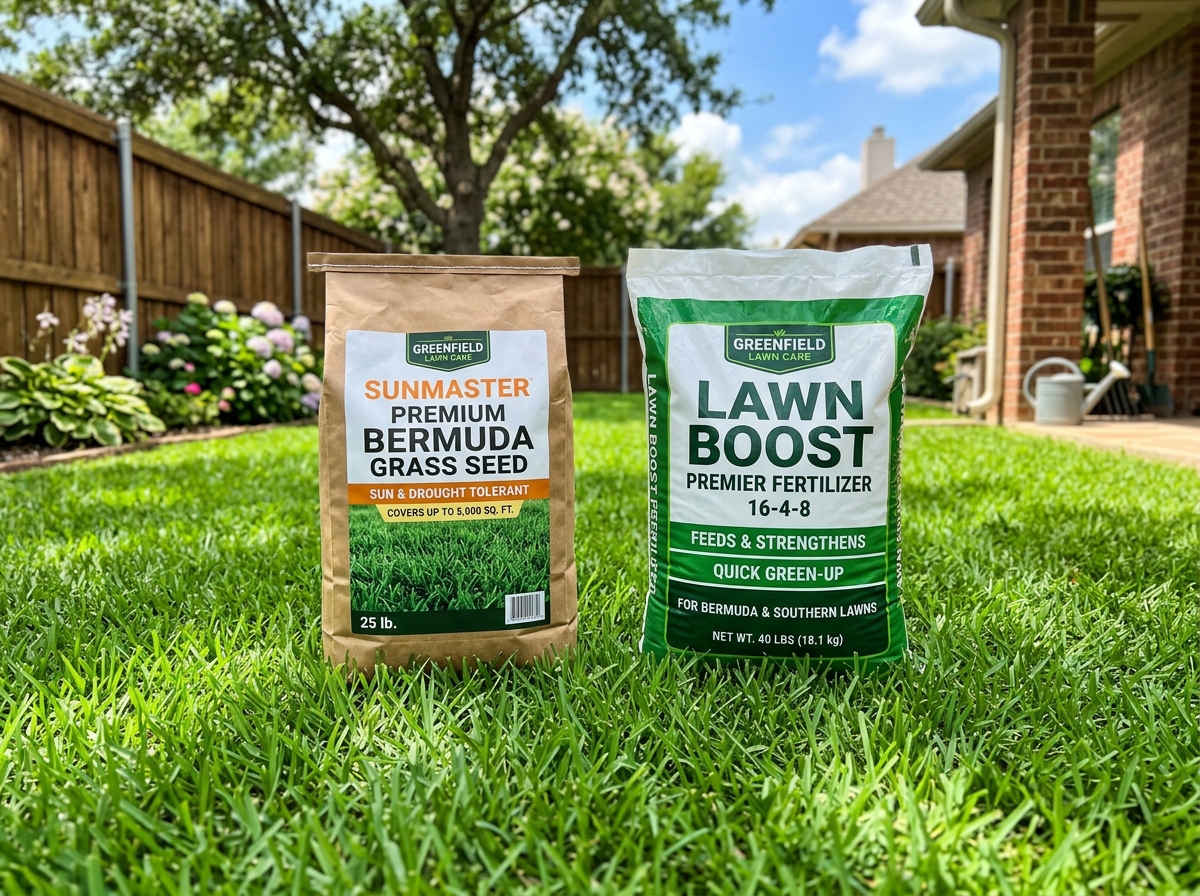
Choosing a bermuda grass seed and fertilizer Mix
When you go to the store, you will see a lot of different labels. Some seeds are "coated" while others are "raw." Coated seeds are often covered in a clay-based material that can absorb up to 2 times more water than an uncoated seed. This is a huge advantage because moisture is the "on switch" for germination.
You should also look at whether the seed is "hulled" or "unhulled." Hulled seed has the outer shell removed, which allows it to germinate much faster, often in as little as 7 to 14 days. Unhulled seed keeps its "armor," which means it takes longer to sprout but can survive tougher conditions if the weather doesn't cooperate immediately.
Many modern products come as a 3-in-1 mix. These contain the seed, a professional-grade starter fertilizer, and sometimes a soil importer or mulch. These are great for convenience and help ensure that the fertilizer is exactly where the seed needs it. If you are new to DIY lawn care, understanding the basics is key. You can learn more in our Fertilizer 101 guide.
Applying Your bermuda grass seed and fertilizer
Even distribution is the secret to a lawn that doesn't look like a patchwork quilt. We always recommend using a high-quality broadcast spreader. To get the best coverage, use a criss-cross pattern. This means you apply half of the recommended amount walking north to south, and the other half walking east to west.
For new lawns, you typically need about 1 pound of seed for every 500 square feet. If you are just overseeding to thicken up an existing lawn, you can stretch that same pound to cover 1,000 square feet. Once the seed and fertilizer are down, you must ensure good seed-to-soil contact. A light raking or using a lawn roller helps press the seed into the dirt. If the seed is just sitting on top of the grass blades, it will never grow. For a deeper dive into the mechanics of application, see our article on How to fertilize your lawn.
Understanding Bermuda Grass Nutritional Requirements
Bermuda grass is a "hungry" turf. It requires more nutrients than many other grass types to maintain its aggressive growth habit. To understand what your lawn needs, you have to look at the N-P-K ratio on the bag. These three numbers represent Nitrogen, Phosphorus, and Potassium.
For a newly seeded lawn, phosphorus (the middle number) is the most important. Phosphorus is the fuel for root development. A ratio like 10-10-10 or 4-6-4 is common for starters. Once the grass is established and you have mowed it a few times, you will shift to a high-nitrogen fertilizer (like a 23-0-0 or 18-1-8) to promote that deep green color and thick top growth.
Bermuda grass generally needs about 4 to 5 pounds of nitrogen per 1,000 square feet every year. We recommend breaking this up into several applications every 4 to 8 weeks during the growing season. Using a slow-release formula is often better because it provides a steady "drip" of nutrients rather than one giant "meal" that could burn the tender new grass. If you are curious about the different types of products available, read our comparison on Is organic fertilizer better than synthetic fertilizer.
Step-by-Step Guide to Planting and Soil Preparation
You wouldn't build a house on a shaky foundation, and you shouldn't plant a lawn on unprepared soil. Preparation is about 90 percent of the work when it comes to bermuda grass seed and fertilizer success.
- Clear the Debris: Remove rocks, sticks, and any existing large weeds.
- Loosen the Soil: Use a tiller or a sturdy rake to loosen the top 2 to 4 inches of soil. Bermuda grass has a hard time pushing roots through compacted clay common in Northeast Ohio.
- Level the Area: Fill in low spots where water might pool.
- Soil Amendments: This is the time to add lime if your pH is too low or organic matter if your soil is sandy.
- The Final Rake: Create small grooves in the soil. These grooves act like little "cradles" for the seed.
If you are working with an existing lawn that just looks a bit thin, you might not need to till the whole yard. Instead, you can look into Core aeration & overseeding. Aeration pulls small plugs of soil out of the ground, which reduces compaction and allows the new seed and fertilizer to reach the root zone much more effectively.
Maintenance Practices for Newly Seeded Lawns
Once the seed is in the ground, your job changes from "builder" to "nanny." New Bermuda seedlings are delicate. The most important rule is to keep the soil moist. This does not mean soaking it once a day. It means light watering 2 to 3 times a day for the first few weeks. You want the top inch of soil to stay damp but not muddy.
As the grass begins to sprout, you can slowly transition to deeper, less frequent watering. This encourages the roots to grow down deep into the soil to find moisture, which makes the lawn much more drought-tolerant in the long run.
When it comes to mowing, patience is a virtue. Wait until the new grass is about 2 to 3 inches tall before your first cut. Set your mower to a high setting for that first mow, removing only the top third of the grass blade. Bermuda grass actually loves being mowed short once it is established, but for the first few months, give it some room to grow. For more professional maintenance strategies, the University of Georgia Turfgrass Program maintenance tips offer excellent research-based advice.
Frequently Asked Questions about Bermuda Grass
When is the best time to plant Bermuda grass?
The absolute best time to put down bermuda grass seed and fertilizer is late spring through early summer. In Northeast Ohio, this usually means late May or June. You are looking for air temperatures consistently in the 80s and soil temperatures above 65 degrees. You must be certain that the risk of frost has completely passed. Bermuda is a warm-season grass, and a late-season frost will kill young seedlings instantly.
How long does Bermuda grass take to germinate?
Under ideal conditions, you will start to see "green fuzz" in about 7 to 14 days. However, it can take up to 21 days for full germination across the entire lawn. Factors that influence this timeline include the variety of seed you chose (hulled vs. unhulled), how consistent you are with watering, and the soil temperature. If the ground is a bit cool, the process will slow down. Don't panic if you don't see results in the first week!
Can I use weed and feed on new Bermuda seedlings?
No! This is a very common mistake that can ruin all your hard work. Most "weed and feed" products contain pre-emergent or post-emergent herbicides that are designed to kill young, tender plants. Unfortunately, they cannot tell the difference between a dandelion and a brand-new Bermuda grass sprout. You should wait until you have mowed your new lawn at least 3 to 4 times before applying any type of weed control. This ensures the root system is strong enough to handle the chemicals.
Conclusion
Creating a lush, durable lawn with bermuda grass seed and fertilizer is a rewarding project that can completely transform your home's curb appeal. By choosing the right seed variety, preparing your soil properly, and following a consistent watering and fertilization schedule, you can enjoy a professional-quality lawn that stands up to the hottest Ohio summers.
At Advanced Quality Lawn, we understand that every yard is unique. Whether you are dealing with heavy clay in Hudson or sandy soil near the lake, we have the expertise to help your lawn thrive. We take pride in our excellent customer service and offer a full-program guarantee to ensure you are happy with the results. We serve a wide range of communities across Northeast Ohio, including Akron, Medina, Cleveland, and many more.
If you are ready to take the guesswork out of your yard work, we are here to help. From professional aeration to custom fertilization programs, we provide the expert care your grass needs. Contact us today to learn more about our Lawn care maintenance services and let us help you grow the lawn of your dreams.