Chinch Bug Treatments at Home Depot: Where to Start
Start with a product labeled for chinch bugs, not just lawn insects. Home Depot options in this roundup include Sunniland 20 lb. Chinch Bug Granules at $13.97, Spectracide Triazicide 20 lb. Granules at $15.97, and Spectracide Triazicide 32 oz. Ready to Spray at $8.47. Prices and stock can vary by store.
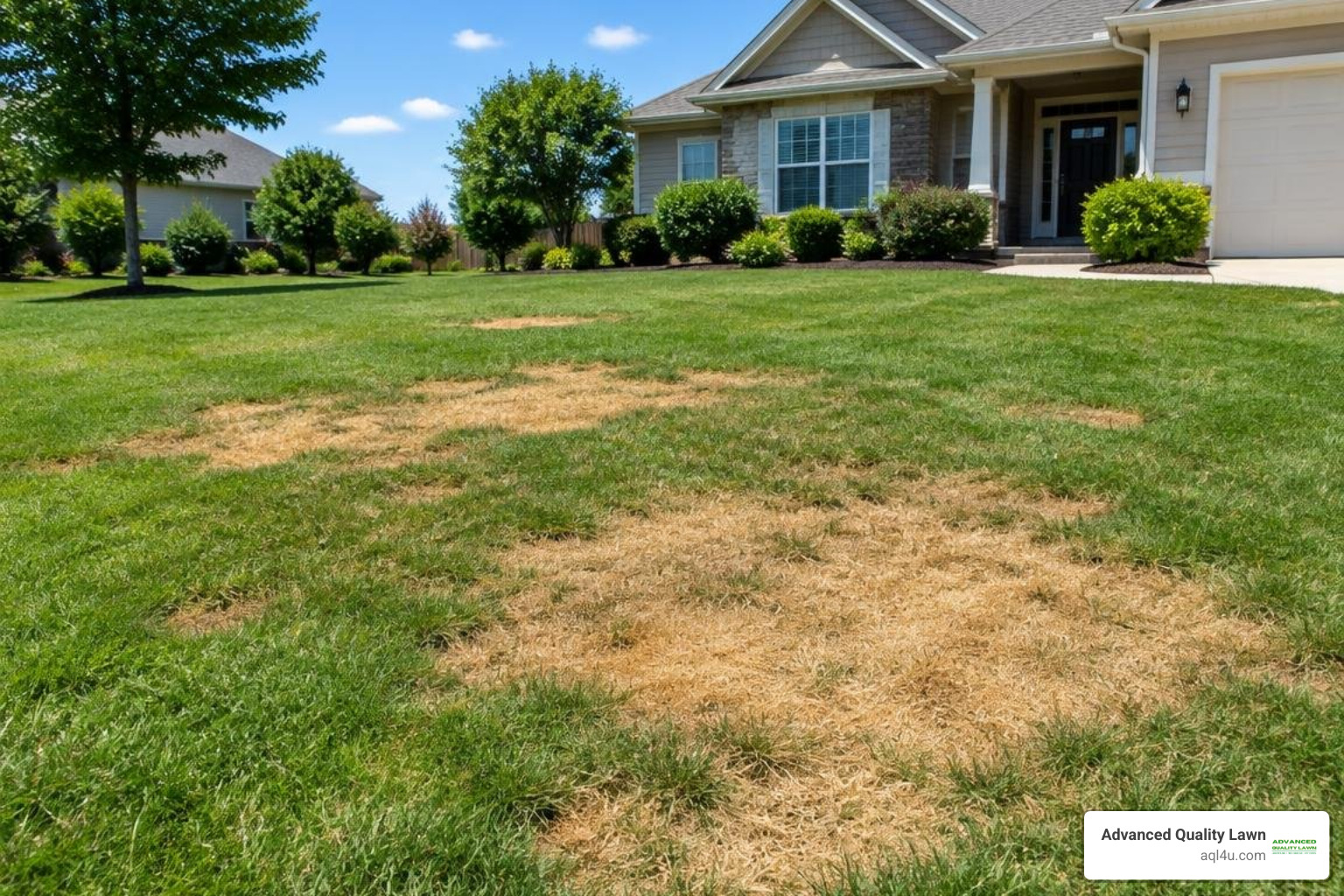
Before buying, check the edge of a growing yellow or brown patch for live chinch bugs. If you find them, choose granules for a larger area or a labeled spray for a smaller patch. Follow the product label for application, watering, and when people and pets can return to the lawn.
I’m Andrew Day, owner of Advanced Quality Lawn, where my team cares for lawns across Northeast Ohio. I help homeowners searching for “chinch bug treatment home depot” compare retail options and decide when a lawn needs more than a store-bought product.
Identifying Lawn Damage and Confirming Chinch Bugs
Spotting turf trouble early saves your yard from major dieback. Chinch bugs are tiny pests measuring roughly one-sixth of an inch, yet their feeding habits pack a massive punch. They pierce grass blades with their needle-like mouthparts, suck out the vital plant juices, and inject a toxic saliva that blocks the grass from transporting water. The result looks almost identical to severe drought stress, which tricks many property owners into running sprinklers instead of addressing the real pest problem.
To make matters trickier, chinch bugs thrive in the hottest, sunniest sections of your lawn. You will often see the first signs of trouble along concrete driveways, stone walkways, and asphalt roads where radiant heat bakes the turf. Reviewing Texas A&M Extension guidance on chinch bug management shows that these insects can multiply quickly during warm spells. Pairing that knowledge with our complete lawn bug control guide will help you pinpoint whether pests or weather are responsible for those thinning patches.
Early Warning Signs and Visual Diagnosis
The earliest sign of a chinch bug infestation is stunted grass growth accompanied by a faint purplish or yellow halo around the edges of green turf. As the insects continue to feed on the grass crowns at soil level, those yellow blades turn straw-brown and die.
Because these bugs move outward as they consume food, the dead patches expand irregularly over time. If you inspect the turf where yellowing grass meets healthy green turf, part the grass blades with your fingers down to the thatch layer. If chinch bugs are present, you will see tiny, fast-moving insects scurrying across the soil surface. Young nymphs are bright red with a white stripe across their backs, while mature adults are black with white, folded wings forming an hourglass or X-shaped marking.
The Flotation Can Test and Beneficial Insect Checks
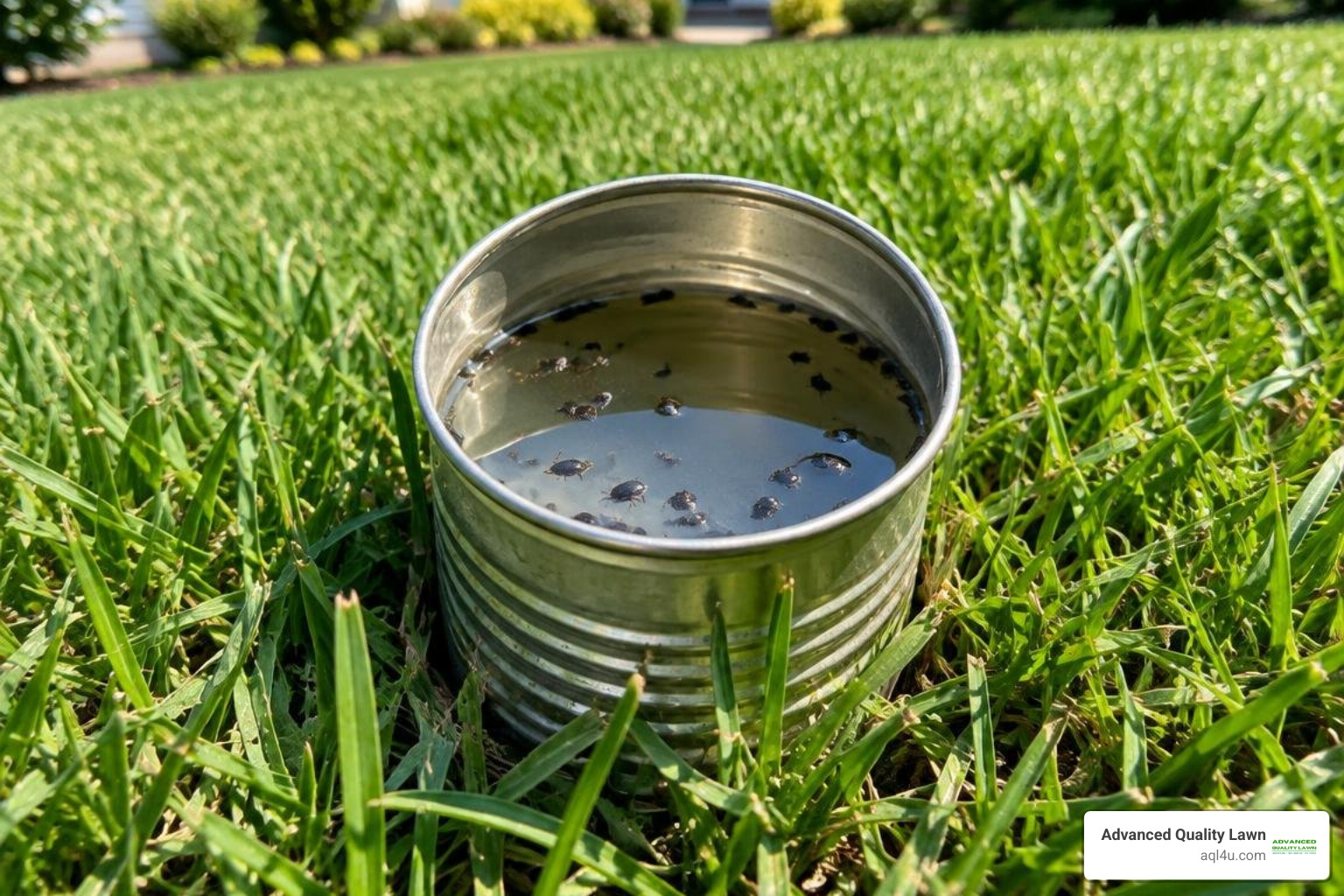
If you want absolute confirmation before purchasing a retail product, the flotation test is the gold standard method. Take a metal cylinder, like an open-ended coffee can or food tin with both top and bottom removed, and press it two to three inches deep into the soil right at the boundary between healthy and yellowing grass. Fill the cylinder with water and keep it topped off for five to ten minutes. Any chinch bugs hiding in the thatch will float to the water surface.
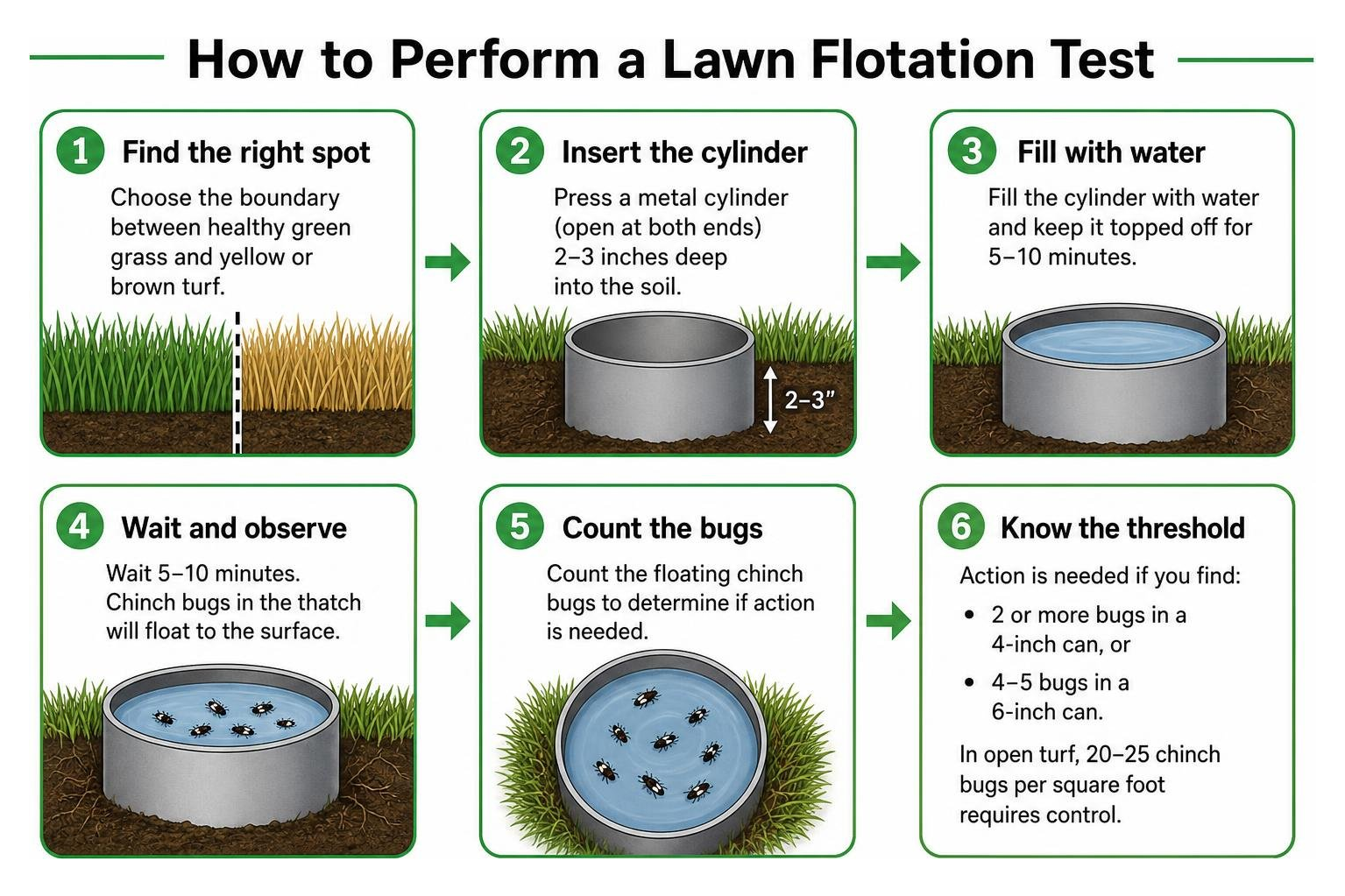
Counting the floating bugs tells you if action is required. Finding two or more bugs in a 4-inch can, or four to five bugs in a 6-inch can, signals a population large enough to cause severe lawn damage. When translated to open turf, reaching a threshold of 20 to 25 chinch bugs per square foot demands immediate control.
During your inspection, make sure you do not mistake chinch bugs for big-eyed bugs. Big-eyed bugs are beneficial predators that actively hunt and eat chinch bugs. You can tell them apart by looking closely at their head shape. Big-eyed bugs have very large, prominent eyes that make their head wider than their thorax, while chinch bugs have narrow, triangular heads. Protecting these beneficial predators prevents secondary insect outbreaks and keeps your soil ecosystem balanced.
Best Chinch Bug Treatment Home Depot Options Compared
Selecting the right product at your local store depends on your yard size, budget, equipment, and how fast you need to stop insect feeding. The Home Depot lawn chinch bug category carries both contact pyrethroids and systemic formulas.
Here is how the top retail options stack up side by side:
| Product Name | Format | Active Ingredient | Price | Coverage Area | Customer Rating |
|---|---|---|---|---|---|
| Sunniland Chinch Bug Granules (20 lb.) | Granular | Bifenthrin | $13.97 | 10,000 sq. ft. | 3.8 / 5 |
| Spectracide Triazicide Granules (20 lb.) | Granular | Gamma-Cyhalothrin | $15.97 | Up to 25,000 sq. ft. | 4.2 / 5 |
| Spectracide Triazicide Granules (10 lb.) | Granular | Gamma-Cyhalothrin | $5.00 | Up to 12,500 sq. ft. | 4.2 / 5 |
| Ortho Bug B-Gon Lawn Killer (20 lb.) | Granular | Bifenthrin | $17.97 | 10,000 sq. ft. | 4.0 / 5 |
| Scotts GrubEx1 (14.35 lb.) | Granular | Chlorantraniliprole | $29.97 | 5,000 sq. ft. | 4.1 / 5 |
| Scotts GrubEx1 (28.7 lb.) | Granular | Chlorantraniliprole | $54.97 | 10,000 sq. ft. | 4.1 / 5 |
| Spectracide Triazicide RTS (32 oz.) | Liquid Spray | Gamma-Cyhalothrin | $8.47 | 5,120 sq. ft. | 4.1 / 5 |
| Ortho Bug B-gon RTS (32 oz.) | Liquid Spray | Bifenthrin | $9.97 | 5,300 sq. ft. | 3.8 / 5 |
| Ortho Home Defense Perimeter (1 Gal.) | Liquid Jug | Bifenthrin | $9.97 | Perimeter Barrier | 4.3 / 5 |
Top Granular Chinch Bug Treatment Home Depot Products
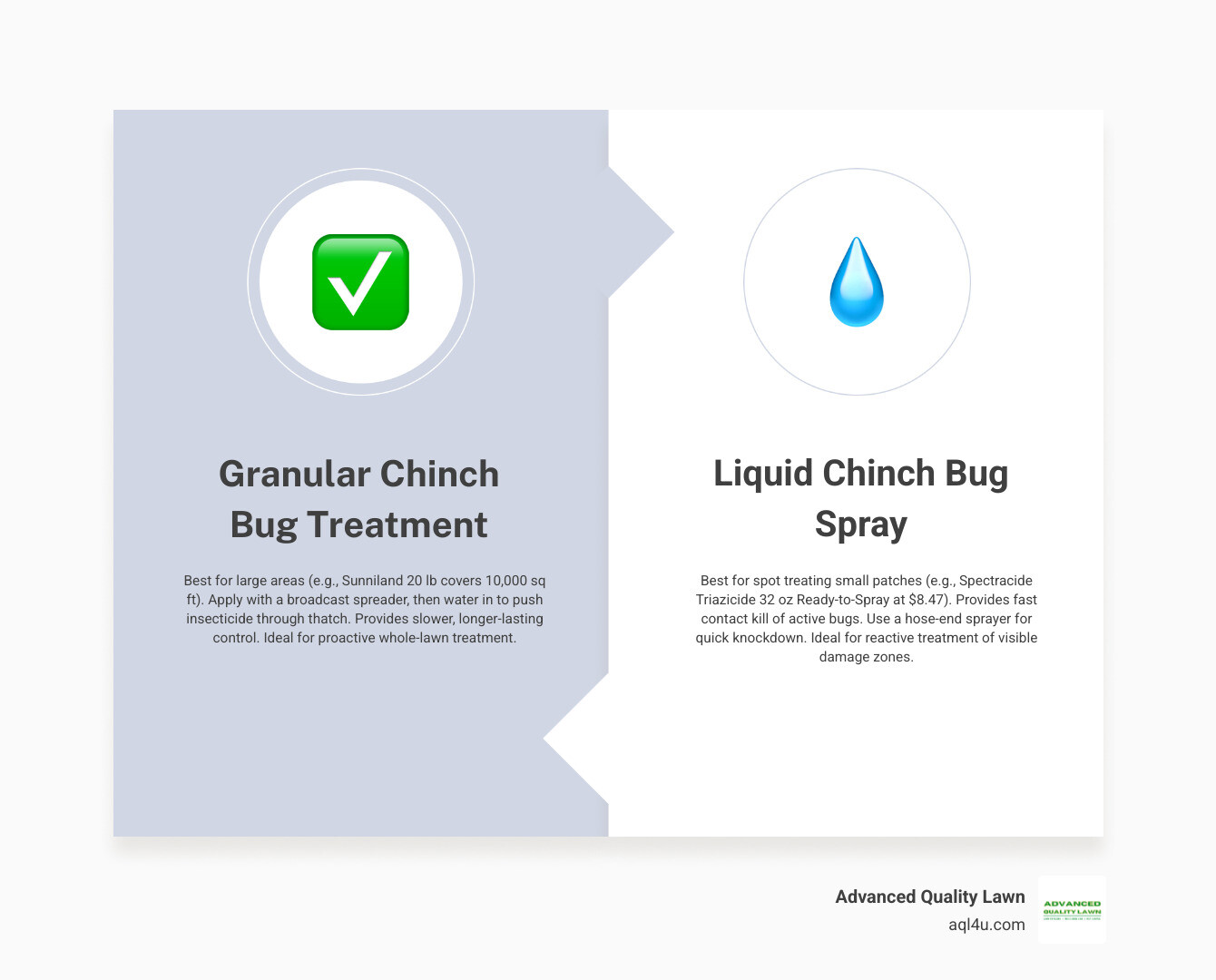
Granular options are ideal when you need to treat entire lawn sections or have dense turf where liquids struggle to reach the soil line.
- Sunniland 20 lb. Ready-to-Use Chinch Bug Granules ($13.97): This specialized formula covers up to 10,000 square feet. It uses bifenthrin to deliver up to four weeks of residual control against chinch bugs and over 100 other common pests. It is one of the most budget-friendly products for broad coverage.
- Spectracide 20 lb. Triazicide Lawn Insect Killer Granules ($15.97): A top retail seller powered by gamma-cyhalothrin. It provides strong contact control for surface pests. The smaller 10 lb. bag is frequently on sale for $5.00, down from its regular $9.47 price point, earning a solid 4.2 rating across thousands of homeowner reviews.
- Ortho Bug B-Gon Lawn Insect Killer 20 lbs. ($17.97): Sold as a retail exclusive, this heavy-duty granular option targets chinch bugs, sod webworms, and ants, creating an effective barrier across residential lawns.
- Scotts GrubEx1 Season Long Insect Killer ($29.97 for 14.35 lbs. or $54.97 for 28.7 lbs.): Powered by chlorantraniliprole, this popular product offers long-term insect suppression. For larger yards, you can also find a two-pack bundle for $44.53. To learn more about how granular options perform across different turf varieties, check out our breakdown of the best lawn insect killer granules.
Top Liquid Chinch Bug Treatment Home Depot Sprays
Liquid insecticides excel when you need immediate knockdown of active surface pests on localized yellow patches.
- Spectracide 32 oz. Triazicide Ready-to-Spray ($8.47): This hose-end bottle automatically mixes the concentrate with your water supply to cover roughly 5,120 square feet. It knocks down feeding chinch bugs on contact, making it a great emergency choice for sudden summer outbreaks.
- Ortho Bug B-gon Lawn and Landscape Ready-to-Spray 32 oz. ($9.97): Another retail exclusive option holding a 3.8 rating from over 1,100 reviews. It connects directly to your garden hose for quick spot applications along dry slopes and walkways.
- Ortho Home Defense Insect Killer for Indoor and Perimeter 1 Gal. ($9.97): Boasting a 4.3 rating from over 9,300 reviews, this ready-to-use spray wand container is designed to treat hardscape boundaries, foundation edges, and driveway borders where chinch bugs often congregate before moving deeper into the yard.
Natural and Chemical-Free Alternatives
For homeowners who prefer organic or low-impact methods, several non-synthetic approaches can help reduce bug numbers without harsh synthetic residues.
Microbial products containing the beneficial entomopathogenic fungus Beauveria bassiana work by infecting chinch bugs directly. When the fungal spores contact the pest, they germinate, penetrate the cuticle, and eliminate the insect naturally. This biological remedy works best during moderate temperatures with adequate lawn moisture.
Insecticidal soaps and horticultural oils are another natural spot-treatment option. When sprayed directly onto active nymphs, these products break down the protective waxy outer coating of the insect, causing rapid dehydration. While natural soaps lack residual staying power, they provide a chemical-free way to manage isolated flare-ups without leaving persistent synthetic materials in the soil.
How to Apply Chinch Bug Treatments for Maximum Effectiveness
Applying your selected product properly makes the difference between complete pest eradication and wasted money. Insecticides must penetrate past the upper grass canopy and settle directly into the thatch layer where chinch bugs live and feed. Research on insect control outlined in the University of Wisconsin Extension turf disorder research highlights that timing and placement matter just as much as active ingredients. For an in-depth look at yard applications, review our guide on the best way to treat yard for bugs.
Granular Spreader vs Hose-End Sprayer Application Steps
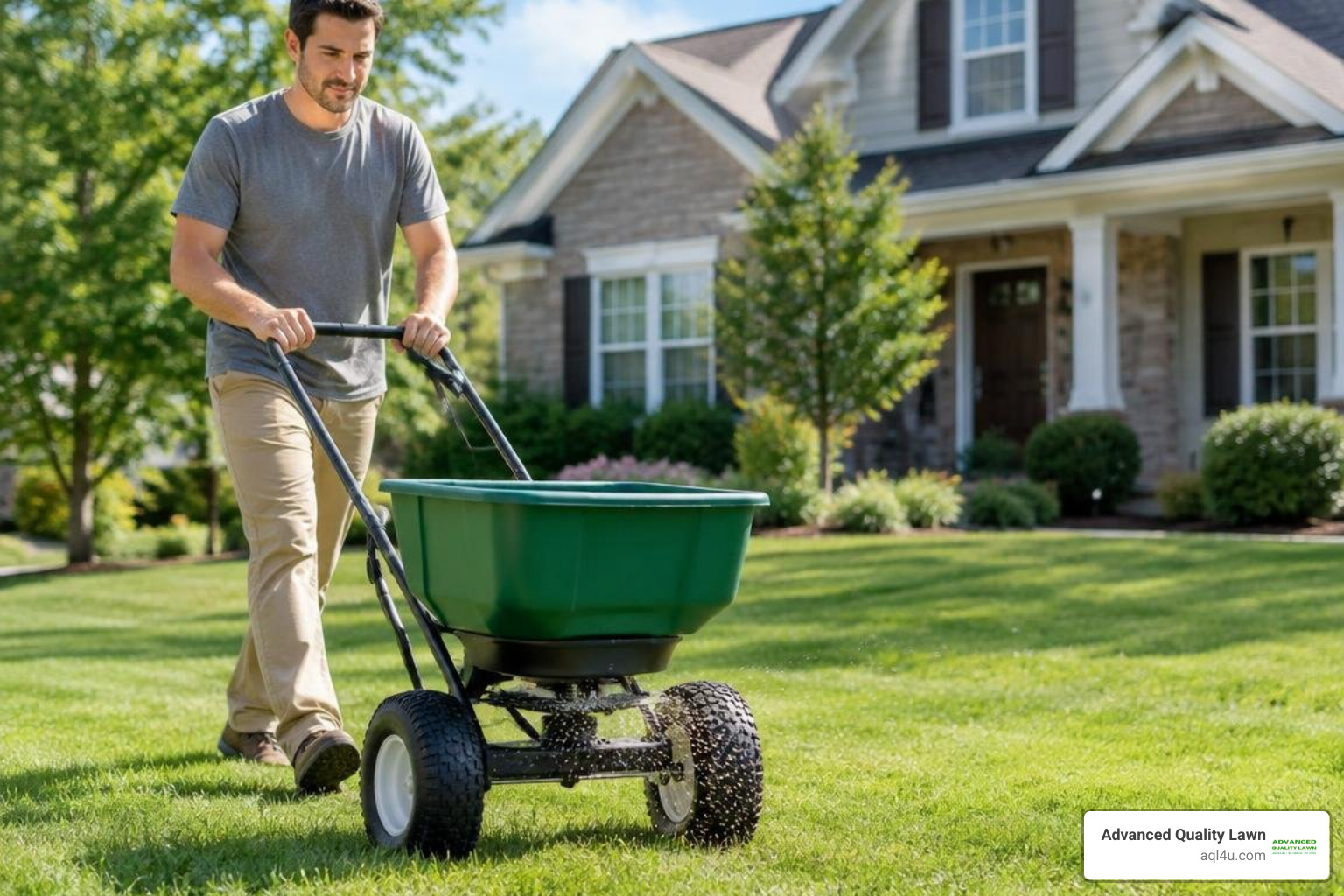
When using granular products, always apply them to dry turf using a properly calibrated broadcast or drop spreader. Spreading over dry grass blades ensures the granules fall through the turf canopy down to the thatch layer rather than sticking to damp foliage. Once the granules are spread, immediately water the lawn with one-quarter to one-half inch of water. This post-application watering is essential because it dissolves the carrier material and washes the active insecticide deep into the thatch.
When utilizing liquid hose-end sprayers, calibrate your sprayer rate to deliver adequate volume. Chinch bugs require soaking coverage rather than a fine surface mist. Spray across the affected area in overlapping passes, extending the application five to ten feet beyond the visible brown edges to target wandering insects. Always wear long pants, closed-toe shoes, and chemical-resistant gloves during application, and keep children and pets off the lawn until the spray has completely dried or granules have been watered in.
Seasonal Timing and Reapplication Schedules
Adult chinch bugs overwinter in leaf litter, overgrown brush, and thick thatch, emerging in spring once air temperatures consistently reach 70°F. In our region across Summit County, Cuyahoga County, Medina County, and surrounding Northeast Ohio communities, adult scouting begins in May.
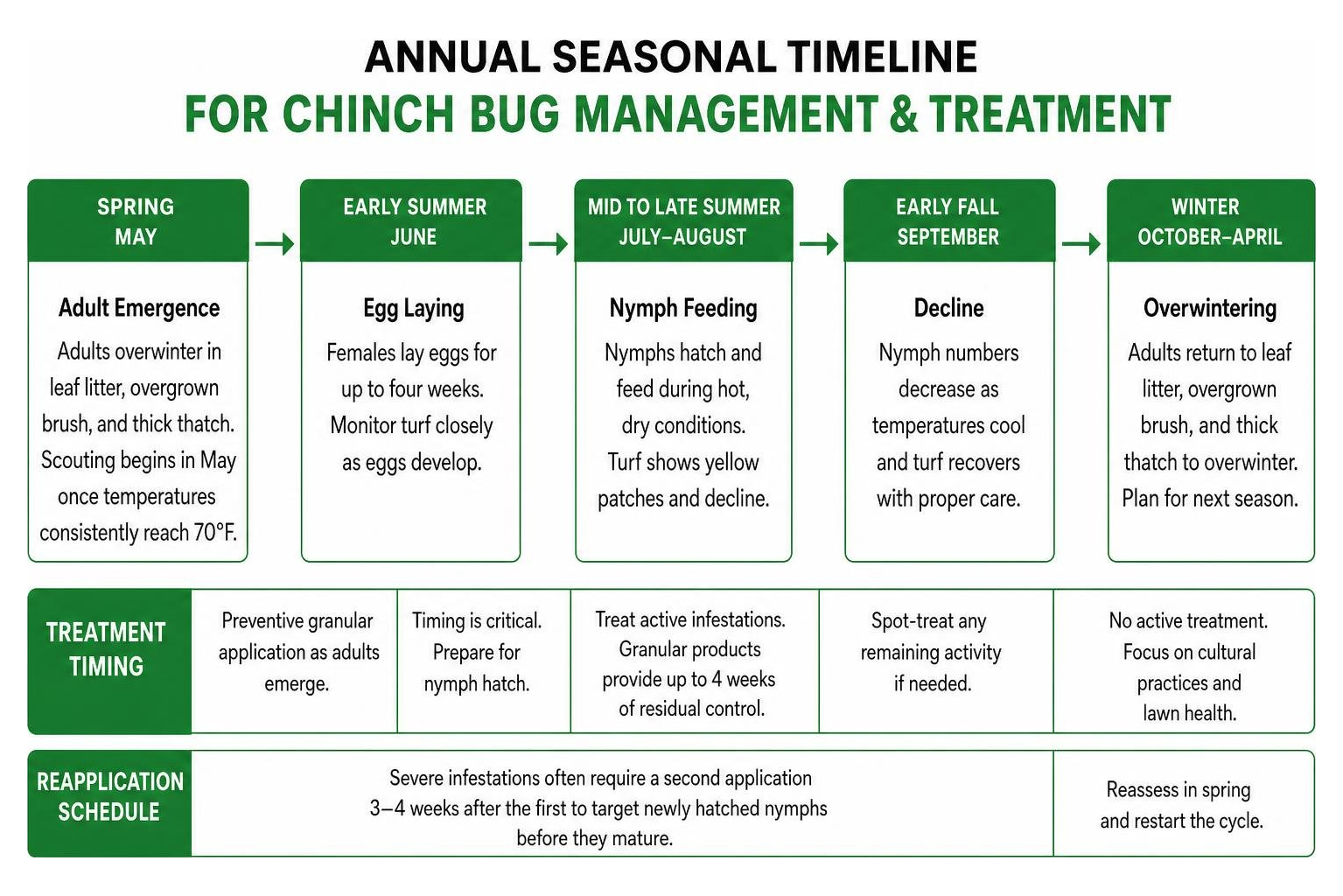
Female chinch bugs can lay up to 400 eggs over a four-week period, leading to destructive nymph feeding throughout July and August when turf experiences heat stress. Granular retail products typically provide residual protection for up to four weeks. Because single treatments do not destroy unhatched eggs, severe infestations often require a second application three to four weeks after the first treatment to capture newly hatched nymphs before they mature.
Preventing Reinfestation and Troubleshooting Failed Treatments
A single insecticide application eliminates current bugs, but long-term prevention depends on eliminating the environmental conditions that attract them in the first place. Exploring the broader lawn pest control category will give you a comprehensive picture of integrated yard health.
Cultural Lawn Care Practices and Resistant Turf
Cultural turf management remains your best natural defense against repeat pest attacks. Heavy thatch acts like a luxury hotel for chinch bugs, shielding them from sun, predators, and insecticides. Keep thatch levels below one-half inch by scheduling annual core aeration in autumn or spring. If thatch exceeds one inch, vertical mowing may be needed to slice through the dense mat.
Watering practices also influence pest pressure. Water deeply and infrequently, providing about one inch of water per week in the early morning hours. This encourages deep root systems while allowing the upper soil surface to dry, which deters pests.
Avoid excessive quick-release synthetic nitrogen fertilizers during the summer months. Rapid, tender grass growth fueled by high nitrogen creates an ideal buffet for feeding chinch bugs. Instead, choose slow-release organic or balanced fertilizers. When overseeding thin patches, select endophyte-enhanced tall fescues or perennial ryegrasses. Endophytes are beneficial, naturally occurring fungi that live within the grass plant, producing natural compounds that repel leaf-feeding insects without chemicals.
Managing Insecticide Resistance and Heavy Thatch
If you applied a retail product and still see live bugs a week later, insecticide resistance or heavy thatch may be the culprit. Overusing the same pyrethroid active ingredients like bifenthrin, cyfluthrin, or lambda-cyhalothrin year after year can cause resistant pest populations to develop.
When resistance occurs, switch chemical classes. Rotating from a pyrethroid to a neonicotinoid or an anthranilic diamide like chlorantraniliprole targets a completely different biological pathway in the insect. Additionally, if your lawn has a thick thatch barrier, add a lawn-safe surfactant to your spray mix or perform core aeration prior to treatment to ensure your product reaches the soil line where pests reside.
Frequently Asked Questions About Chinch Bug Treatments
How quickly do Home Depot chinch bug treatments eliminate active bugs?
Liquid hose-end sprays provide rapid contact kill, typically eliminating surface-feeding bugs within 24 to 48 hours. Granular treatments take slightly longer because they must be watered into the turf to release their active ingredients, reaching full effectiveness within three to five days. Both formats generally offer residual protective barriers lasting between two and four weeks.
Can frequent lawn watering cure a chinch bug infestation?
No, watering alone will not eliminate an active chinch bug infestation. While extra irrigation helps stressed grass tolerate light feeding damage and encourages beneficial fungal growth in the soil, it does not kill the pests. Once pest populations exceed the critical threshold of 20 bugs per square foot, targeted control products or cultural dethatching are required to stop ongoing damage.
What should I do if a store-bought chinch bug killer fails?
If a retail treatment fails, first perform another flotation test to confirm that live chinch bugs are still present rather than secondary issues like fungal diseases or grub feeding. If bugs remain active, the product may have been blocked by thick thatch or the bugs may be resistant to that active ingredient. Switch to a product with a different chemical mode of action or contact a professional lawn care provider for commercial-grade treatment solutions.
Conclusion
Guarding your turf against destructive insects requires quick identification, proper product selection, and consistent cultural care. Retail products from your local store can help knock down minor surface infestations when applied according to label directions. However, stubborn infestations, heavy thatch layers, and widespread turf damage often demand professional equipment and specialized products.
At Advanced Quality Lawn, we provide comprehensive lawn solutions designed to keep your yard thick, green, and resilient against destructive pests. Contact our team today to explore our comprehensive lawn care and maintenance services and protect your outdoor investment all season long.