
How Granular Crabgrass Preventers Work: Pre-Emergent vs. Post-Emergent

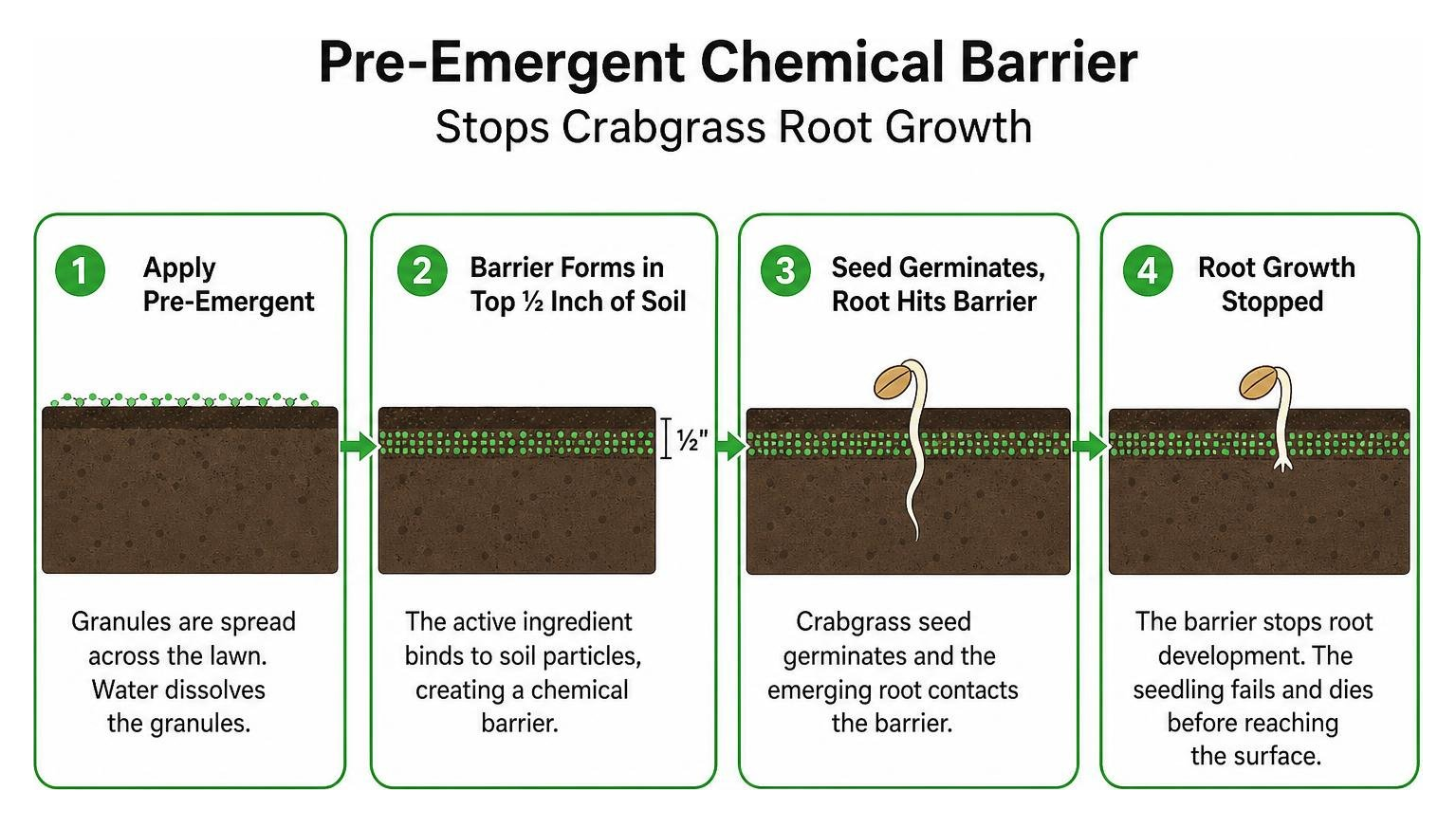
For the best granular crabgrass killer, choose a prodiamine product such as Crabgrass Control Plus 0-0-7 for long-lasting prevention, or a dithiopyr product such as Preen Lawn Crabgrass Control if you need early post-emergence help on young seedlings. Most products on retail shelves are pre-emergents designed to stop weed seeds from establishing. They do not target adult weeds that are already green and thriving in your turf. Instead, they form a protective chemical barrier in the top half-inch of your soil.
When you apply proper pre-emergent weed prevention, the granules dissolve with water and bind tightly to soil particles. As dormant weed seeds wake up and begin to sprout, their emerging roots touch this invisible zone and fail to develop. Post-emergent treatments work differently by absorbing directly into the leaves of actively growing weeds to shut down their internal systems.
| Herbicide Type | Primary Action | Best Timing | Target Weed Stage | Soil Barrier Formed |
|---|---|---|---|---|
| Pre-Emergent (Prodiamine / Pendimethalin) | Root inhibition | Soil at 50 to 55°F | Unsprouted seeds | Yes |
| Early Post-Emergent (Dithiopyr) | Cell division inhibition | Soil at 55 to 60°F | Seeds up to 4-week seedlings | Yes |
| Post-Emergent (Quinclorac) | Foliar disruption | Actively growing | Mature, tillering crabgrass | No |
Pre-Emergence Barrier Mechanics
The true strength of a pre-emergent comes from its ability to stop cell division in root tips. Active ingredients like prodiamine and pendimethalin attach securely to organic matter in your lawn bed. When crabgrass seeds germinate in the spring warmth, they attempt to send down their primary taproot.
The chemical barrier halts this process immediately, causing the seedling to wither and die before it ever breaks the soil surface. This mechanism provides season-long crabgrass control without harming established turfgrass plants that already have mature, deep root systems beneath the barrier zone.
Post-Emergence Reach of Granular Herbicides
Most granular products offer zero control once crabgrass pokes its green head through your lawn. Dithiopyr is the primary exception to this rule. It provides strong pre-emergence control while extending a small post-emergence grace period to homeowners.
Using early post-emergent dithiopyr applications gives you up to four weeks after weed germination to knock out young seedlings before they reach the multi-tiller stage. Beyond that four-week window, granular options become ineffective because mature weeds require liquid foliar sprays with surfactants to absorb the chemical properly through their waxy leaves.
Choosing the Best Granular Crabgrass Killer for Your Lawn
Finding the right granular bag requires looking past bright retail marketing to examine active ingredients, fertilizer carriers, and square-foot coverage. Some formulas focus strictly on weed prevention, while others supply valuable nutrients like potassium or nitrogen to strengthen turf density.
Prodiamine 0-0-7: Best Granular Crabgrass Killer for Long-Lasting Prevention
For pure, extended preventive power, Crabgrass Control Plus 0-0-7 with 0.37% prodiamine is our top recommendation. Prodiamine holds tightly to the soil longer than almost any other pre-emergent on the market, offering up to six months of reliable protection.
The 0-0-7 carrier uses 100 percent muriate of potash to deliver vital potassium without forcing rapid, surge-growth nitrogen in early spring. This makes it exceptional for weed and feed program planning because it covers roughly 12,500 square feet per 50-pound bag, delivering professional-grade coverage and efficiency.
Preen Lawn Crabgrass Control: Best Granular Crabgrass Killer for Early Post-Emergence
If you are a few weeks late applying your early spring preventer, Preen Lawn Crabgrass Control is an outstanding safety net. Powered by 0.19% dithiopyr, this product provides up to four months of pre-emergent defense while knocking down newly sprouted crabgrass seedlings up to four weeks after germination.
Each 15-pound bag covers 5,000 square feet and suppresses over 40 other aggressive annual lawn weeds, including yellow foxtail, spurge, and henbit.
Hi-Yield Crabgrass Weed Control (Benefin & Trifluralin)
Homeowners looking to avoid synthetic fertilizer altogether will appreciate Hi-Yield Crabgrass Weed Control. This product combines 1.33% benefin with 0.67% trifluralin on an inert carrier, containing zero nitrogen, phosphorus, or potassium.
It provides dependable control when laid down one to two weeks before annual seeds sprout. A single 9-pound bag treats anywhere from 5,000 up to 20,000 square feet depending on your specific turfgrass species and target application rate.
Scotts Crabgrass Preventer (Pendimethalin)
Scotts Crabgrass and Grassy Weed Preventer is a reliable retail option built around the active ingredient pendimethalin. The convenient 10.06-pound bag covers 5,000 square feet and creates a consistent barrier against crabgrass, foxtail, and barnyardgrass.
Pendimethalin integrates rapidly with light moisture, making it a dependable choice for early spring yard protection before seasonal rains arrive.
Application Timing and Soil Temperature Guidelines
Timing matters far more than brand choice when dealing with pre-emergent weed controls. If you spread granules after crabgrass seeds have established roots, standard pre-emergents will fail entirely, requiring you to pivot toward summer crabgrass management strategies to clean up breakthrough weeds.
Spring Application Window
Crabgrass seeds begin their germination process when soil temperatures reach a consistent 55 degrees Fahrenheit at a depth of one to two inches for three to five consecutive days. In Northeast Ohio, this window usually opens between late March and mid-April.
A trusted natural indicator is the yellow blooms on forsythia bushes. When forsythia flowers begin to drop, your soil is entering that critical 50 to 55-degree zone. Always apply your granular barrier ahead of this threshold and water the lawn to set the barrier before warm weather arrives.
Fall Prevention for Winter Annuals
Granular preventers are not just for spring crabgrass. Applying a second pre-emergent round in late summer or early autumn stops annoying winter annual weeds like Poa annua, henbit, and common chickweed before they sprout in cool weather.
This fall application provides crucial residual protection through early spring, which works wonderfully alongside combining broadleaf and grassy weed control to keep your turf immaculate across all four seasons.
Lawn Compatibility, Seeding Restrictions, and Turf Safety
Because pre-emergents are designed to halt seed growth, they do not distinguish between weed seeds and desired grass seeds. Applying a granular preventer before or during an overseeding project will ruin your seed germination rates.
| Grass Type | Common Species | Herbicide Tolerance | Reseeding Wait Window |
|---|---|---|---|
| Cool-Season | Kentucky Bluegrass, Tall Fescue, Perennial Ryegrass | High for Prodiamine, Dithiopyr, Pendimethalin | 8 to 16 Weeks |
| Cool-Season | Fine Fescue | Moderate (Use lower label rates) | 12 to 16 Weeks |
| Warm-Season | Bermudagrass, Zoysiagrass | High for all major granular pre-emergents | 8 to 12 Weeks |
| Warm-Season | Centipedegrass, Bahiagrass | Moderate (Avoid heavy prodiamine rates) | 12 to 16 Weeks |
Cool-Season Lawn Safety
Lawns across our service territory in Akron, Hudson, Brecksville, Solon, and Medina consist primarily of cool-season varieties like Kentucky bluegrass, tall fescue, fine fescue, and perennial ryegrass. These grasses tolerate prodiamine, dithiopyr, and pendimethalin well once fully established.
However, you must observe strict reseeding windows after crabgrass preventer applications. Prodiamine barriers can suppress grass seed germination for up to four months, meaning you should complete spring weed prevention early if you plan to overseed your lawn in late summer. This strategy also assists in managing spring dandelions and crabgrass without harming your lawn's primary root framework.
Warm-Season Lawn Safety
While warm-season grasses like Bermuda and Zoysia are not native to northern climates, property owners dealing with these turfs elsewhere need to maintain precise application limits. Products designed for crabgrass control on Bermuda lawns tolerate high rates of prodiamine and dithiopyr during spring green-up.
Sensitive varieties like centipede require customized approaches outlined in centipede grass care guidelines to prevent unwanted root stunting and leaf yellowing.
Application Best Practices and Mistakes to Avoid

Even top-quality granular products will fail if applied unevenly. Follow these proven application protocols to protect your lawn:
- Always calibrate your broadcast spreader before filling the hopper to prevent over-applying chemicals.
- Apply half the required product walking north to south, and the remaining half walking east to west for uniform crisscross coverage.
- Never apply granular products to wet turf unless the label explicitly calls for it, as granules will stick to grass blades instead of reaching the soil.
- Water your lawn with at least one-half inch of irrigation or natural rainfall within 24 to 48 hours to dissolve the granules and activate the barrier.
- Avoid aerating, heavy raking, or verticutting your lawn after application, as disturbing the topsoil breaks the chemical shield.
- Do not blow lawn mower clippings into street gutters or storm drains to protect local waterways from chemical runoff.
Frequently Asked Questions About Granular Crabgrass Killers
When is the absolute best time to apply a granular crabgrass preventer?
The best time to apply is in early spring when soil temperatures consistently measure between 50 and 55 degrees Fahrenheit at a two-inch depth. This typically occurs between late March and mid-April across Northeast Ohio, right as yellow forsythia bushes begin dropping their blooms.
Can I overseed my lawn after applying a granular crabgrass killer?
Most granular preventers create a soil barrier that stops all seed germination, including quality grass seed. You must wait between 8 to 16 weeks after application before seeding, depending on the active ingredient and rate used. Always check your product label before seeding.
How much water is needed to activate granular crabgrass preventers?
Granular pre-emergents require roughly one-half inch of rainfall or sprinkler irrigation to dissolve the carrier granules and bind the active chemicals to the top layer of soil. For maximum effectiveness, ensure your lawn receives this moisture within 48 hours of spreading the product.
Conclusion
Stopping stubborn grassy weeds takes proper timing, careful product selection, and consistent care. By matching your lawn type to the right active ingredient, monitoring soil temperatures in early spring, and watering in your granules thoroughly, you can enjoy a thick, green lawn all season long.
If you prefer to let local experts handle your yard, Advanced Quality Lawn provides complete weed control, tree and shrub care, and professional lawn care and maintenance services across 99+ zip codes throughout Summit, Medina, Cuyahoga, Portage, Geauga, and Stark counties. Give our team a call today to keep your yard weed-free.