
How to Plunge Your Way to a Mole-Free Yard
The Best Way to Get Rid of Moles in the Yard Starts With Active Tunnels
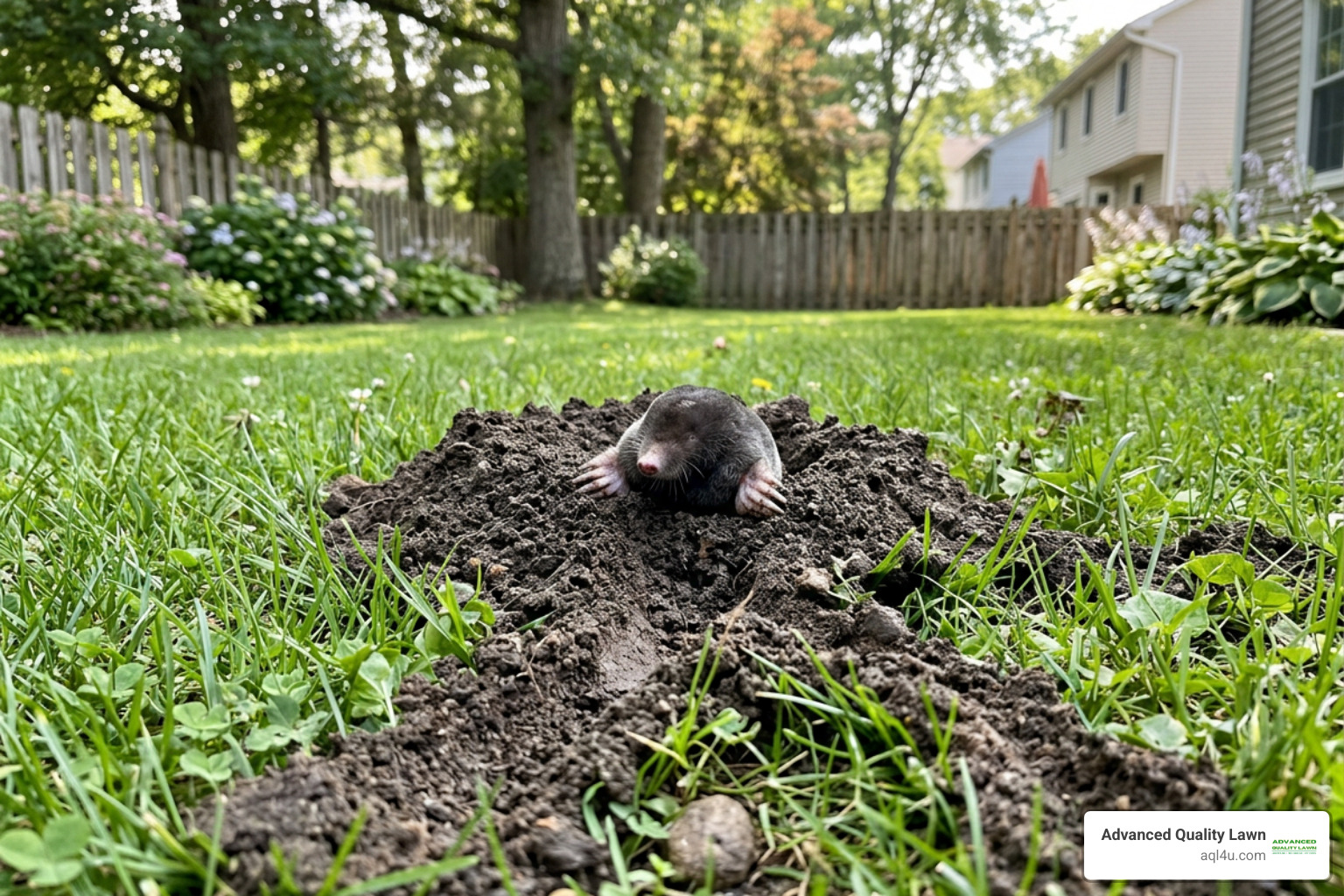
The best way to get rid of moles in the yard is to trap them in confirmed active tunnels. Mechanical traps placed in main travel runways are the most reliable option, while repellents and grub treatments may help limit activity but rarely remove a mole on their own.
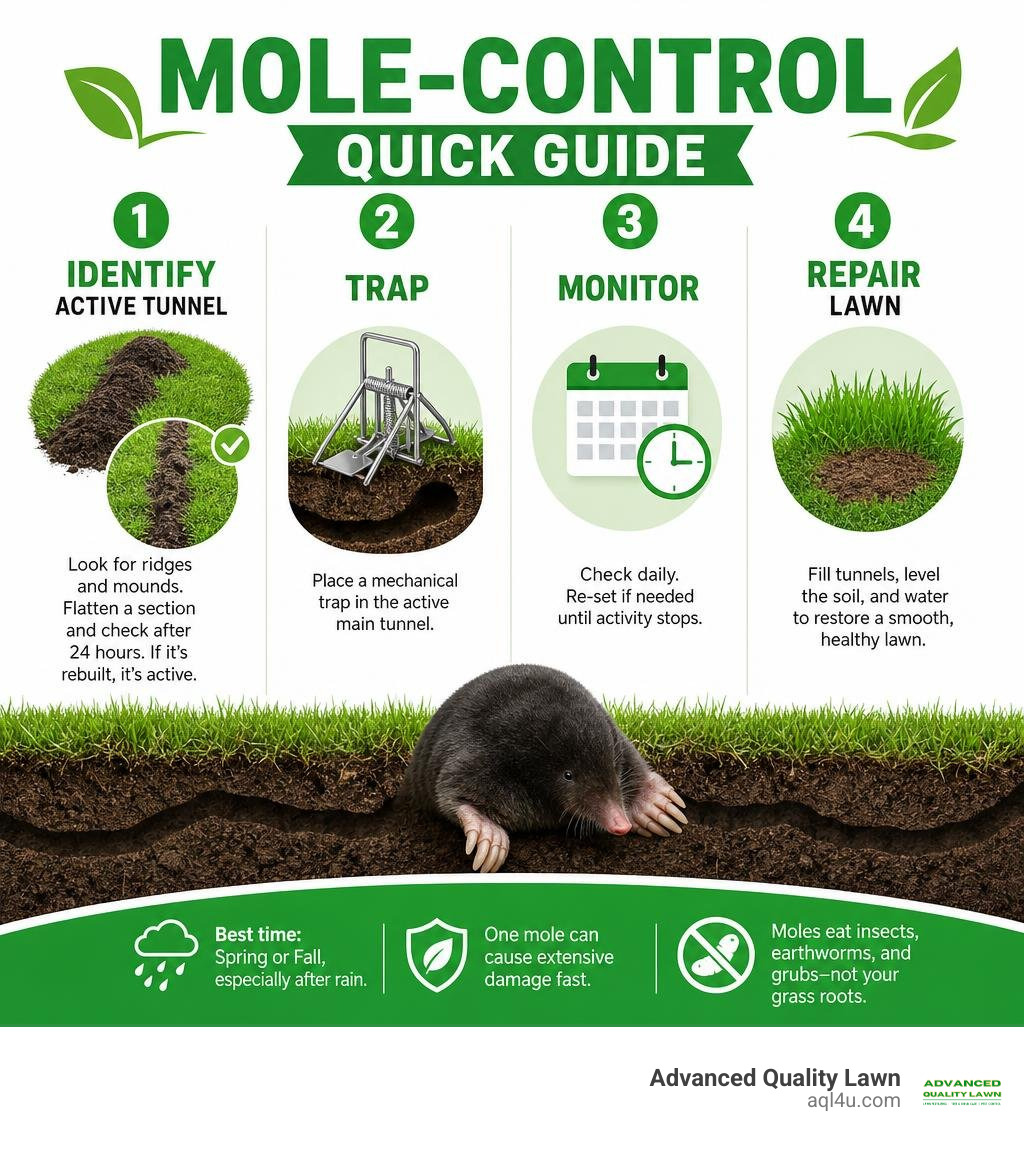
- Look for raised surface ridges and volcano-shaped soil mounds. These are common signs of mole activity.
- Confirm the tunnel is active by flattening a short section and checking it after 24 hours. A rebuilt ridge is a working runway.
- Act in spring or fall, especially after rain, when moles are closer to the surface and tunneling heavily.
- Do not assume a large tunnel network means many moles. One fast-moving mole can create extensive lawn damage in a short time.
Moles do not eat grass roots, bulbs, or your landscaping plants. They are insect-eaters that hunt earthworms, grubs, and other soil life. Still, their shallow tunnels can lift turf, break grass roots, and turn a healthy Ohio lawn into a bumpy mess almost overnight.
I am Andrew Day, owner of Advanced Quality Lawn in the Akron area, and our team brings more than 30 years of lawn care experience to the work of finding the best way to get rid of moles in the yard while protecting the lawn around it. First, it helps to make sure moles, not another digging animal, are causing the damage.
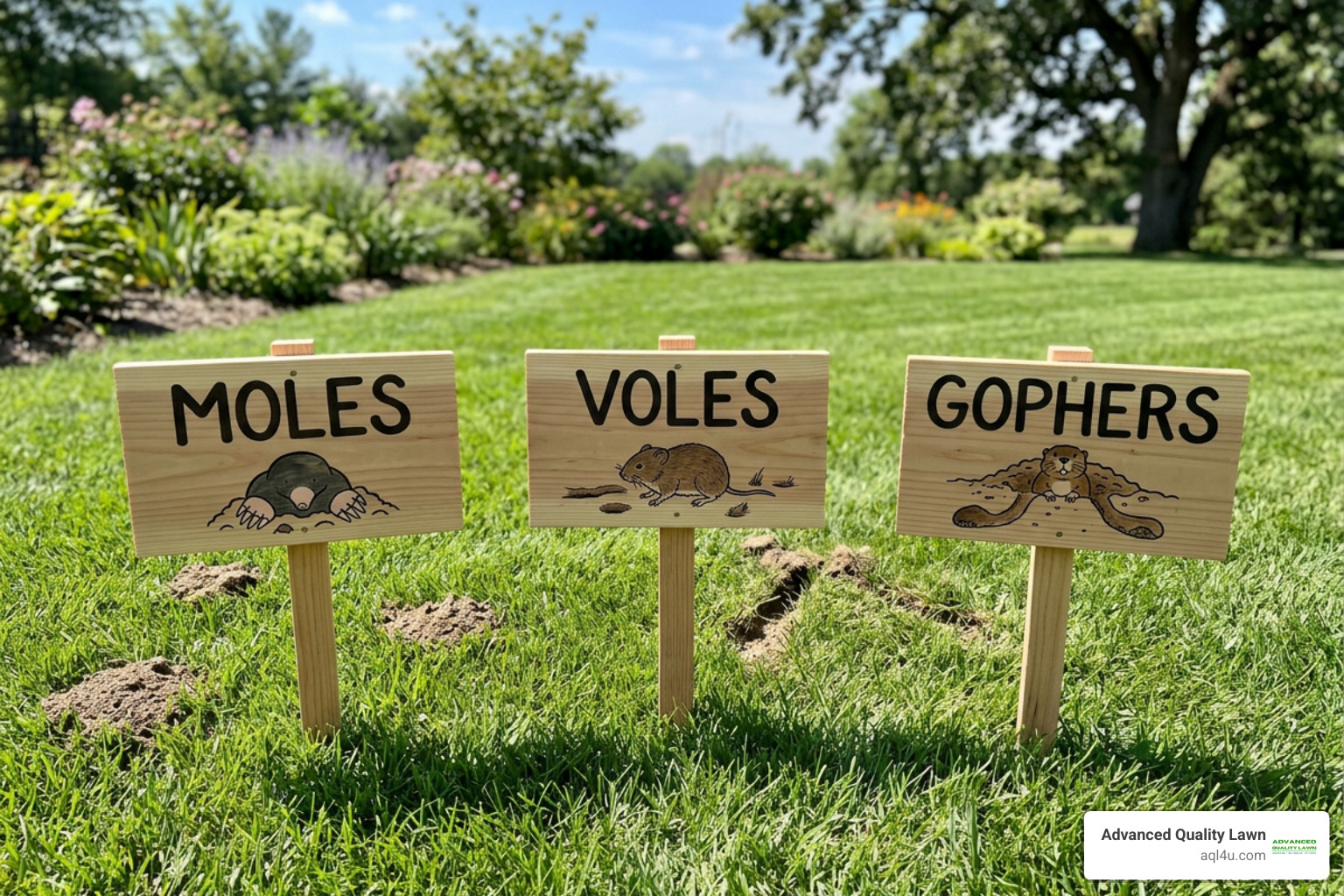
Identifying Your Underground Enemy: Moles vs. Voles vs. Gophers
Before spending time setting traps or purchasing products, we need to verify which creature is digging up your property. Lawn damage created by underground pests can look similar at a glance, but the control techniques for each animal are completely different.
Moles, voles, and pocket gophers leave distinct visual clues across your lawn and garden beds. Knowing these physical markers ensures that you do not waste effort attempting to trap an insectivore with rodent bait or treat a rodent issue with mole traps.
Volcano Mounds vs. Crescent Gopher Ridges
The shape of the soil mounds on your lawn offers an immediate hint about the pest underground.
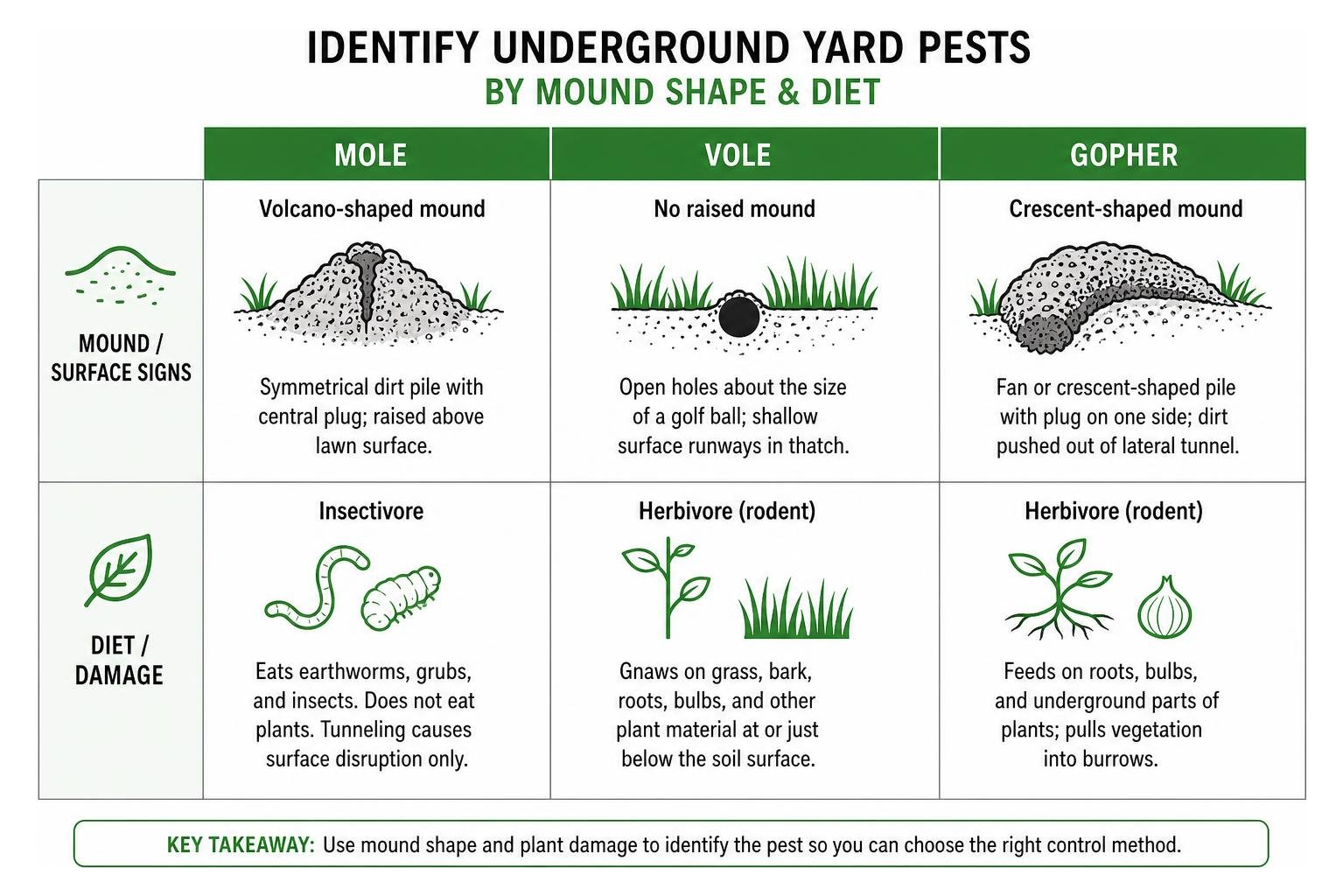
Moles create volcano-shaped mounds by pushing soil straight up from deep travel tunnels. These symmetrical dirt piles feature a central vertical plug where the animal pushed dirt to the surface.
In contrast, pocket gophers dig lateral tunnels to the surface and dump dirt off to one side. This creates a crescent-shaped or fan-shaped mound with an offset plug on one edge. Gophers are pocketed in specific geographic areas, while moles are widely spread across Northeast Ohio counties like Summit, Stark, Medina, and Portage.
Voles do not build raised dirt mounds at all. Instead, they leave open entrance holes roughly the size of a golf ball and travel through shallow surface pathways hidden under dense thatch. If you want to dive deeper into identifying different yard critters across our region, check out our guide on Common Ohio Garden Pests and How to Get Rid of Them. For more details on mole habits, explore the insights provided in Moles in the Garden: How to Identify and Humanely Get Rid of Them.
Plant Root Damage vs. Insectivore Tunneling
The type of damage found on your landscape plants further narrows down the target pest. Moles belong to the insectivore family. They possess twice as much blood and double the hemoglobin of other small mammals, allowing them to thrive in low-oxygen subterranean tunnels. They use powerful front limbs to exert a lateral digging force equal to 32 times their body weight.
Because moles hunt earthworms, grubs, and soil insects, they do not eat plant tissue. Any wilting grass or yellowing plants above a mole tunnel stem purely from mechanical disruption. The mole pushes soil upward, separating grass roots from moisture and nutrient-rich soil.
Voles and gophers are rodents that actively devour vegetation. Voles gnaw on lower tree bark, clip turfgrass blades close to the soil crown, and chew hosta roots or flower bulbs. Gophers pull whole plants into their burrows from below. If you find half-eaten flower bulbs or cleanly severed plant roots, you are dealing with voles or gophers rather than moles.
What Is the Best Way to Get Rid of Moles in the Yard?
When homeowners ask us for the best way to get rid of moles in the yard, our answer is grounded in scientific research from university extension offices. Physical trapping is the single most consistent and practical method for clearing active moles from a home lawn.
While many quick-fix repellents claim fast results, mechanical trapping physically removes the animal from your lawn network. Most DIY homeowners can resolve an active mole issue within 7 to 21 days using simple trapping techniques.
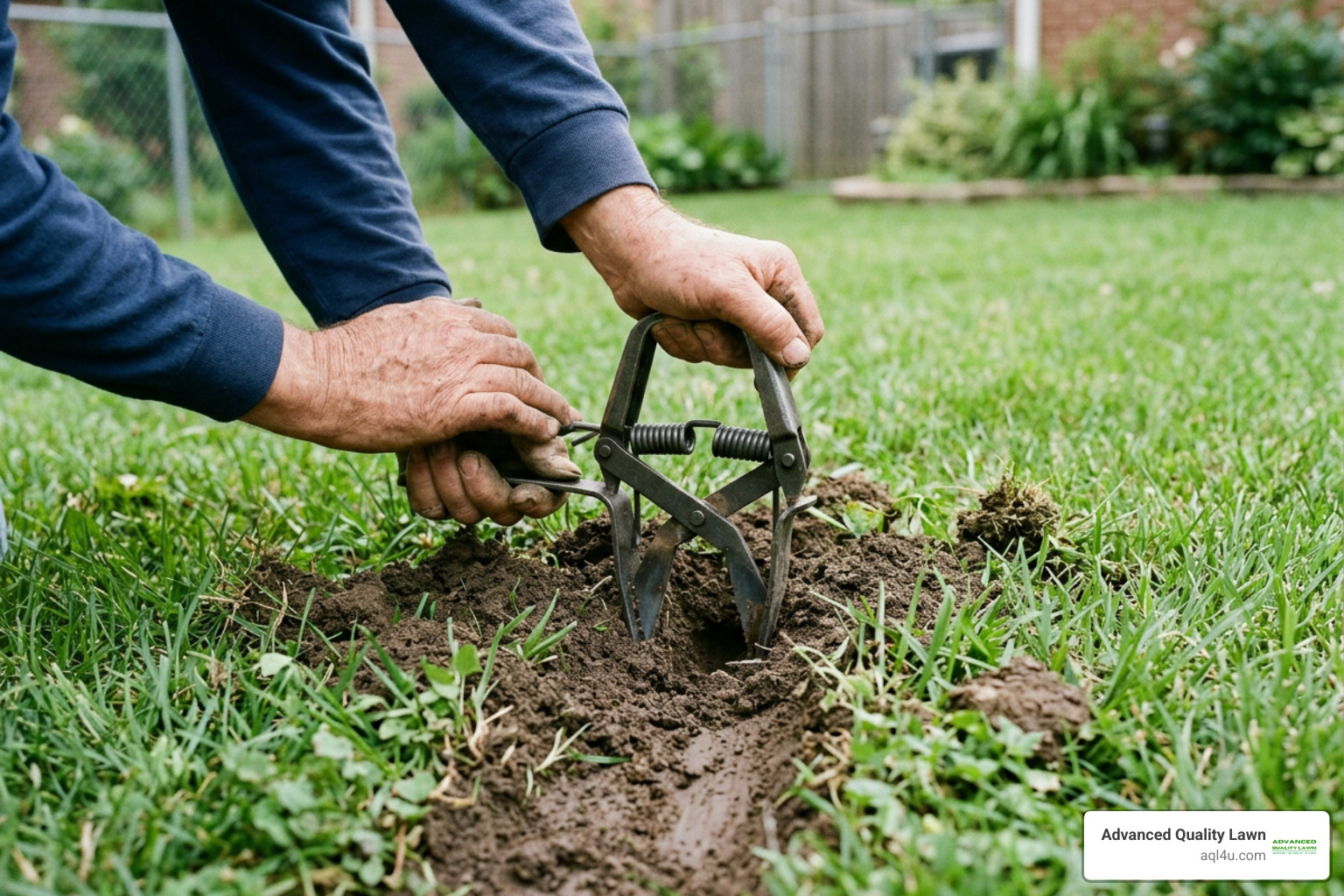
Trapping: The Best Way to Get Rid of Moles in the Yard Fast
Mechanical mole traps come in three main styles: scissor-jaw traps, plunger or harpoon traps, and choker-loop traps. Each style works well when installed correctly over an active travel passage.
- Scissor-jaw traps sit straddling the runway with jaws buried in soft soil on either side of the tunnel. When the mole pushes past the trigger mechanism, the spring-loaded jaws snap horizontally across the run.
- Plunger or harpoon traps feature sharp prongs positioned above the subterranean tunnel. The trigger pan rests directly on a flattened section of the ridge. As the mole attempts to reopen the blocked passage, it pushes the trigger upward and releases the overhead spears.
- Choker-loop traps use wire loops positioned inside the tunnel path, strangling the mole cleanly when triggered.
University studies confirm that trapping works quickly because moles travel through straight main runs multiple times each day. For an in-depth look at trapping mechanics and extension findings, read How to Get Rid of Moles in Your Yard: Why Trapping Works Fast (and Most Repellents Don't).
Testing 24-Hour Flattened Runs to Find Active Tunnels
Setting traps at random locations across a lawn produces poor results. Moles dig two distinct types of subterranean passages: temporary feeding probes and straight main travel runways.
Feeding probes wander aimlessly across your turf in squiggly patterns. Moles construct these surface ridges while searching for food after rain, and they rarely revisit them. Main travel runways follow straight lines, long lawn boundaries, driveways, fence lines, or foundation walls. Moles use these main routes daily to move between deep nesting chambers and hunting grounds.
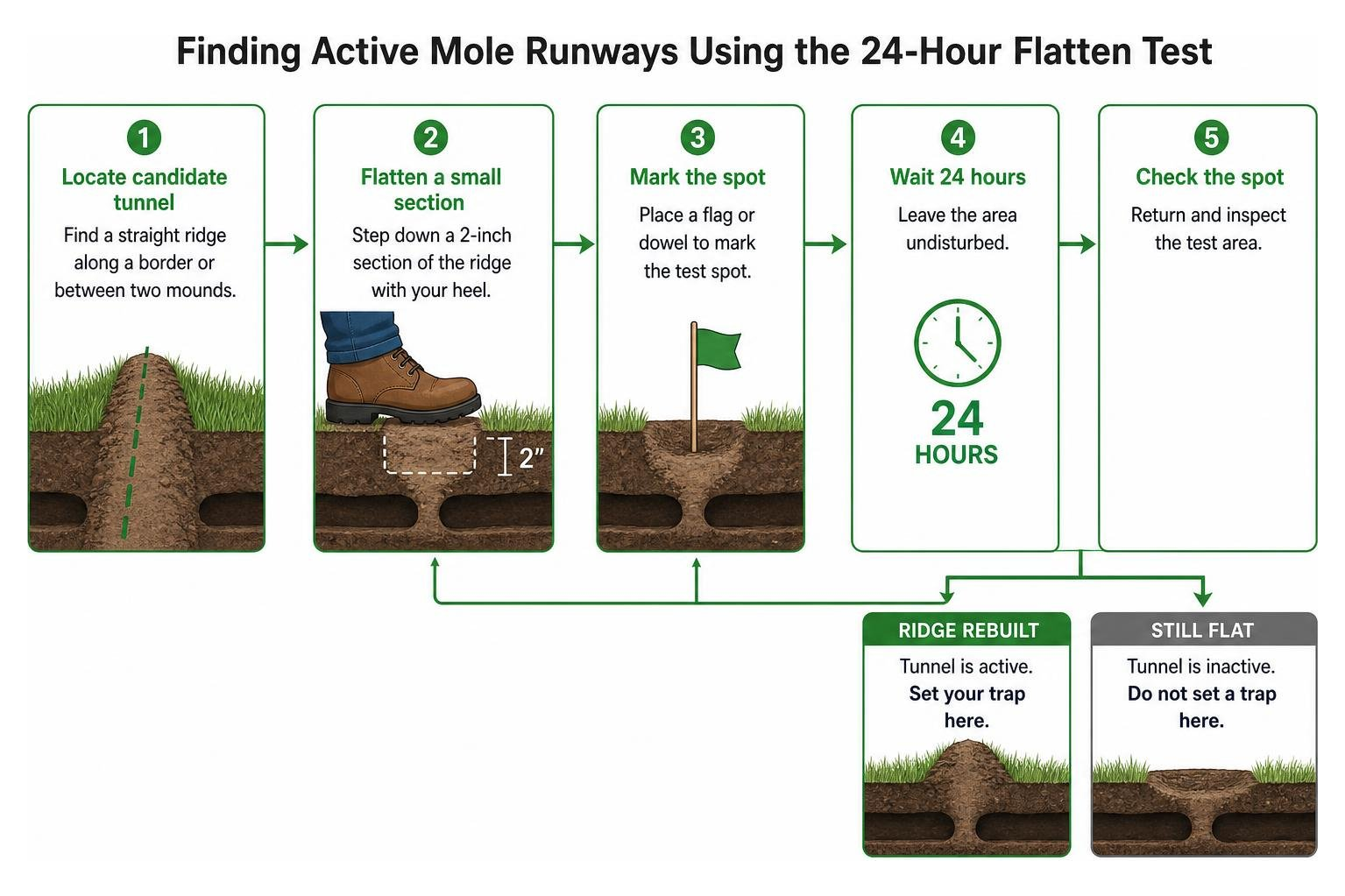
Follow this simple testing process to locate active travel runways:
- Locate candidate tunnels that run straight along borders or connect two visible dirt mounds.
- Step down a small two-inch section of the surface ridge using your heel to collapse the passage flat.
- Mark the test spot with a bright lawn flag or wooden dowel.
- Return 24 hours later to inspect the flat section. If the mole pushed the flattened soil back up, you have found an active main runway suitable for setting your trap.
- Wear clean gloves whenever setting traps or handling soil near runways. Human scent around disturbed soil creates a short gap that causes moles to detour around the area for up to 48 hours.
Comparing Mole Control Methods: Trapping, Baiting, and Repellents
Choosing the right approach depends on your comfort level with setting mechanical devices, household budget, and personal preferences regarding wildlife management. The breakdown below outlines how common control methods compare across cost, speed, and overall effectiveness.
- Mechanical Trapping: Provides results within 7 to 21 days at an average DIY cost of $20 to $40. The main advantage is highly reliable and verifiable removal, while the primary limitation is requiring proper location testing.
- Bromethalin Worm Baits: Works within 12 to 24 hours post-ingestion at an average DIY cost of $25 to $45. The main advantage is fitting shallow runs where traps fail, while the primary limitation is requiring careful handling around pets.
- Castor Oil Repellents: Offers temporary results lasting 7 to 21 days at an average DIY cost of $15 to $35 per application. The main advantage is a non-lethal and pet-safe formulation, while the primary limitation is washing out with rainfall.
- Grub Control Chemicals: Takes weeks to months at an average DIY cost of $30 to $60. The main advantage is eliminating secondary lawn pests, while the primary limitation is that it does not eliminate earthworms.
Bromethalin worm baits mimic the natural shape and feel of living earthworms. Because moles feed by touch underground, they accept these synthetic gel worms when placed inside active runs. Once ingested, the neurotoxin works within 12 to 24 hours. That pet safety requires proper bait placement deep inside sealed subterranean tunnels. For example, an 11-pound dog would need to ingest roughly 9 to 19 bromethalin bait worms to reach a lethal dose, but baits must always remain safely buried out of reach of domestic animals.
Castor oil repellents use concentrated natural oils to coat soil particles and earthworms. Moles dislike the taste and scent of castor oil, causing them to shift their hunting boundaries temporarily. However, castor oil products provide only 7 to 21 days of displacement before rainfall washes the active compound beneath the root zone.
Is Grub Control the Best Way to Get Rid of Moles in the Yard?
A widespread lawn care myth claims that eliminating grubs from your soil is the best way to get rid of moles in the yard. While moles do consume white grubs, grubs make up only a small fraction of their daily diet.
Earthworms represent 70 to 80 percent of a mole's total food source. A healthy suburban lawn packed with rich organic matter supports dense earthworm populations. Even if you completely eliminate grubs from your soil, moles will continue tunneling happily across your lawn as long as earthworms remain abundant.
Applying grub control products strictly to eliminate moles wastes time and money. Grub treatments serve a vital role in preventing beetle larvae from eating your grass roots, but they do not solve an active mole problem. Learn more about controlling soil insects for turf health in our guide on the Best Way to Kill Grubs in Lawn.
The Truth About Home Remedies and Sonic Stakes
Over the years, homeowners across Akron, Cuyahoga Falls, and surrounding Northeast Ohio communities have tried every imaginable home remedy to drive away moles. Popular folk ideas include inserting juicy fruit chewing gum, human hair, broken glass, mothballs, pinwheels, or ultrasonic vibrating stakes into mole tunnels.
University extension services have repeatedly tested these popular methods and concluded that they are ineffective. Sonic stakes and battery-powered vibrators fail because moles adapt quickly to minor soil vibrations. Chewing gum and human hair do not alter mole movement patterns.
Placing mothballs or chemicals in subterranean soil tunnels can introduce toxic compounds into the local groundwater supply. Mechanical traps and registered worm baits remain the only scientifically proven remedies for clearing active infestations.
Preventing Future Infestations and Repairing Lawn Damage
Once you successfully trap or remove active moles from your lawn, focus on repairing visible turf damage and taking sensible preventative measures to minimize future invasions.
Moles are solitary and fiercely territorial creatures. A typical one-acre lawn generally supports only two to three moles at a given time due to earthworm limits. However, when a territory opens up after a mole is removed, a neighboring mole may eventually wander into the vacant tunnel system.
Soil Moisture Management and Physical Mesh Barriers
Managing irrigation levels across your lawn helps discourage surface tunneling. Moles prefer moist, soft soil because earthworms concentrate near the surface when moisture is high.
- Limit lawn watering to no more than one inch per week, including natural rainfall. Deep, infrequent watering keeps grass roots strong while allowing the top layer of soil to dry out, encouraging earthworms and moles to remain deeper underground.
- Install subterranean barriers around high-value flower beds, vegetable plots, or ornamental plantings. Trench 12 to 18 inches deep and line the perimeter with 1/4-inch mesh hardware cloth.
- Backfill the trench with soil, ensuring the mesh barrier extends two inches above the soil line to prevent underground diggers from tunneling over or under the wire.
Repairing Turf Ridges and Reseeding Bare Spots
Restoring a mole-damaged lawn requires prompt action to save grass roots lifted out of the soil.
- Walk down shallow ridges using your feet to press lifted turf back into contact with the underlying soil. Light rolling restores root contact before grass blades dry out and brown.
- Rake out large volcano mounds to flatten piles of excavated soil over surrounding turfgrass.
- Overseed bare patches caused by collapsed tunnels. Apply fresh grass seed suited for Northeast Ohio lawns, top-dress with a thin layer of compost, and keep the soil lightly moist until seeds germinate.
- Aerate compaction across damaged areas to encourage deep root growth and help your lawn recover its thick, uniform appearance.
Frequently Asked Questions About Mole Control
How many moles are typically living in one yard?
Most homeowners assume an army of pests has invaded when multiple mounds appear across their grass. In reality, one to three moles typically occupy a standard suburban lawn. A single adult mole can dig surface tunnels at a rate of 18 feet per hour and add over 100 feet of new tunnel network per day during damp spring weather. Because moles are solitary and territorial, clearing just one or two animals usually resolves the entire issue.
How long does it take to trap a mole?
When a mechanical trap is placed correctly over a confirmed active main runway, most moles are caught within 24 to 72 hours. If your trap remains untouched after three to four days, open the tunnel, re-test for activity with the 24-hour flatten method, and move the device to a different straight travel route.
What is the best time of year to set mole traps?
Spring and autumn offer the ideal conditions for trapping moles across Ohio lawns. During spring, frequent rains bring earthworms and moles close to the surface, making active ridges easy to spot. Female moles also give birth to litters of two to six young in mid-April through May, so early spring trapping stops population expansion. Fall provides a secondary window before soil freezes and forces moles deep underground for winter.
Taking Back Your Lawn With Professional Support
Finding the best way to get rid of moles in the yard comes down to using reliable tools, properly identifying active runways, and staying patient throughout the process. Trapping remains the gold standard for clearing moles quickly, protecting your lawn investment, and restoring a smooth, beautiful turf canopy.
At Advanced Quality Lawn, we provide full-service lawn care programs designed to keep your yard thick, healthy, and resilient year-round. From insect management to ongoing turf feeding, our experienced team serves homeowners across Akron, Stow, Hudson, Cuyahoga Falls, Solon, Chagrin Falls, Medina, and 99+ zip codes throughout Northeast Ohio. Browse our full range of services on our Lawn Care Maintenance page, and let us help you achieve a vibrant, green lawn today!