
5 Natural Crabgrass Killers That Actually Work
The Best Natural Way to Kill Crabgrass Starts With Early Action
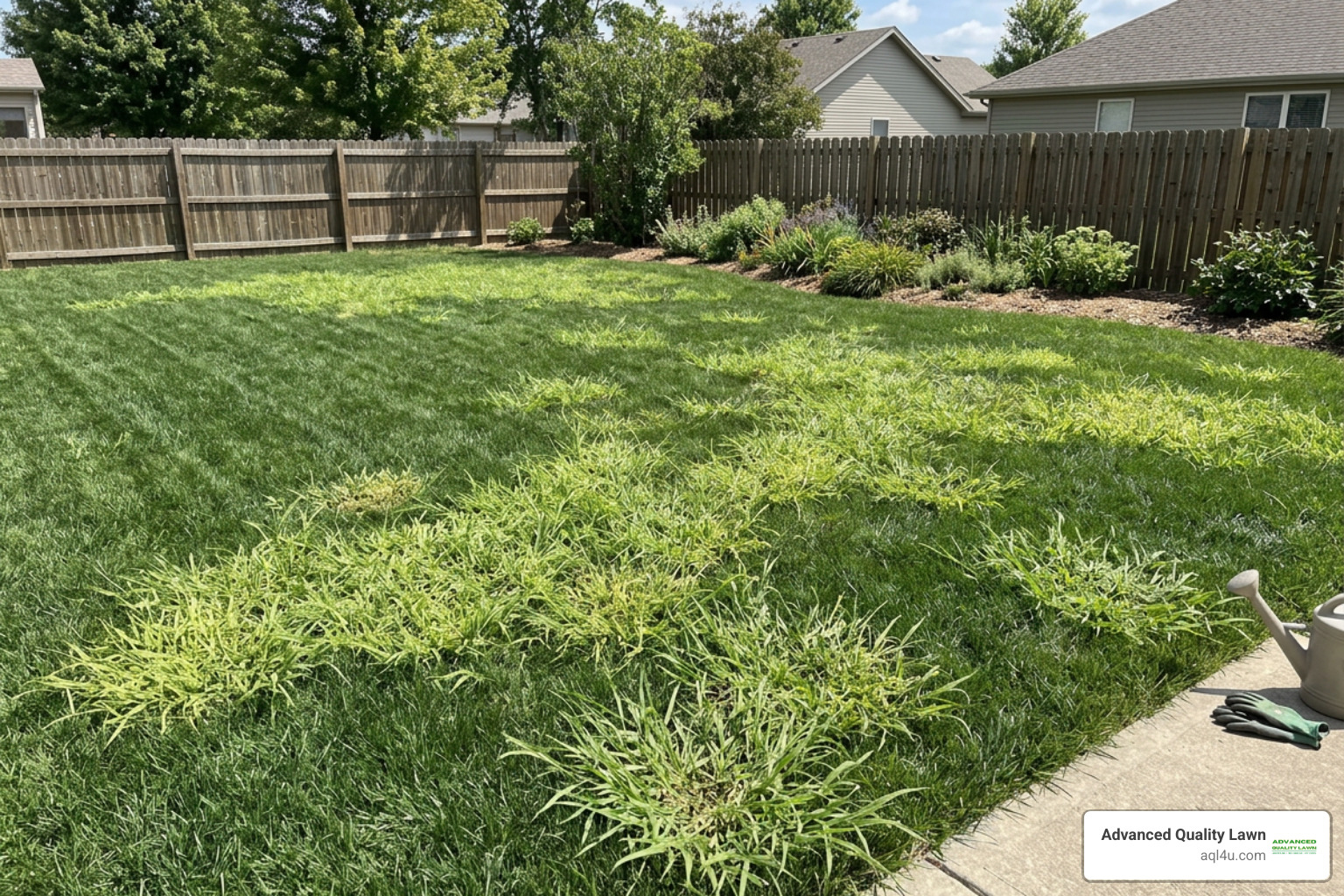
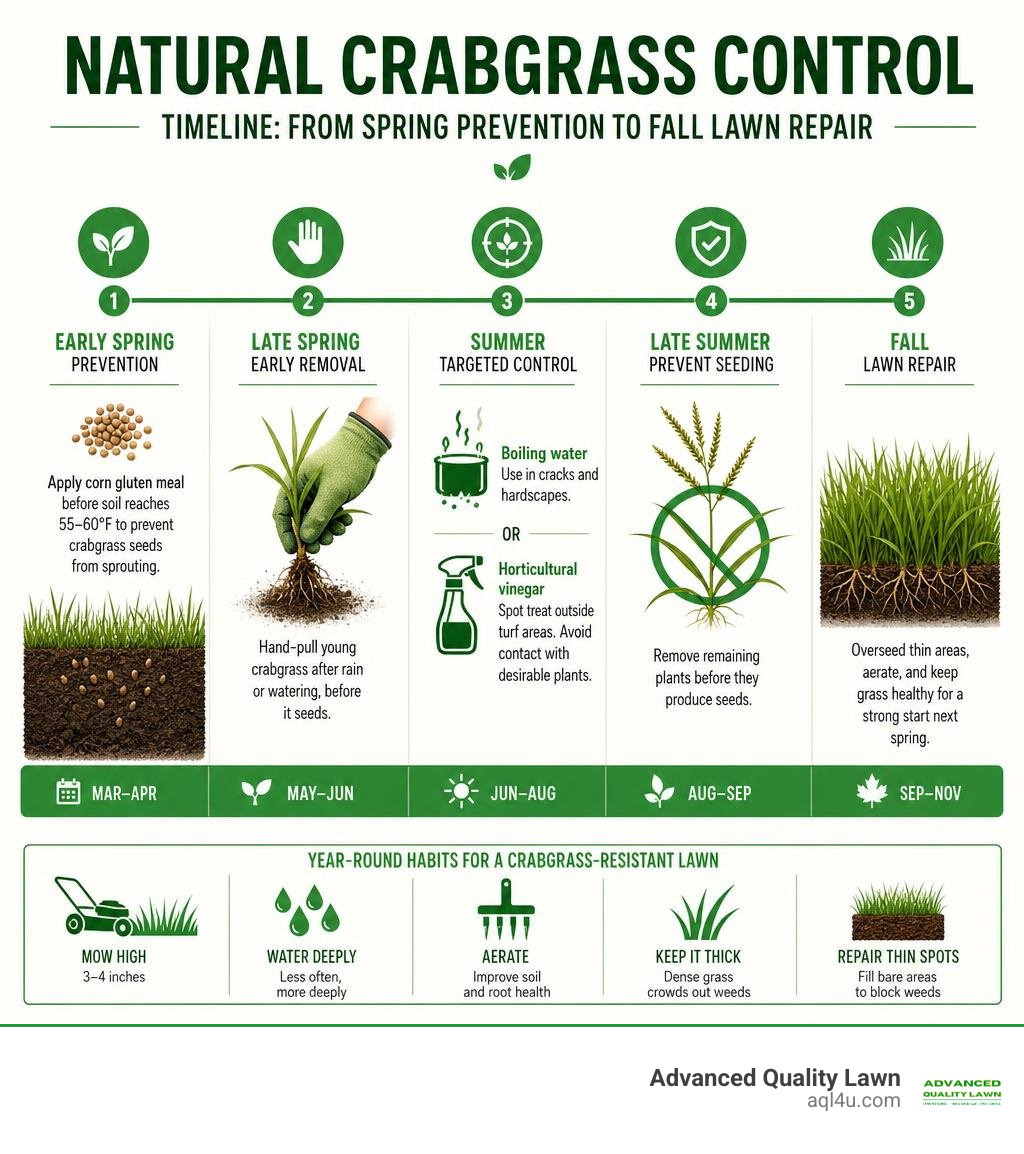
The best natural way to kill crabgrass is to pull young plants before they seed, then prevent new seedlings with a thick, healthy lawn and well-timed corn gluten meal. For isolated plants in driveway cracks or garden edges, horticultural vinegar or boiling water can work quickly, but both can also kill nearby grass.
| Goal | Best natural approach |
|---|---|
| Remove a few plants from turf | Hand-pull after rain or watering |
| Kill plants in cracks and hardscape | Boiling water |
| Burn back targeted plants outside turf | Horticultural vinegar |
| Stop new crabgrass before it sprouts | Corn gluten meal before soil reaches 55 to 60 F |
| Prevent repeat problems | Mow high, water deeply, aerate, and repair thin spots |
Crabgrass is a fast-spreading summer annual that thrives where lawn grass is thin, stressed, or cut too short. One plant can produce up to 150,000 seeds, so the goal is not just to remove what you see today. It is to stop seed production and build dense turf that leaves little room for new weeds.
I am Andrew Day of Advanced Quality Lawn. With more than 30 years of lawn care experience behind our Northeast Ohio team, I have seen that the best natural way to kill crabgrass is a practical mix of early removal, careful spot treatment, and stronger turf care.
What Is Crabgrass and How to Identify It
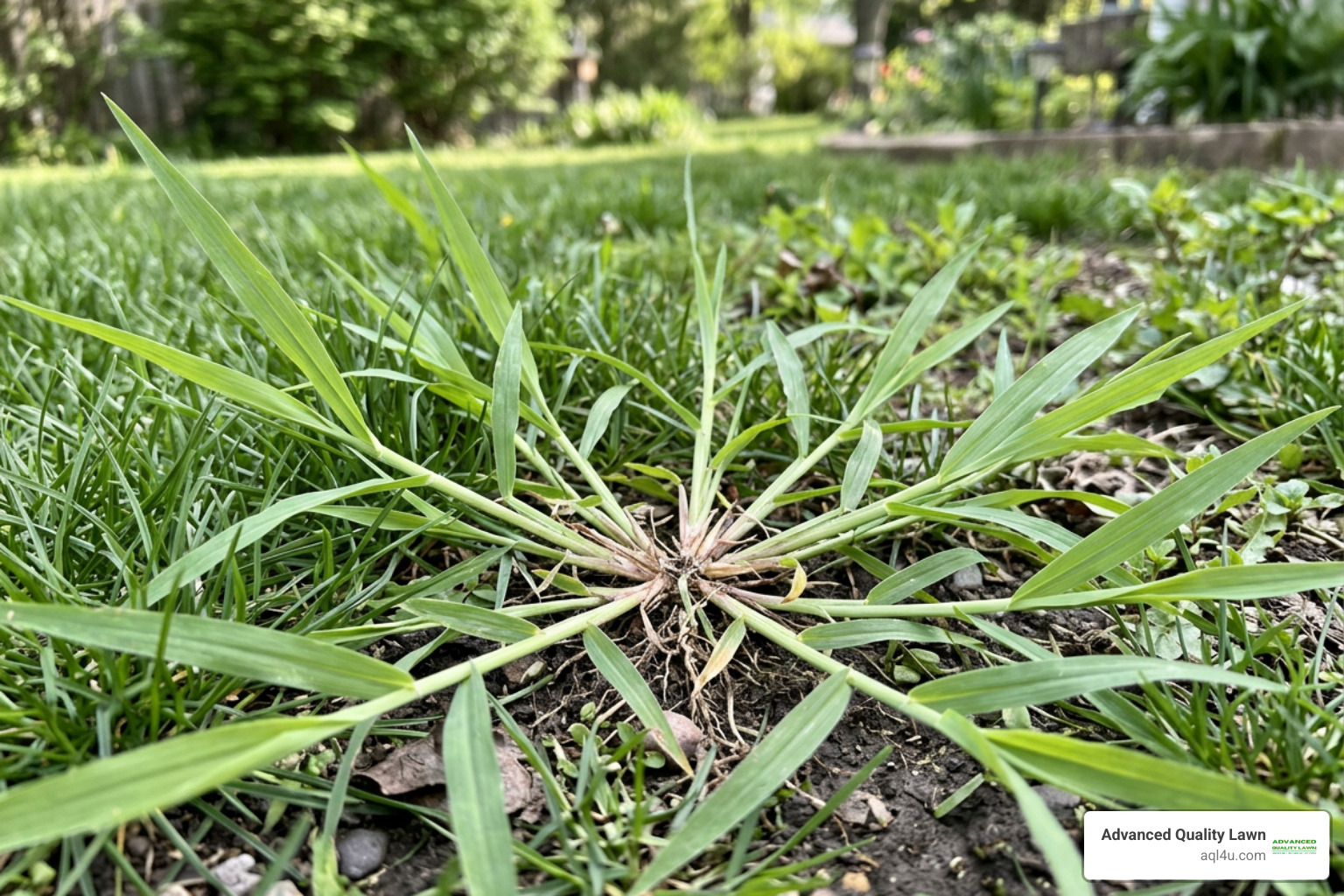
Before attempting to eliminate weeds from your property, you need to verify what you are fighting. Crabgrass belongs to the genus Digitaria, with large crabgrass (Digitaria sanguinalis) and smooth crabgrass (Digitaria ischaemum) being the two most common species in our region. This aggressive plant operates on a strict annual lifecycle. It dies completely with the autumn frost, but it leaves behind millions of dormant seeds waiting in the top layer of your soil.
Identifying crabgrass early gives you a massive advantage. Look for these key visual indicators in late spring and early summer:
- Low-growing spreading habit: Crabgrass stems branch outward from a central root crown, growing horizontally along the soil before sending up leaf blades that resemble crab legs.
- Purple stem base tint: Young crabgrass tillers often display a distinct reddish or purple color near the base of the stems where they meet the crown.
- Broad blade texture: The leaf blades are significantly wider and lighter green than desirable cool-season grasses like Kentucky bluegrass or fine fescue.
- Finger-like seedheads: In mid-summer, mature plants produce distinct seed spikes that split into multiple finger-like branches at the tip of the stem.
Understanding why crabgrass is so destructive helps explain why quick action is necessary. A single plant can produce up to 150,000 seeds during one growing season, and those seeds can remain viable in the soil for 3 years or longer. Furthermore, an individual clump can spread to cover 1 to 3 square feet of space. As it expands, it steals critical water, sunlight, and soil nutrients from turfgrass. For a deeper breakdown of this weed's biology, check out our Crabgrass Control: Complete Prevention & Treatment Guide (2026).
The Best Natural Way to Kill Crabgrass: 5 Proven Methods
When you want to eliminate existing crabgrass without applying synthetic chemicals to your lawn, selecting the right method depends on where the weed is growing and how widespread the infestation is. Natural remedies vary in how quickly they work, whether they kill surrounding grass, and where they are safest to apply.
| Method | Speed of Results | Selectivity | Ideal Application Area |
|---|---|---|---|
| Horticultural Vinegar | 24 to 48 hours | Non-selective (kills grass) | Driveway cracks, patio seams, garden beds |
| Manual Extraction | Immediate | Selective (safe for turf) | Lawn turf, flower beds, scattered patches |
| Boiling Water | Instant | Non-selective (kills grass) | Sidewalk seams, gravel driveways, paver steps |
| Baking Soda & Soap | 3 to 5 days | Non-selective (burns turf) | Isolated weed clumps in high-heat areas |
| Soil Solarization | 4 to 6 weeks | Non-selective (clears area) | Heavily overrun beds, lawn renovation zones |
Below, we detail how each of these 5 organic remedies works so you can select the best natural way to kill crabgrass in your own yard.
1. Horticultural Vinegar: The Best Natural Way to Kill Crabgrass on Contact
Standard kitchen vinegar contains roughly 5% acetic acid, which is too weak to destroy mature weed structures. Horticultural vinegar, on the other hand, contains a concentrated 20% to 30% acetic acid solution. This high concentration acts as a powerful contact herbicide that desiccates plant tissues by stripping away the waxy cuticle layer and rupturing cell walls on contact.
To make a custom spot spray mix, combine 1 gallon of horticultural vinegar with 1 tablespoon of liquid dish soap. The soap acts as a surfactant, breaking the surface tension of the liquid so it clings evenly to the waxy leaves of the weed rather than rolling off onto the soil.
Because concentrated vinegar is non-selective, it will burn any desirable grass or garden foliage it touches. Always apply it as a targeted spot spray on warm, bright, sunny days when temperatures exceed 70 degrees Fahrenheit. The intense sunlight accelerates the desiccation process, often causing foliage to turn brown and shrivel within 24 hours. That while vinegar scorches top growth quickly, large mature plants with deep roots may require repeat applications to fully die back. Learn more about organic spraying options in our guide on Natural Ways to Kill Crabgrass in Your Yard and explore our tips for finding the Best Lawn Spray for Crabgrass.
2. Manual Extraction: The Best Natural Way to Kill Crabgrass Roots
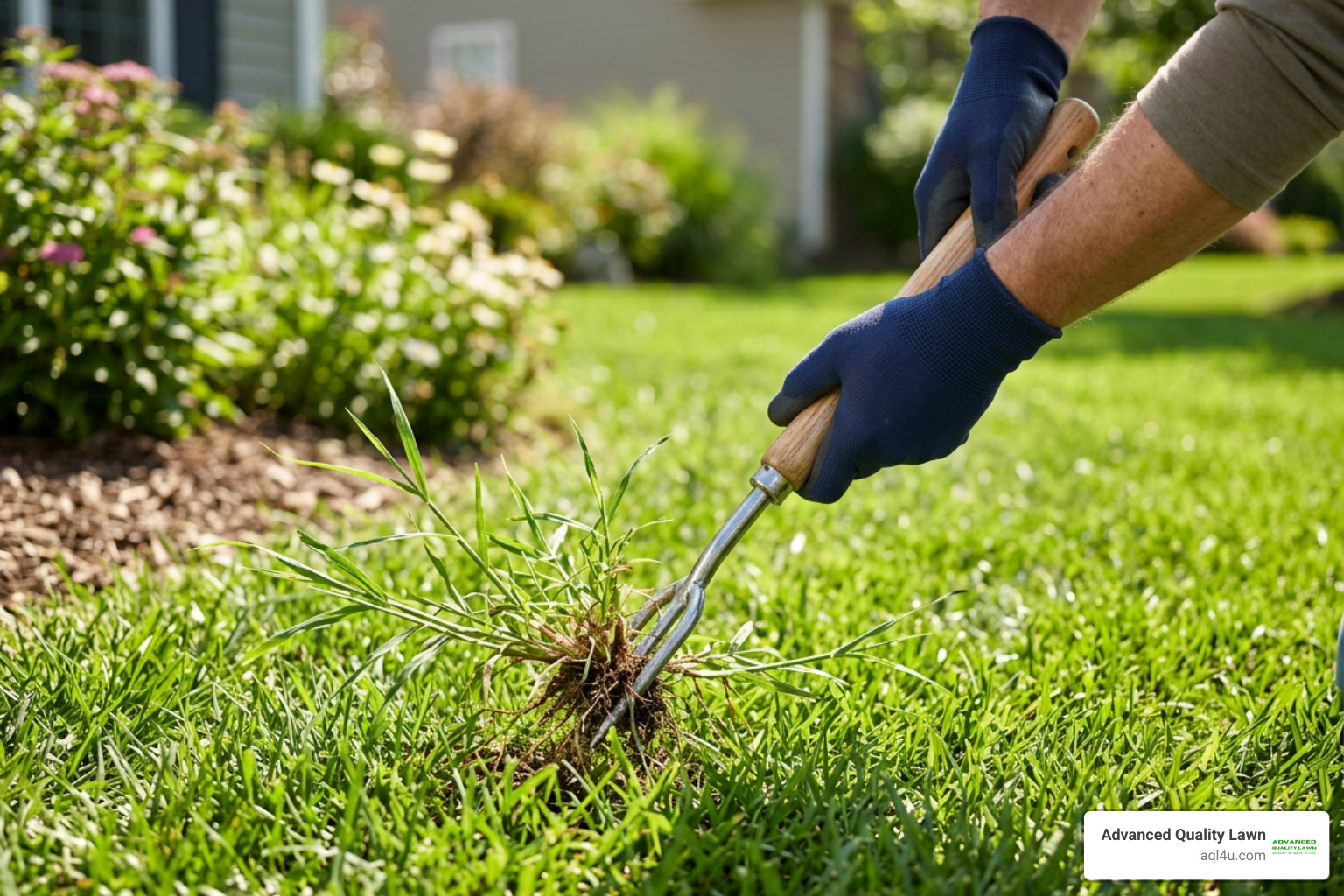
When crabgrass sprouts directly inside healthy turfgrass, physical removal remains the best natural way to kill crabgrass without risking chemical overspray or burning your desired lawn. Unlike perennial weeds with deep taproots or spreading underground rhizomes, crabgrass relies on a central crown and fibrous root system. If you pull the crown entirely, the plant dies permanently.
Follow these practical steps for successful hand-pulling:
- Moisten the soil: Never pull weeds from bone-dry dirt. Water the area deeply or wait until a day after a heavy rain shower when the ground is soft and pliable.
- Leverage the root crown: Slide a fishtail weeding tool, dandelion extractor, or hori-hori knife into the soil directly beside the base of the weed.
- Pry gently upward: Angle the tool to loosen the soil beneath the root ball, then grip all tillers at the base and pull firmly upward to extract the whole root crown.
- Enforce the bare patch protocol: Immediately fill the resulting hole with clean topsoil, tamp it down, sprinkle fresh grass seed, and water it thoroughly.
Leaving open soil patches after weeding is a common mistake. Open dirt invites dormant weed seeds to germinate instantly. By seeding bare spots immediately, you create dense turf cover that prevents the next wave of weeds from establishing. Read more detailed steps in our Ultimate Crabgrass Removal Guide Summer.
3. Scalding with Boiling Water
Thermal scalding with boiling water is one of the simplest, most cost-effective non-chemical treatments available. When poured directly onto a plant, boiling water causes immediate cellular collapse throughout the leaves, stems, and shallow root system.
This thermal method is ideal for treating weeds emerging from sidewalk seams, paver joints, brick patios, and gravel driveways. In these hardscape locations, you can pour boiling water without any risk of damaging desirable turf grass.
To apply this treatment safely, heat a full kettle of water to a rolling boil. Carefully carry the kettle outdoors and pour the scalding water slowly onto the central crown of the target plant. Ensure the water thoroughly saturates the soil surrounding the base so heat reaches the top roots. Within minutes, the foliage will wilt, turn dark green, and collapse. While highly effective in cracks and gravel, avoid using boiling water in lawn areas because it scalds desirable turfgrass roots just as quickly as weeds.
4. Baking Soda and Soap Spot Treatments
Baking soda, or sodium bicarbonate, functions as a natural foliar desiccant when applied directly to weed leaves. When baking soda settles on damp foliage, it disrupts the leaf surface pH and draws moisture out of the plant cells, causing severe foliar burn and eventual dieback.
To treat isolated weed patches with baking soda, follow this simple process:
- Lightly mist the target plant with water using a spray bottle, or apply early in the morning when natural dew is present.
- Add a few drops of dish soap to your water spray to help particles stick to the foliage.
- Sprinkle a light, uniform coating of household baking soda directly over the damp leaves, ensuring full coverage across the center crown.
- Allow the sun to shine on the treated plant for 2 to 3 days.
The leaves will turn brown and dry up over several days. Exercise caution around surrounding lawn grass, as high concentrations of sodium bicarbonate can temporarily scorch turf blades. If baking soda drifts onto your regular grass, rinse the turf blades lightly with clean water to wash away the powder.
5. Soil Solarization for Heavy Infestations
If a garden bed or lawn area is completely overwhelmed by sprawling mature weeds and thousands of dropped seeds, soil solarization offers a natural solution. Solarization uses the extreme heat of the mid-summer sun trapped under clear plastic sheeting to pasteurize the top few inches of soil.
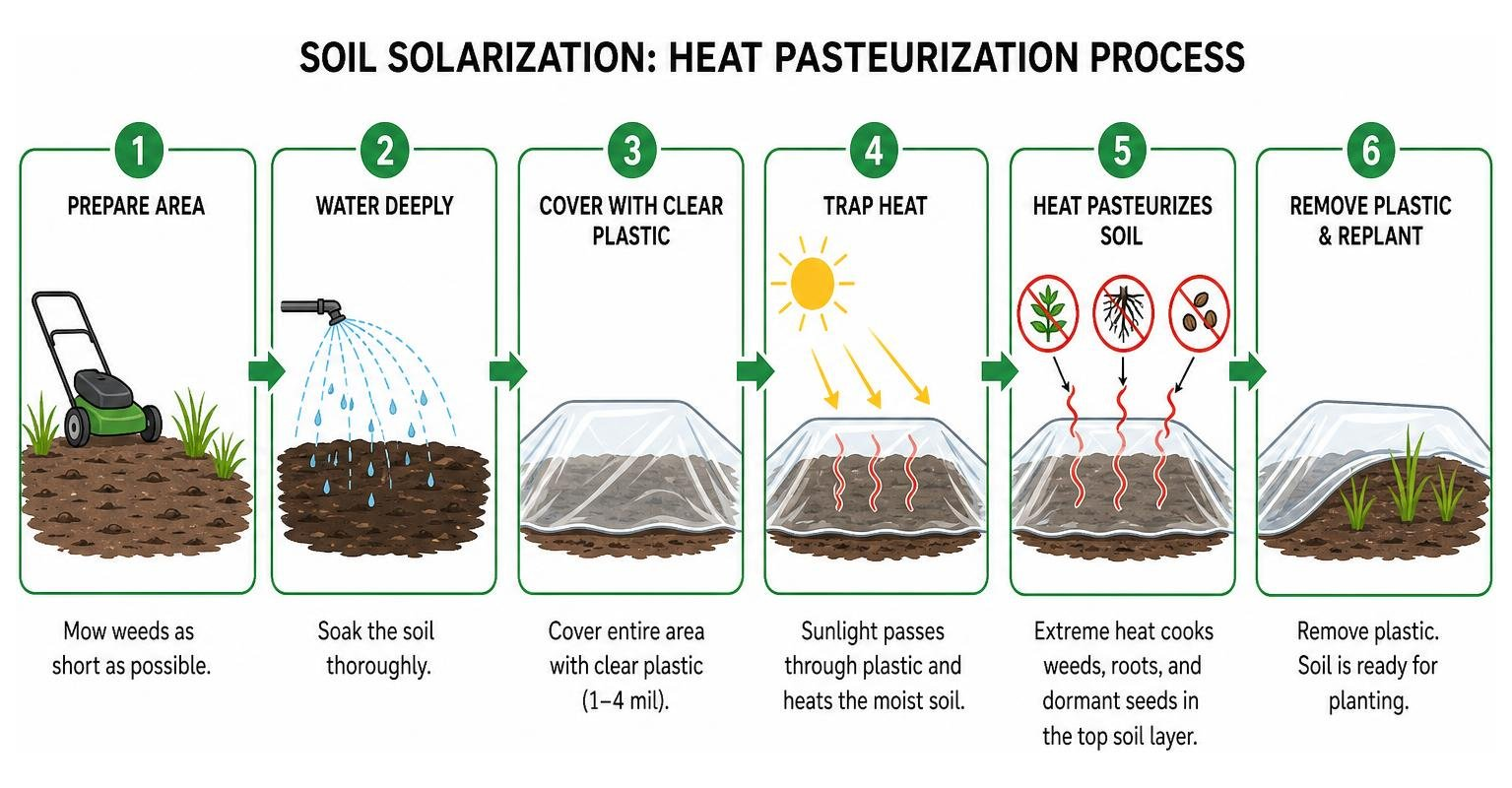
This process cooks mature weeds, destroys delicate root systems, and sterilizes dormant seeds buried in the upper seed bank. Here is how to execute soil solarization correctly:
- Mow the infested area as short as possible to clear surface bulk.
- Souse the ground deeply with water, as moist soil conducts heat far more efficiently than dry dirt.
- Cover the entire zone with a sheet of heavy-duty clear plastic (1 to 4 mil thickness). Clear plastic allows solar radiation to pass through and trap heat, whereas black plastic absorbs heat at the surface without warming the underlying soil as deeply.
- Anchor the plastic edges tightly with soil, bricks, or heavy stones to prevent air leakage.
- Leave the plastic seal intact for 4 to 6 weeks during the hottest summer months (July through August).
Soil temperatures under the plastic can exceed 140 degrees Fahrenheit, effectively clearing the top seed bank. Once you remove the plastic, avoid tilling the ground deeply, as tilling brings buried dormant seeds back up to the surface where they can sprout.
How to Prevent Crabgrass Naturally Using Corn Gluten Meal
While killing visible plants provides immediate satisfaction, stopping seeds from sprouting in the first place is the true key to long-term success. The most reliable organic tool for this job is corn gluten meal, a natural byproduct of the commercial corn milling process.
Corn gluten meal works as an organic pre-emergent herbicide. It contains natural dipeptides that inhibit root formation in newly sprouted plant embryos. When a weed seed germinates in soil treated with corn gluten meal, the emerging shoot cannot build a lateral root system. As a result, the young seedling dehydrates and dies before it can ever break through the soil surface.
To achieve maximum weed control, timing and application rate are critical:
- Application rate: Apply granular corn gluten meal at a rate of 20 pounds per 1,000 square feet of lawn area.
- Timing threshold: Apply the product in early spring before soil temperatures reach 55 degrees Fahrenheit at a 2-inch depth.
- Natural indicator: Watch local landscape plants for timing cues. In Northeast Ohio, forsythia bushes blooming with bright yellow flowers serve as a reliable natural signal that soil temperatures are approaching 55 degrees.
Corn gluten meal also contains roughly 10% nitrogen by weight, providing a slow-release natural fertilizer boost that helps your established grass grow thicker. However, corn gluten meal is strictly a pre-emergent inhibitor. It has zero impact on mature weeds that have already established roots, and applying it late in the season will simply fertilize active weeds. To dive deeper into organic pre-emergents, read our guides on Natural Pre-Emergent Weed Killer and discover the Best Pre-Emergent Weed Killer for Lawns.
Cultural Lawn Care Practices to Stop Crabgrass Before It Starts
Natural sprays and organic pre-emergents are valuable tools, but maintaining a dense, healthy lawn is your ultimate long-term defense against unwanted weeds. Crabgrass seeds require direct sunlight and warm soil to germinate. A thick, vibrant carpet of grass shades the soil surface, keeping ground temperatures cool and blocking the sunlight tiny seeds need to wake up.
Proper mowing habits play a massive role in weed suppression. Adjust your mower deck to cut grass at a height of 3 to 4 inches throughout the growing season. Research shows that keeping turf grass cut to 3 or 4 inches tall shades the soil surface so effectively that it can prevent up to 95% of crabgrass seeds from germinating. Always follow the one-third mowing rule by never removing more than one-third of the total grass blade length during a single mowing session. Cutting grass too short stresses the root system and creates open gaps in the canopy.
Watering practices also dictate whether turf or weeds prevail. Avoid light, daily sprinklings, which keep the upper soil surface damp and encourage shallow-rooted weed seeds to sprout. Instead, practice deep, infrequent watering. Provide your lawn with roughly 1 inch of water per week, applied in early morning sessions once or twice a week. Deep watering forces turf grass roots to push several inches down into the soil in search of moisture, building a strong turf structure that easily outcompetes shallow weeds.
Finally, soil health and density determine how resistant your lawn remains year after year. Heavy foot traffic compresses soil particles, creating hard-packed dirt where turfgrass roots struggle while tough weeds flourish. Performing regular autumn core aeration relieves compaction by removing small plugs of soil, allowing oxygen, water, and nutrients to reach deep roots. Following aeration with autumn overseeding fills in bare patches with premium cool-season grass varieties. Learn more about seasonal care strategies in our Crabgrass Control Guide 2026 and consult our Crabgrass Preventer Safe Seeding Guide.
Manual Pulling vs. Natural Sprays: Weighing the Pros and Cons
Choosing between hand-pulling weeds and using natural contact sprays involves weighing labor, speed, and safety for your surrounding lawn. Both approaches offer clear advantages depending on the specific problem area.
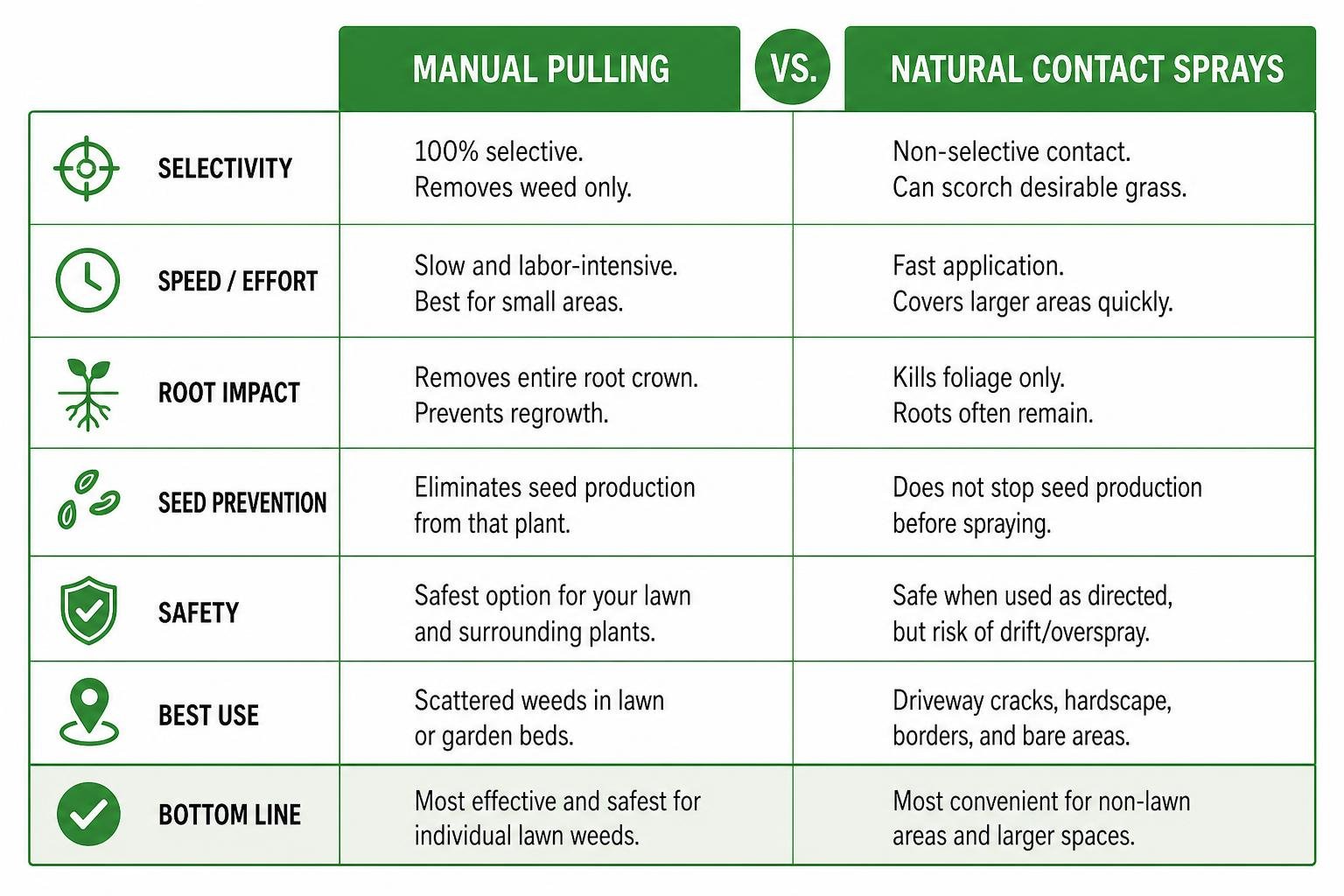
Manual extraction provides total selectivity. When you pull a weed by hand, you remove the entire root crown without harming a single blade of adjacent grass. It delivers instant visual results and completely eliminates seed production from that plant. However, manual pulling requires physical effort, bending, and time, making it impractical for large lawn areas that are heavily infested.
In contrast, natural contact sprays like 20% horticultural vinegar or baking soda mixes offer fast application over larger non-lawn areas. You can cover driveway cracks or garden bed borders in a fraction of the time it takes to pull individual weeds. The major drawback is that these sprays are non-selective contact burndowns. If overspray drifts onto desirable turf grass, it will scorch and kill those grass blades just as easily. Additionally, sprays often leave deep root systems intact on mature plants, requiring follow-up spot applications.
For scattered lawn weeds, manual removal remains the safest, most effective natural method. For hardscape cracks, driveway edges, or clear garden beds, natural sprays offer superior convenience.
Frequently Asked Questions About Natural Crabgrass Control
What is the best timing to apply natural crabgrass treatments?
The optimal timing depends entirely on whether you are applying a pre-emergent preventer or a post-emergent spot treatment. Natural pre-emergents like corn gluten meal must be applied in early spring before seeds sprout, right when soil temperatures consistently reach 55 degrees Fahrenheit for 3 consecutive days. In Northeast Ohio, this window typically opens between mid-April and early May, right as local forsythia bushes display full yellow blooms.
For contact post-emergent treatments like horticultural vinegar, the best timing is on warm, dry, sunny days during late spring or early summer when weeds are small and actively growing. Warm temperatures and bright sunlight maximize foliar desiccation.
Does corn gluten meal kill existing mature crabgrass?
No, corn gluten meal does not kill existing or mature weeds. It functions exclusively as a pre-emergent herbicide by stopping new root formation as dormant seeds begin to sprout. If you apply corn gluten meal to a lawn where crabgrass has already established roots and formed visible green tillers, the product will fail to kill the weed. In fact, because corn gluten meal contains roughly 10% nitrogen fertilizer by weight, applying it late will nourish mature weeds and help them grow larger. Always remove active weeds physically or with spot sprays before applying pre-emergent controls.
Will natural sprays like vinegar or boiling water kill my regular grass?
Yes, natural contact sprays such as concentrated horticultural vinegar, boiling water, and strong baking soda mixtures are non-selective. They do not distinguish between unwanted weeds and desirable turfgrasses like Kentucky bluegrass, fine fescue, or perennial ryegrass. Any green plant tissue that comes into direct contact with these treatments will experience cellular damage and tissue death. When treating weeds inside your lawn canopy, protect surrounding turf by placing a protective cardboard shield around the weed or use targeted physical extraction instead.
Conclusion
Conquering invasive weeds without synthetic chemicals requires a thoughtful combination of early detection, well-timed treatments, and proper turf care practices. Whether you choose physical hand-pulling, contact desiccation with horticultural vinegar, thermal scalding, or spring corn gluten meal applications, consistency is the key to depleting the buried seed bank over time. Pairing these targeted actions with high mowing heights, deep watering, core aeration, and fall overseeding builds a lush green canopy that keeps weeds out naturally.
At Advanced Quality Lawn, we take pride in helping homeowners across Akron, Hudson, Stow, Medina, Solon, and surrounding Northeast Ohio communities achieve healthy, vibrant lawns. If you want expert guidance or comprehensive maintenance tailored to your yard's unique needs, explore our Professional Lawn Care Maintenance Services today and let our experienced team help you build a thick, weed-resistant lawn you can enjoy all season long.