Understanding the Best Fertilizer for New Bermuda Sod

The best fertilizer for new Bermuda sod is a high-phosphorus starter formula, such as a 10-20-10 or 18-24-6 N-P-K ratio, applied as a slow-release product to support root development without burning tender new grass.
Quick answer: Top choices for new Bermuda sod fertilizer
| Priority | Fertilizer Type | N-P-K Example | Best For |
|---|---|---|---|
| 1st | High-phosphorus starter | 10-20-10 or 18-24-6 | Root establishment (first 2-4 weeks) |
| 2nd | Balanced slow-release | 10-10-10 or 16-4-8 | Early growth after rooting |
| 3rd | High-nitrogen maintenance | 20-0-10 or 12-4-8 | After 4+ mowings, ongoing health |
Getting your new Bermuda sod off to the right start is more important than most homeowners realize. The first few weeks after installation are critical. Roots are fragile, nutrients are limited, and the wrong fertilizer at the wrong time can set your lawn back weeks or even cause patchy, weak growth.
Ohio's clay-heavy soils and unpredictable spring weather add another layer of difficulty. What works in Georgia or Texas does not always translate to a suburban yard in Akron or Canton.
The good news is that with the right fertilizer, the right timing, and a simple schedule, new Bermuda sod can root quickly and grow into a thick, healthy lawn.
I'm Andrew Day, owner of Advanced Quality Lawn, and with over 30 years of lawn care experience serving Northeast Ohio homeowners, I've helped countless clients choose the best fertilizer for new Bermuda sod and avoid the costly mistakes that come from guessing. In this guide, I'll walk you through exactly what to use, when to apply it, and how to get the results you're after.
When we talk about the best fertilizer for new Bermuda sod, we are really talking about fuel for a very specific engine. Bermuda grass is a warm-season turf that thrives on sun and heat, but when it arrives at your home in rolls or pallets, it has just been severed from its life-support system. It needs to knit its roots into your soil as fast as possible to survive.

To understand what to buy, we have to look at the three numbers on the bag, known as the N-P-K ratio. These stand for Nitrogen (N), Phosphorus (P), and Potassium (K).
- Nitrogen is for top growth and green color.
- Phosphorus is for root development.
- Potassium is for overall plant health and stress resistance.
For new sod, the middle number is your best friend. Phosphorus is what tells the grass to stop focusing on growing tall and start focusing on growing deep. You can learn more about these basics in our guide Fertilizer 101: What is it and when should you use it.
Beyond just the minerals, the best fertilizer for new Bermuda sod also encourages soil microbial activity. In Northeast Ohio, our soil can sometimes be compacted or "tired." A high-quality fertilizer helps wake up the beneficial fungi and bacteria in the dirt, making nutrients more available to those tiny, new white roots.
Choosing the Best Fertilizer for New Bermuda Sod Ratios
If you walk into a big-box store in Medina or Hudson, you will see dozens of bags. For new Bermuda sod, look for a starter formula. Common effective ratios include 10-20-10 or 18-24-6. Notice how that middle number is high? That is intentional.
According to U.S. Department of Agriculture research on starter fertilizers, phosphorus is most effective when it is placed close to the soil surface where the new roots can reach it immediately. A balanced nutrient approach ensures the grass has enough nitrogen to stay green without forcing it to grow so fast that the roots cannot keep up. This balance is what provides true root vigor.
Applying the Best Fertilizer for New Bermuda Sod Safely
The biggest fear most homeowners have is "burning" their expensive new lawn. Fertilizer burn happens when too many salts build up, sucking the moisture out of the grass blades. To avoid this, we always recommend using a slow-release product.
When learning how to fertilize your lawn, the first step is spreader calibration. If your spreader is open too wide, you will dump too much in one spot. We suggest setting your spreader to a lower setting and making two passes in a crisscross pattern. This ensures even coverage. Most importantly, you must water the lawn immediately after applying granular fertilizer to wash the nutrients off the blades and down into the soil where they belong.
Timing the First Application for Root Establishment
Timing is everything. If you fertilize too early with a high-nitrogen product, you might stress the plant. If you wait too long, the sod might turn yellow and struggle to take hold.
There are two main schools of thought on timing. Some professionals prefer a liquid application on Day 1 to give the grass an immediate "sip" of nutrients. However, for most homeowners in our service areas like Cuyahoga Falls or Stow, a waiting period of 2 to 4 weeks is often safer. This allows the sod to recover from the shock of being moved before you ask it to start processing heavy nutrients.
To know if your lawn is ready, perform a "pull test." Gently grab a handful of grass and tug upward. If it lifts easily like a rug, the roots are not set yet. If you feel resistance, those roots are doing their job, and it is a great time to check when to use fertilizer.
One local tip for Northeast Ohio: keep dormancy in mind. Bermuda grass goes dormant and turns brown when temperatures drop. If you are laying sod late in the season, do not force-feed it nitrogen, as this can make it vulnerable to winter kill.
Liquid vs Granular Starter Options
Which is better? It depends on your goals.
Liquid Fertilizers offer immediate uptake. Because the nutrients are already dissolved, the grass can absorb them through the leaves and roots almost instantly. A 16-4-8 liquid fertilizer is a popular choice for providing a quick boost.
Granular Fertilizers are the "slow and steady" option. They break down over several weeks, providing a consistent stream of food. This is often better for root zone accessibility over the long haul.
| Feature | Liquid Fertilizer | Granular Fertilizer |
|---|---|---|
| Speed | Very Fast | Slow to Moderate |
| Application | Sprayer (Easy to miss spots) | Spreader (More uniform) |
| Burn Risk | Low (if diluted) | Moderate (if over-applied) |
| Longevity | 1-2 weeks | 4-8 weeks |
Step-by-Step Application Guide for New Sod
Before you spread a single grain, we highly recommend a soil test. Bermuda grass prefers a pH between 6.0 and 7.0. If your soil is too acidic (common in some parts of Summit County), the grass cannot "unlock" the nutrients you are giving it, no matter how much you spend on the best fertilizer for new Bermuda sod.
- Test the Soil: Check your pH and nutrient levels first.
- Prep the Area: Ensure the sod is well-watered but the blades are dry so granules do not stick to the leaves.
- Set the Spreader: Follow the bag instructions for a "new lawn" or "starter" rate.
- Apply Evenly: Walk at a steady pace. Do not stop or turn while the spreader is open.
- Target Rate: Aim for about 1.5 pounds of actual nitrogen per 1,000 square feet for the initial establishment phase, but check your specific product label as concentrations vary.
- Water It In: Apply at least half an inch of water immediately after spreading.
For more detailed help on the mechanics, see our archive on how to fertilize your lawn.
Avoiding Common Fertilization Mistakes
We see the same mistakes year after year in places like Solon and Brecksville. The most common is over-fertilizing. More is not better; more is usually a dead lawn.
Another huge mistake is using "weed and feed" products. Most weed killers are designed to stop seeds from germinating or to stress broadleaf plants. On brand new sod, these chemicals can stunt root growth or kill the grass entirely. You should wait until you have mowed the lawn at least 3 or 4 times before even thinking about weed control.
There is also the debate of Is organic fertilizer better than synthetic fertilizer. Organic options like compost or biosolids are great for long-term soil health and have a very low burn risk, but they work slowly. Synthetic starters are often better for that initial 30-day "emergency" root growth period.
Integrating Fertilization with Mowing and Watering
Fertilizing is just one piece of the puzzle. It has to work in harmony with how you cut and water the grass.
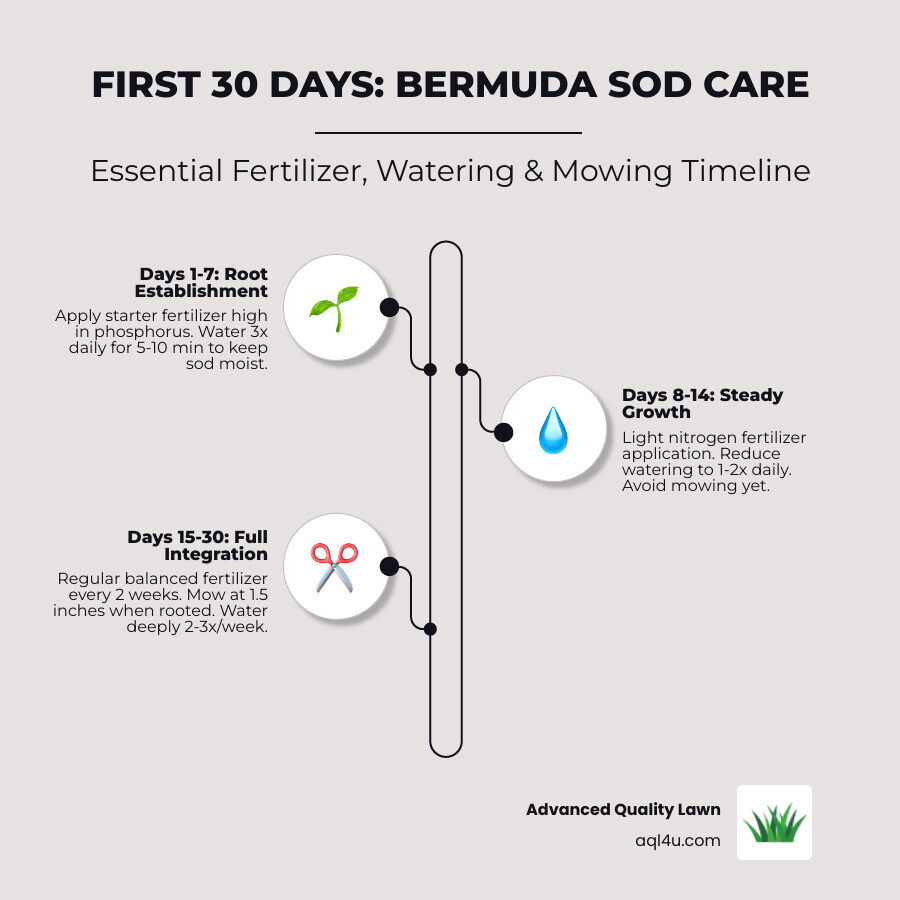
Most new Bermuda sod in Northeast Ohio will be ready for its first haircut within 13 to 15 days, provided the roots have taken hold. You want to set your mower to a higher setting for the first few cuts, usually around 1.5 inches, then gradually move down to the ideal 0.5 to 1.5 inch height that Bermuda loves.
According to The University of Georgia Turfgrass Program maintenance research, keeping a consistent schedule is vital. If you let the grass grow too tall and then scalp it, you stress the roots that you just worked so hard to establish.
Watering is equally critical. For the first 9 days, you should water twice daily to keep the soil moist 3 to 4 inches deep. By day 16, you can transition to a more standard schedule. We recommend an "irrigation audit"—simply put some tuna cans out while you water to see how long it takes to get 1 inch of water. Once established, Bermuda needs about 1 inch of water per week.
Long-Term Maintenance and Nitrogen Needs
Once your sod is established (usually after the first 30 to 45 days), its appetite changes. Bermuda is a "hungry" grass. It typically needs 4 to 5 pounds of nitrogen per 1,000 square feet annually to stay thick and green.
We recommend applying fertilizer every 6 to 8 weeks during the growing season (late spring through early fall). As we move into autumn in Ohio, your choice of the Best fertilizer for lawn should shift toward higher potassium. This "winterizer" approach helps the grass store energy in its roots to survive our cold winters in Cleveland and Akron.
Frequently Asked Questions about Bermuda Sod
What is the best N-P-K ratio for new Bermuda sod?
The best fertilizer for new Bermuda sod is a starter formula with a high middle number, such as 10-20-10, 18-24-6, or even a balanced 10-10-10. This ensures the plant has plenty of phosphorus for root development.
How soon after laying sod can I fertilize?
While some pros apply a liquid starter on day one, most homeowners should wait 2 to 4 weeks until the roots have begun to knit into the soil. Always perform a pull test to ensure the sod is stable before the first granular application.
Should I use slow-release or quick-release fertilizer?
For new sod, slow-release is almost always better. It provides a steady stream of nutrients and significantly reduces the risk of fertilizer burn, which can be devastating to new, expensive sod.
Conclusion
Establishing a beautiful Bermuda lawn in Northeast Ohio is a rewarding project, but it requires patience and the right tools. By choosing a high-phosphorus starter, timing your application to match root growth, and staying consistent with watering, you will have the best-looking yard on the block.
At Advanced Quality Lawn, we take the guesswork out of the process. We provide professional lawn care services across Summit, Stark, and Portage counties, offering everything from soil testing to full-season fertilization programs. Our team is dedicated to excellent customer service, and we stand behind our work with service call guarantees.
If you want to ensure your new sod gets the professional treatment it deserves, or if you have questions about your specific soil conditions in places like North Royalton or Twinsburg, we are here to help.
Ready for a lush, green lawn without the stress? Contact us today for a free quote on our professional lawn care services.