Don't Get Burned by Using the Best Way to Kill Fire Ants
The Two-Step Method: The Best Way to Kill Fire Ants in Yard

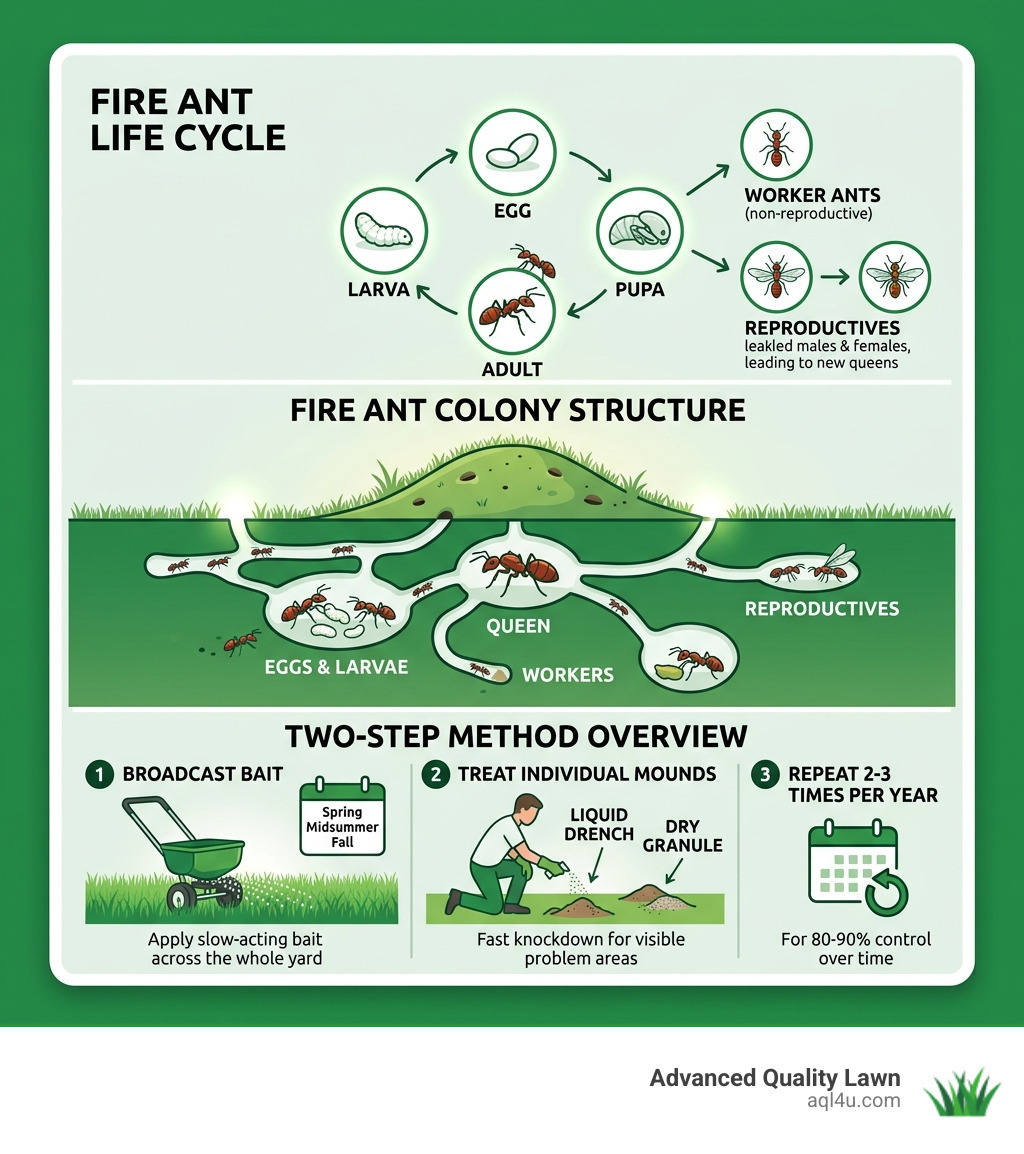
The best way to kill fire ants in yard is the Two-Step Method: broadcast a slow-acting bait across your entire lawn, then treat individual mounds directly. Here is a quick overview:
- Broadcast bait across the whole yard (1 to 2.5 lbs per acre) in spring, midsummer, or fall when ants are actively foraging
- Treat individual problem mounds with a liquid drench, dry granule, or dust product for faster knockdown
- Repeat 2 to 3 times per year to maintain 80 to 90 percent control
This combination targets every colony in your yard, including small ones you cannot yet see.
Fire ants are not just a nuisance. A single mature colony can house more than 100,000 ants, and a queen can lay up to 800 eggs per day. Left unchecked, populations can reach 40 million ants per acre. Their painful stings are a real danger, especially for children, pets, and anyone with sting allergies.
If you have ever unknowingly stepped into a mound mid-lawn-mow, you already know how fast that situation goes wrong.
The good news? Fire ants are actually easier to control than most homeowners think, as long as you use the right approach.
I'm Andrew Day, owner of Advanced Quality Lawn, and with more than 30 years of lawn care experience in Northeast Ohio, I have helped countless homeowners find the best way to kill fire ants in yard and keep them from coming back. In the sections below, I will walk you through every step you need to take to reclaim your yard safely and effectively.
When we talk about the best way to kill fire ants in yard, we are really talking about a strategy that works with the biology of the ant rather than against it. Many people make the mistake of only attacking the mounds they can see. This is like trying to fix a leaky roof by only mopping the floor. You might clean up the mess for a moment, but the source of the problem is still there.
The Two-Step Method is the gold standard for fire ant management. It was developed by university researchers to provide a comprehensive solution that reduces fire ant populations by 80 to 90 percent. This method is particularly effective for properties with five or more mounds per quarter-acre. If you only have one or two mounds, you might get away with just treating those spots, but in most cases, a full-yard approach is necessary.
Fire ants are highly social insects that live in complex colonies. If you attack a mound with a contact killer, the survivors often relocate the queen to a safer spot a few feet away. This is why you often see two new mounds pop up after you thought you killed one. By using the Two-Step Method, you ensure that even the hidden colonies are neutralized before they become a problem. You can learn more about how these pests can impact your turf in our guide on Ants Destroying Lawn.
Why the Two-Step Method is the Best Way to Kill Fire Ants in Yard
The secret to this method lies in how it handles the queen. In a fire ant colony, the queen is the only one who can lay eggs. If she stays alive, the colony stays alive. Most worker ants only live about five weeks, but a queen can live for several years.
The Two-Step Method uses baits that worker ants actually want to eat. They take this bait back to the nest and feed it to the larvae. The larvae then liquefy the food and share it with the queen through a process called trophallaxis. Because the insecticide in the bait is slow-acting, the workers don't die immediately. They have plenty of time to distribute the "gift" to the queen. Once the queen is eliminated or becomes infertile, the colony is effectively dead.
This is a much more cost-effective strategy than buying dozens of cans of contact spray. It provides long-term prevention by suppressing colonies before they ever build those unsightly mounds in your beautiful Northeast Ohio lawn.
Testing Foraging Activity for the Best Way to Kill Fire Ants in Yard
Before you go out and spread bait, you need to make sure the ants are actually hungry. Fire ants don't forage all day every day. If the ground is too cold or too hot, they stay deep underground to regulate their temperature.
We recommend the "potato chip test." It is simple, cheap, and very effective. Take a greasy potato chip and place it on the ground near a mound (but do not disturb the mound itself). Wait about 30 minutes. If you come back and find the chip covered in ants, they are actively foraging. This means it is the perfect time to apply your bait.
Generally, ants are most active when soil temperatures are between 70 and 90 degrees Fahrenheit. In April 2026, as we see those spring temperatures rise in places like Hudson or Medina, this is the perfect time to start your first round of testing. If the ants ignore the chip, save your bait for another day. Applying bait when ants aren't looking for food is just a waste of money because the soybean oil in the bait will eventually go rancid and the ants won't touch it.
Step 1: Broadcasting Baits for Long-Term Prevention
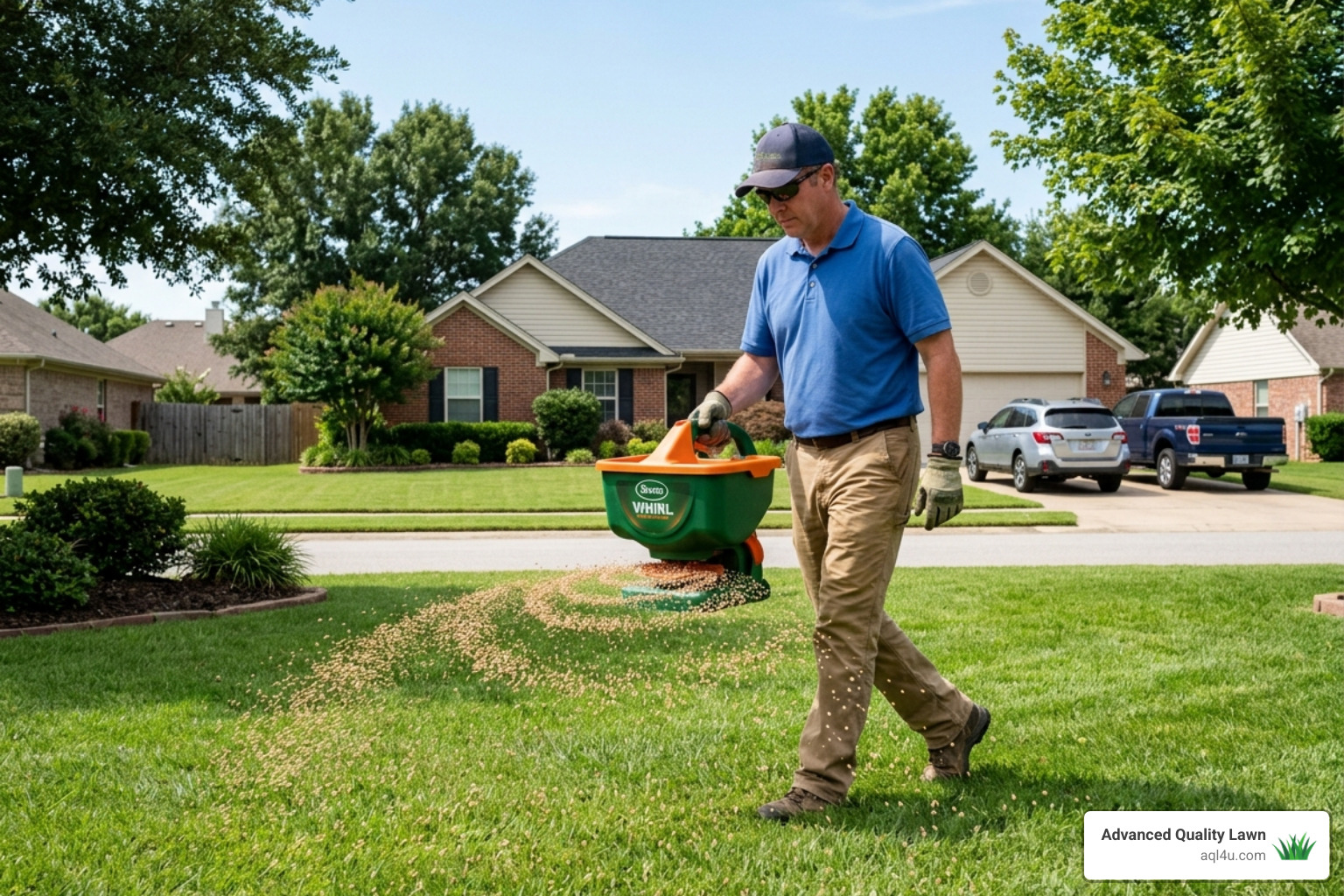
The first step is the most important for long-term success. Broadcasting bait means spreading it over your entire yard, not just on the mounds. Most fire ant baits consist of corn grits coated in soybean oil that contains a slow-acting insecticide. To a fire ant, this is a five-star meal.
When you broadcast, you are reaching the foraging tunnels that can extend 25 feet or more from a mound. This ensures that every colony in the area has access to the bait. According to Fire Ant Control in Home Lawns, broadcasting baits 2 to 3 times per year can reduce the number of mounds by 80 to 90 percent.
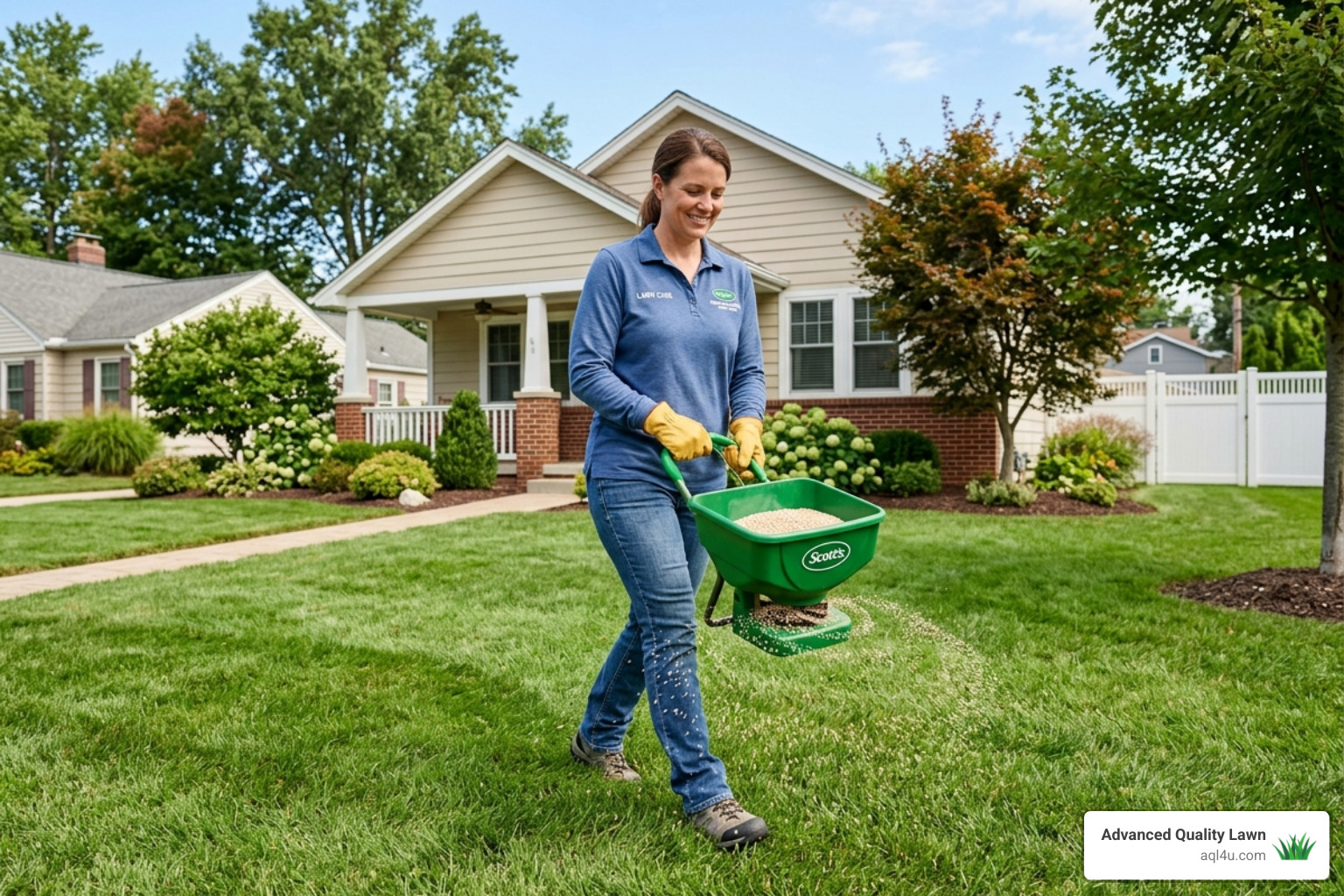
For a typical lawn in Northeast Ohio, you only need about 1 to 1.5 pounds of bait per acre. A hand-held spreader is usually better for this than a large push spreader because the application rate is so low. If you use a standard fertilizer spreader, you might accidentally put out too much.
Here are a few pro tips for Step 1:
- Use fresh bait: Always buy a new bag at the start of the season. If the bait smells like old vegetable oil, the ants won't eat it.
- Watch the weather: Do not apply bait if rain is in the forecast within the next 24 to 48 hours. Water will wash away the oils and ruin the bait.
- Don't mix: Never mix your fire ant bait with fertilizer or grass seed.
Step 2: Individual Mound Treatments for Rapid Elimination
While Step 1 is doing the heavy lifting behind the scenes, you might still have a few large mounds that you want gone right now. This is where Step 2 comes in. About a week after you have broadcast your bait, you can go back and treat those stubborn individual mounds.
There are several ways to do this, including liquid drenches, dry granules, and dusts. Each has its own set of pros and cons. Liquid drenches are often the fastest, but they require the most work. You typically need to mix 1 to 2 gallons of insecticide in a bucket and pour it over the mound.
| Treatment Type | Speed of Results | Effort Level | Best For |
|---|---|---|---|
| Liquid Drench | Very Fast (Hours) | High | Mounds near patios or high-traffic areas |
| Dry Granules | Moderate (Days) | Low | General mound control |
| Dusts | Fast (1-2 Days) | Low | Quick spot treatments |
When treating a mound, the most important rule is do not disturb the mound before or during treatment. If you poke it with a stick or kick it, the ants will immediately go into "save the queen" mode. They will grab the queen and move her deep into the ground or through an underground tunnel to a new location. For a deeper dive into these options, check out our Ultimate Guide Kill Ants Yard.
If you are using a liquid drench, start by applying about a quarter of the volume in a circle roughly 12 inches around the outside of the mound. Then, pour the rest directly onto the mound. This "rings the bell" and prevents the queen from escaping through those side tunnels.
Seasonal Timing and Safety for Pets and Children
Timing is everything when it comes to the best way to kill fire ants in yard. In Northeast Ohio, we recommend a three-treatment schedule:
- Spring (around Easter): This catches the colonies as they wake up and start growing.
- Midsummer (around July 4th): This keeps the population from exploding during the heat of the year.
- Fall (around Labor Day): This is perhaps the most important treatment. It weakens the colonies before winter, meaning you will have fewer mounds to deal with next spring.
Safety is always our top priority at Advanced Quality Lawn. If you have children or pets, you are likely worried about the chemicals in your yard. The good news is that fire ant baits are used at very low concentrations. Once the bait is spread and the ants have carried it underground, the risk is minimal.
Always read the product label for specific re-entry times. For most granular products, it is safe for pets and children to return to the yard once the product has been watered in or has had time to settle. If you are treating near a vegetable garden, look for products specifically labeled for use around edible plants, such as those containing spinosad.
Frequently Asked Questions about Fire Ant Control
Can boiling water effectively kill fire ant mounds?
We get asked this a lot! While it sounds like a great "natural" solution, it is only about 60 percent effective. You need about 2 to 3 gallons of boiling water per mound to have a chance at reaching the queen. The biggest downside is that boiling water will absolutely kill your grass. You will end up with a dead spot in your lawn that is 2 feet wide. Plus, if you don't kill the queen, she will just move a few feet over, and you will have a new mound next to your new brown spot.
When is the best time of day to apply fire ant bait?
The best time is usually late afternoon or early evening. This is when temperatures are starting to cool down, and the ants are most active. Avoid applying bait in the middle of a scorching hot day when the sun is beating down on the lawn. Also, make sure the grass is dry. Morning dew can ruin the bait just as easily as a rainstorm.
Are there effective organic ways to kill fire ants?
Yes! Spinosad is a naturally occurring soil bacterium that is very effective against fire ants. It is the active ingredient in many organic fire ant baits. It works a bit faster than some chemical baits but usually requires more frequent applications. Some people also use botanical oils like d-limonene (orange oil), though these are typically contact killers and don't provide the same colony-wide results as a bait.
Conclusion
Managing fire ants doesn't have to be an endless battle. By using the Two-Step Method, you are using science to your advantage. Remember to broadcast your bait across the whole yard to target those hidden colonies, and then use mound treatments for the visible ones.
At Advanced Quality Lawn, we understand that your yard is an extension of your home. Whether you are in Akron, Cuyahoga Falls, or anywhere across Northeast Ohio, we are here to help you maintain a beautiful, pest-free lawn. If the fire ants are becoming more than you want to handle on your own, our professional team has the tools and expertise to take care of the problem for you.
We provide excellent customer service with full-program guarantees to ensure your outdoor space remains safe for your family and pets. For more tips on keeping your yard in peak condition, visit our page on Advanced Quality Lawn Maintenance. Don't let fire ants keep you from enjoying your yard this summer!