
The Best Spot Treatment for Crabgrass Starts With Your Lawn Type
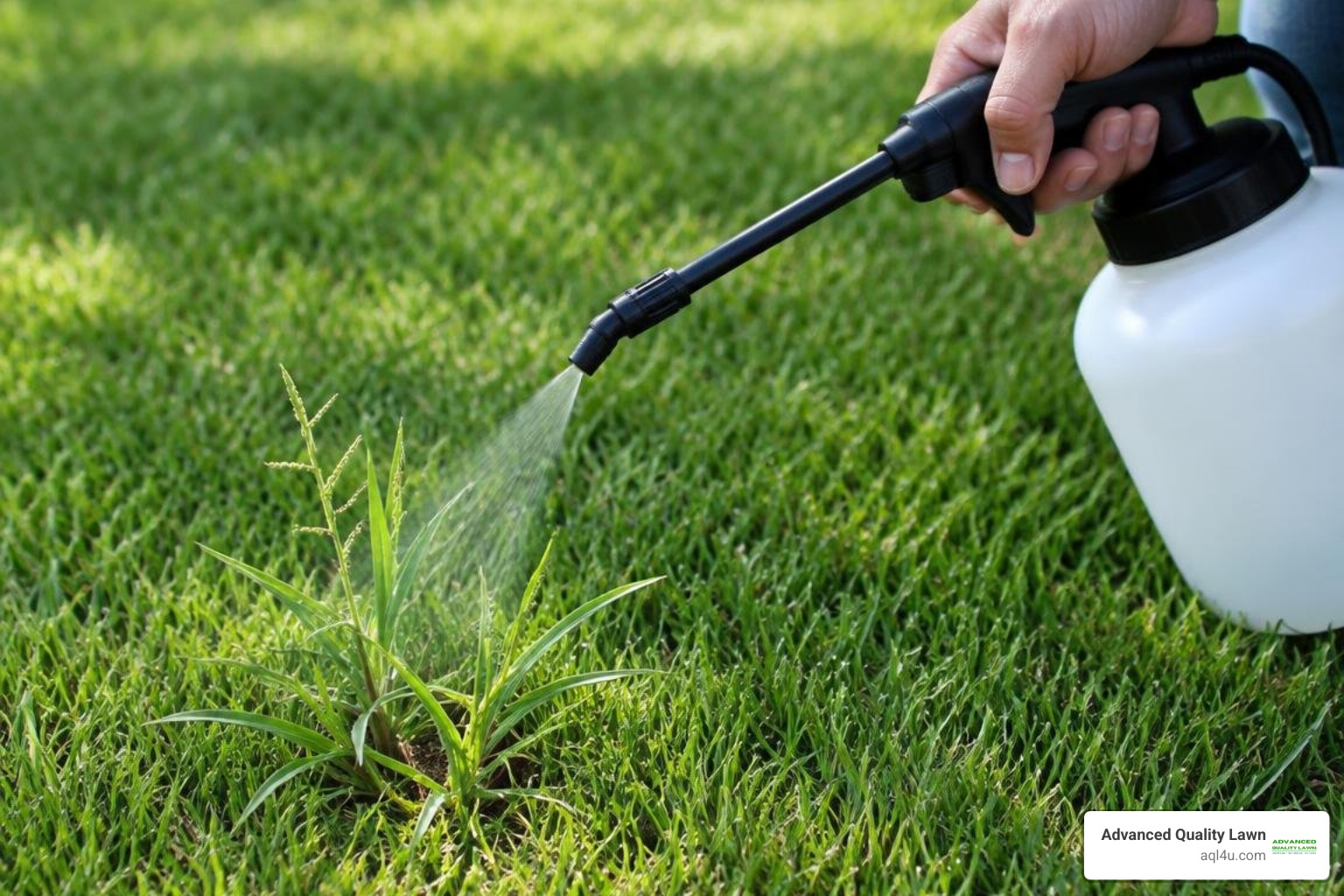
For an established Ohio lawn, start with a selective post-emergent spray containing quinclorac. Check the product label to confirm it is safe for your grass type. Spray only the crabgrass on a calm day when the weed is actively growing and the lawn is not stressed by heat or drought. Young plants are easiest to control, but larger clumps may need another treatment.
A pre-emergent prevents new crabgrass seeds from sprouting. It will not remove the plants already in your lawn. Once a treated patch dies, fill the bare space with healthy turf so crabgrass has less room to return.
I'm Andrew Day, owner of Advanced Quality Lawn in Northeast Ohio. My team draws on more than 30 years of lawn care experience to choose the best spot treatment for crabgrass and help homeowners keep it from coming back.
Spot Treatment vs. Blanket Application: When to Target Crabgrass
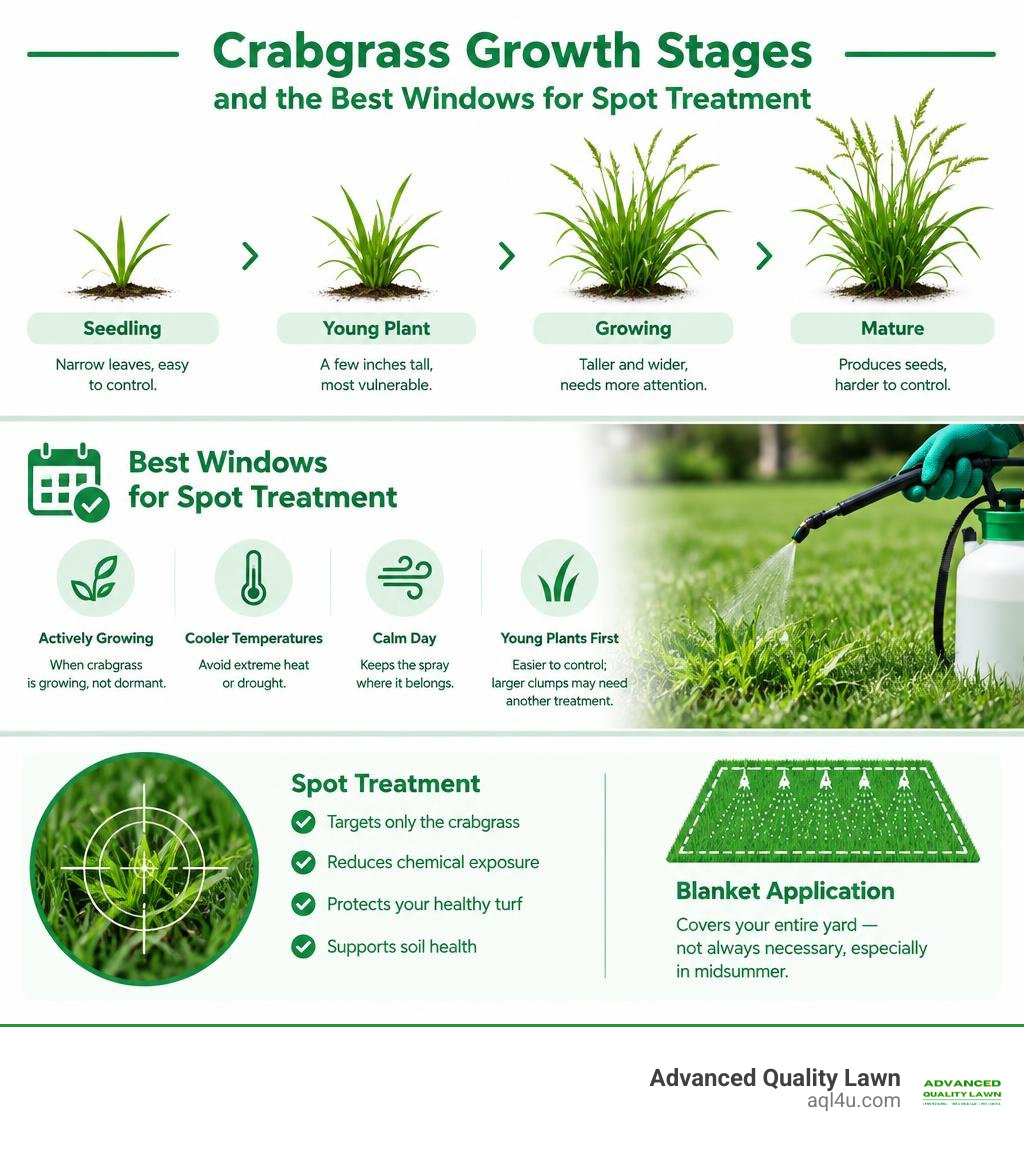
Blanket applications cover your entire yard with liquid herbicide or granular products. While blanket treatments make sense for early spring pre-emergents, coating an entire yard in midsummer with post-emergent chemicals is rarely necessary. Spot spraying allows you to target individual weeds without stressing desirable turfgrass across your entire property.
By switching to localized applications, you reduce chemical exposure and protect your soil biology. Utilizing targeted lawn sprays that protect grass lets you eliminate stubborn weeds while leaving your turf undisturbed. According to Penn State Extension research on postemergence crabgrass control, selective post-emergence herbicides are most effective when applied to actively growing weeds rather than broadcast over heat-stressed turf.
Pre-Emergent Barriers vs. Post-Emergent Spot Sprays
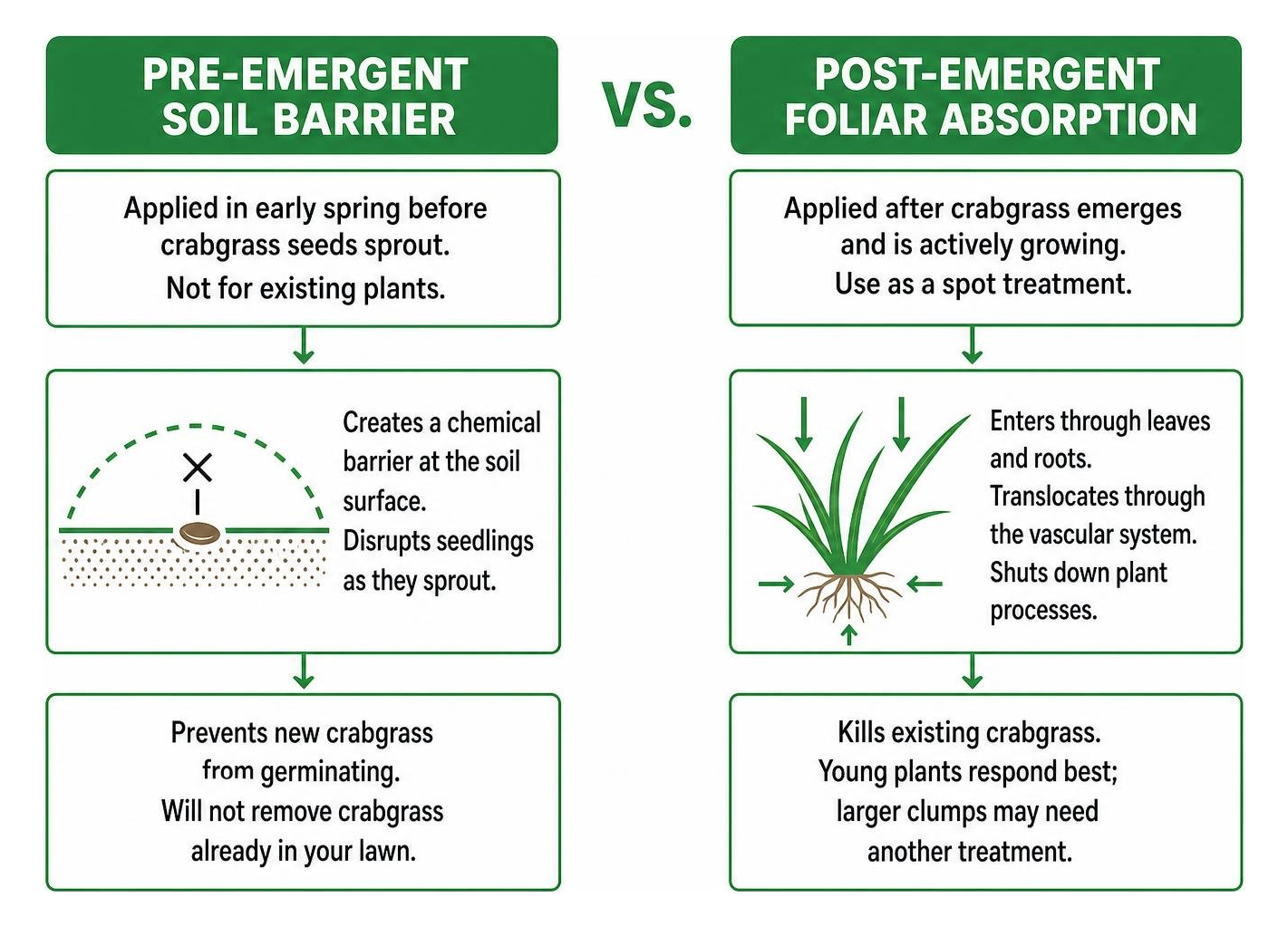
Pre-emergent herbicides work by forming a chemical barrier at the soil surface that disrupts seedlings as they sprout. They must be applied in early spring before soil temperatures reach 55 degrees for several consecutive days. If a crabgrass plant has already broken through the soil surface and developed leaves, a pre-emergent barrier will do nothing to stop it.
Post-emergent herbicides enter through foliar absorption and root uptake, translocating through the vascular system to shut down plant processes. Spot treatments are post-emergent rescue tools designed specifically to eradicate visible crabgrass escapes that bypassed your spring barrier.
Identifying Crabgrass Growth Stages for Maximum Efficacy
The timing of your spot spray directly impacts weed mortality. Crabgrass develops through distinct vegetative stages:
- Seedling Phase: The plant displays 1 to 3 leaves. It absorbs chemicals quickly, requiring minimal herbicide volume.
- Untillered Stage: The main stem is established, but side shoots have not branched out. Control rates remain near 100 percent.
- 4-Tiller Threshold: Side shoots branch out from the central crown. Once crabgrass exceeds 4 tillers, control becomes significantly harder and often requires a follow-up application.
- Mature Seedheads: The plant produces finger-like seed spikes that drop thousands of viable seeds into your soil.
Choosing the Best Spot Treatment for Crabgrass by Active Ingredient
Selecting the right active ingredient ensures you knock out the weed without discoloring or killing your lawn species. Cool-season grasses common in Northeast Ohio, such as Kentucky bluegrass, perennial ryegrass, and tall fescue, respond differently to specific chemical classes.
| Active Ingredient | Primary Target Growth Stage | Compatible Turf Types | Key Benefit | Typical Speed of Action |
|---|---|---|---|---|
| Quinclorac | Seedling to mature gorilla size | Tall fescue, Kentucky bluegrass, ryegrass | Works on young and multi-tiller plants | Visible curl in 3 to 7 days |
| Fenoxaprop-p-ethyl | 1 to 5 tillers | Tall fescue, fine fescue, perennial ryegrass | High performance on tillered grassy weeds | Reddening in 7 to 10 days |
| Mesotrione | Under 4 tillers | Kentucky bluegrass, tall fescue, buffalograss | Safe during seeding and overseeding | Turns white in 7 to 14 days |
| Pinoxaden | Multi-tiller escapes | Bermudagrass, zoysiagrass | Summer safety on warm-season lawns | Dieback in 10 to 21 days |
Quinclorac: The Best Spot Treatment for Crabgrass at Any Stage
Quinclorac is widely regarded as the gold standard for selective crabgrass control. It acts by disrupting cellulose biosynthesis in susceptible grasses and mimicking synthetic auxins. This dual action gives products like Drive XLR8 Herbicide exceptional flexibility. Research shows quinclorac controls crabgrass across virtually all growth stages, from young seedlings to mature plants.
Formulations like Drive XLR8 herbicide become rainfast in less than one hour and provide up to 30 days of residual suppression. When applied at 1.45 fluid ounces per 1,000 square feet, Q-Ball Turf Herbicide provides more than 90 percent control of crabgrass escapes within 7 days after treatment. For yards with a mixture of broadleaf weeds and summer annual grasses, multispecies broadleaf and crabgrass herbicides containing quinclorac tackle multiple weed varieties in one pass.
Fenoxaprop-p-Ethyl and Mesotrione: Options for Specific Turf and Seeding
Fenoxaprop-p-ethyl, sold under trade names like Acclaim Extra, is an ACCase inhibitor that targets grassy weeds by stopping fatty acid synthesis. It excels on larger crabgrass, with rates ranging from 0.30 fluid ounces per 1,000 square feet for young plants up to 0.90 fluid ounces for plants with 4 to 5 tillers. However, applicators must use caution on Kentucky bluegrass during high heat, as temporary stunting can occur.
Mesotrione, the active ingredient in Tenacity, inhibits the 4-HPPD enzyme, disrupting carotenoid synthesis and causing susceptible plants to lose chlorophyll and turn stark white. Its primary strength lies in renovation projects. Unlike most post-emergents that require waiting weeks to seed, mesotrione can be used during lawn seeding according to crabgrass preventer safe seeding methods to stop weeds while allowing desirable grass seeds to establish.
Warm-Season Specialists: Pinoxaden and Selective Post-Emergents
While cool-season lawns dominate Ohio, warm-season varieties like bermudagrass and zoysiagrass require specialized chemical care. Pinoxaden formulations, such as Manuscript, provide targeted control on warm-season turf when crabgrass escapes get out of hand. Pinoxaden includes built-in safeners that protect warm-season blades even during elevated summer temperatures. For detailed southern turf management, Syngenta targeted weed control guidelines recommend applying specific rates paired with methylated seed oils to overcome the dense waxy cuticles that develop in midsummer heat.
Step-by-Step Guide: How to Mix and Apply Spot Treatments Safely
Applying liquid post-emergent weed control requires precision to ensure maximum absorption without drifting onto prize garden plants or over-saturating your turf.
How to Apply the Best Spot Treatment for Crabgrass with a Tank Sprayer
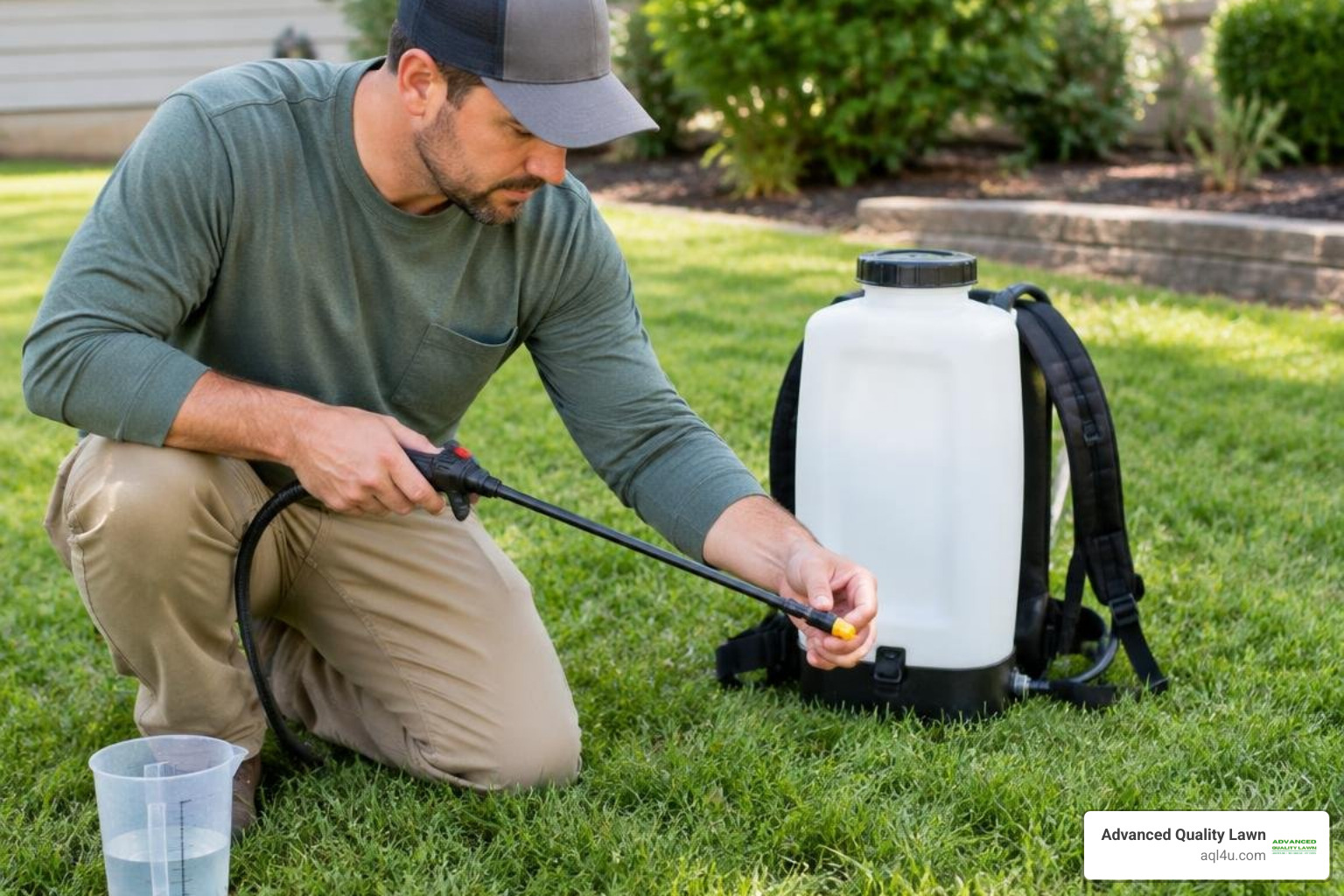
- Select Your Equipment: Use a dedicated pump-up handheld or backpack sprayer equipped with a fan nozzle tip. Fan nozzles deliver a uniform spray pattern that coats wide crabgrass leaves evenly.
- Add Water First: Fill the clean tank half-full with clean water before measuring chemical concentrates.
- Measure Accurately: Measure your herbicide precisely according to the product label. When using liquid quinclorac concentrates, standard spot rates average 1.45 fluid ounces per gallon of water per 1,000 square feet.
- Mix in Surfactant: Add a non-ionic surfactant or methylated seed oil if recommended by the label. Surfactants break surface tension, allowing the herbicide droplet to flatten and penetrate the waxy leaf coating rather than beading up and rolling off.
- Agitate and Spray: Top off the tank with the remaining water volume, agitate the mixture thoroughly, and pump up to moderate pressure. Target the center of the crabgrass clump, spraying until the foliage is wet but stopping before the liquid drips onto the soil.
Temperature Limits and Timing to Prevent Turf Burn
Summer weather introduces risks when spraying post-emergent chemicals. Cool-season grasses like fine fescue and Kentucky bluegrass experience physiological stress and enter photorespiration when air temperatures climb above 85 degrees. Spraying selective herbicides during extreme heat can compromise turfgrass selectivity, causing yellowing, foliar burn, or dead patches in your lawn.
Always schedule spot applications for early morning hours when ambient temperatures are between 60 and 80 degrees, soil moisture is adequate, and wind speeds remain below 5 miles per hour. Avoid treating lawns experiencing summer drought dormancy until they have received sufficient irrigation or natural rainfall.
Preventing Crabgrass Recurrence: Cultural Controls and Non-Chemical Fixes
Herbicides solve immediate weed infestations, but your everyday lawn maintenance habits determine whether crabgrass returns next season. A thick lawn is your best long-term defense.

Mowing Height and Deep Watering Practices
Mowing height plays an enormous role in weed suppression. In an N.C. State Extension trial, tall fescue maintained at a 1-inch mowing height ended the summer 95 percent covered in crabgrass. In contrast, identical turf mowed at 4 inches had essentially zero crabgrass emergence. The tall grass blades shade the soil surface, cooling ground temperatures below the 55-degree germination threshold and blocking the sunlight crabgrass seeds need to sprout.
Adjust your mower deck to maintain cool-season grasses between 3.5 and 4 inches throughout the summer months. Complement high mowing with deep, infrequent watering. Provide 1 to 1.5 inches of water once or twice per week rather than daily shallow cycles. Deep watering encourages desirable grass roots to push downward while leaving topsoil dry, starving shallow crabgrass root systems.
Non-Chemical Spot Removal and Seed Bank Reduction
For homeowners looking for natural crabgrass eradication methods, manual removal works well for isolated patches. As noted in the Iowa State Extension guide on crabgrass management, hand-pulling is most successful right after a heavy rain or deep soaking when the root crown pulls cleanly from damp soil.
A single mature crabgrass plant can drop up to 150,000 seeds into your soil before dying off in the first autumn frost. Pulling or digging isolated weeds before seedheads form prevents this massive deposit, steadily depleting the local weed seed bank over successive seasons.
Frequently Asked Questions About Crabgrass Spot Treatment
How long does it take for crabgrass spot treatment to work?
Most quinclorac spot sprays produce visible wilting, leaf twisting, and color changes within 3 to 7 days. Complete plant breakdown and root death typically occur between 14 and 21 days following application. Mesotrione treatments turn the foliage bright white within 7 to 10 days before the plant dries up completely.
Can I spray crabgrass killer on newly seeded grass?
Most post-emergent crabgrass products require you to wait until new grass seedlings have been mowed at least two to three times before spraying. The major exception is mesotrione, which is uniquely labeled for use prior to or on the day of seeding with compatible cool-season turf varieties like Kentucky bluegrass and tall fescue.
Why did my crabgrass spot spray fail to kill the weed?
Spraying failures usually happen because the crabgrass was too mature, the weather was too hot, rainfall occurred immediately after spraying, or no surfactant was included in the mix. Crabgrass with more than 4 tillers has a thick protective wax layer and extensive root reserves, requiring a second spot treatment 14 to 21 days after the first application to achieve full control.
Conclusion
Targeted spot treatment provides a dependable way to reclaim your lawn from summer crabgrass without subjecting your desirable grass to unnecessary blanket chemical treatments. By selecting the right active ingredient for your turf species, timing applications during mild morning temperatures, and utilizing correct surfactant pairings, you can eliminate stubborn grassy weeds swiftly and safely.
Pairing targeted spot treatments with proper cultural practices such as high mowing, deep irrigation, and seasonal overseeding creates a thick turf barrier that naturally crowds out future weeds. If you prefer expert assistance in managing seasonal weeds, explore professional lawn care and maintenance programs with our local team at Advanced Quality Lawn to keep your yard weed-free throughout every season.