Mastering the Spread for a Weed-Free Lawn
What You Need to Know Before Applying Weed and Feed

Applying weed and feed correctly can be the difference between a thick, green lawn and a patchy yard full of dandelions. But get the timing or technique wrong, and you risk burning your grass, wasting product, or missing the weeds entirely.
Here is a quick overview of how to apply weed and feed the right way:
- Mow your lawn 1 to 2 days before application
- Dampen the grass so granules stick to weed leaves
- Apply when temperatures are between 60°F and 90°F and weeds are actively growing
- Use a spreader at the label's recommended rate (typically 3.6 lbs per 1,000 sq ft)
- Walk in a crisscross pattern for even coverage
- Wait 24 to 72 hours before watering after a post-emergent application
- Stay off the lawn until granules have settled
- Do not reapply more than twice per year
Most homeowners run into trouble by applying too early, too late, or in the wrong weather. This guide walks you through every step so you get real results.
I'm Andrew Day, owner of Advanced Quality Lawn, and with over 30 years of lawn care experience in Northeast Ohio, I have seen what works and what goes wrong when applying weed and feed across a wide range of grass types and soil conditions. In the sections below, I will share exactly what our team does to get consistent, lasting results for homeowners across the Akron area.
Understanding Weed and Feed Formulas
To get the most out of your yard care routine, you must understand what is actually inside that bag of weed and feed. These products are not magic potions, they are chemical mixtures designed to accomplish two specific tasks at the same time.
At its core, a weed and feed product contains two main components. The first is fertilizer, which feeds your turf. The second is herbicide, which targets and eliminates unwanted plants. When you look at the packaging, you will see three numbers listed prominently. This is the NPK ratio, which stands for nitrogen, phosphorus, and potassium.
Nitrogen is the ingredient responsible for that rapid, vibrant green growth we all love to see in the spring. Phosphorus helps establish strong root systems, and potassium improves overall plant health and stress tolerance. If you want to dive deeper into how these nutrients interact with your soil, check out our guide on Fertilizer 101: What Is It and When Should You Use It.
The weed control portion of the formula consists of selective herbicides. Selective means the chemicals are engineered to target specific weeds without harming your grass. For typical lawns in Northeast Ohio, these herbicides are designed to leave cool-season grasses completely untouched while wiping out broadleaf invaders.
How Herbicide and Fertilizer Combinations Work
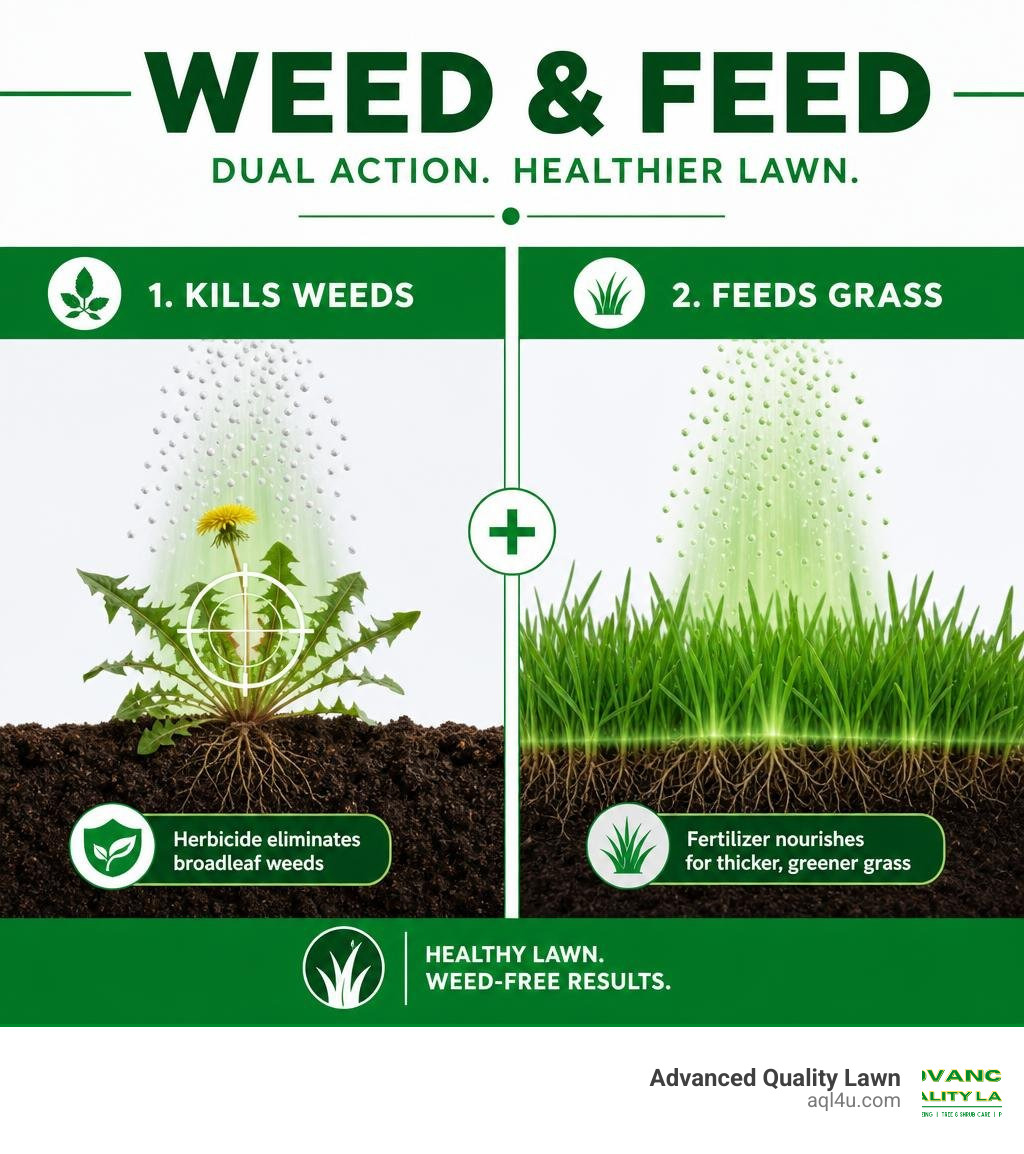
The dual-action treatment of weed and feed works by exploiting the physical differences between grass and weeds. Most granular weed and feed products rely on contact. When you spread the granules onto a damp lawn, the tiny particles cling to the broad leaves of weeds like dandelions and clover.
Once the granules stick, the selective herbicides are absorbed through the leaves. These are often systemic herbicides, which means they travel down through the plant stems to kill the weed down to the very tips of its roots. Common active ingredients like 2,4-D, Dicamba, and MCPP are highly effective contact killers for these broadleaf pests.
While the herbicide is busy shutting down the weed, the fertilizer granules fall to the soil surface. When water eventually reaches the ground, these nutrients dissolve and are absorbed by the roots of your grass. This sudden boost of nitrogen helps the grass grow quickly, filling in the empty spaces left behind by the dying weeds. To learn more about targeting specific broadleaf invaders, read about the Best Solution to Kill Weeds.
Selecting the Right Formula for Your Grass
Using the wrong weed and feed formula can severely damage your yard. You must match the product to your specific turf type and the weeds you want to target.

In Northeast Ohio cities like Hudson, Solon, and Broadview Heights, our yards consist of cool-season grasses. These include Kentucky Bluegrass, Perennial Ryegrass, and Fine or Tall Fescues. Most standard weed and feed products are perfectly safe for these grass types. However, you must always read the label to ensure compatibility.
You also need to identify the weeds you are fighting. Are you dealing with active broadleaf weeds like dandelions, chickweed, and clover? Or are you trying to stop crabgrass before it even starts?
- Pre-emergent formulas are designed to prevent weed seeds from successfully germinating. They create a chemical barrier in the topsoil that interrupts cellular division in emerging seedlings. This is your primary weapon for crabgrass prevention.
- Post-emergent formulas target weeds that are already visible and actively growing in your yard. They must make physical contact with the leaves of the weed to work.
That most standard post-emergent weed and feed products will not kill established crabgrass because crabgrass is a grass species, not a broadleaf weed. If you apply a broadleaf killer to crabgrass, it will have little to no effect.
Best Practices for Applying Weed and Feed
Success with applying weed and feed comes down to careful preparation and precise execution. You cannot simply throw the product onto the lawn on a random weekend and hope for the best.
Before you begin, make sure your lawn is ready. Clear away any fallen leaves, twigs, or heavy thatch. If your thatch layer is thicker than a half-inch, we recommend dethatching or aerating before you apply any treatments. This ensures the fertilizer can actually reach the soil.
Temperature is another critical factor. You should only apply these products when daytime temperatures are consistently between 60°F and 90°F. If you apply them during a summer heatwave when temperatures exceed 90°F, the active ingredients can become volatile, and the concentrated salts in the fertilizer can easily burn and kill your grass.
Choosing the Right Season for Applying Weed and Feed
Timing is everything when it comes to lawn care. For cool-season lawns in Northeast Ohio, there are two primary windows for applying weed and feed treatments.
The first window is spring. This is when the lawn is waking up and broadleaf weeds are beginning to emerge. The key trigger for a spring application is soil temperature. You want to wait until the soil temperature consistently reaches 50 to 55 degrees. This is usually around the time you need to perform your first or second mow of the season.
The second, and often more effective, window is early fall. Many professional turf managers prefer fall applications for broadleaf control. In September, perennial weeds are actively preparing for winter by storing energy in their roots. When you apply a post-emergent herbicide during this time, the weed draws the chemical deep into its root system, resulting in a much more effective kill.
For a deeper look at seasonal timing, check out the article on When Should You Apply Weed and Feed to Your Lawn?. If you are specifically looking to stop weeds before they sprout in the early spring, read our guide on the Best Pre-Emergent Weed Killer for Lawns.
Step-by-Step Instructions for Applying Weed and Feed
Follow these steps carefully to ensure a safe and effective application:
- Mow the lawn: Cut your grass at its normal height 1 to 2 days before you plan to apply the product. This gives the grass blades time to recover from the cut while keeping the weeds tall enough to catch the granules.
- Dampen the grass: For post-emergent products, the grass must be wet so the granules stick to the weed leaves. Apply early in the morning when the lawn is covered in natural dew, or lightly water the grass beforehand.
- Calibrate your spreader: Do not guess on the settings. Check the back of the product bag for the exact settings for your specific spreader model. If you want to be precise, calibrate your spreader on a small 250 square foot area to ensure you are applying the correct amount.
- Apply in a systematic pattern: Start by spreading a header strip around the outer perimeter of your lawn. This gives you a turnaround zone. Then, walk back and forth in straight, overlapping lines.
- Use a crisscross pattern: To avoid stripes or missed spots, many experts recommend setting your spreader to half the recommended rate and making two perpendicular passes across the lawn.
- Clean up: Once you are finished, sweep or blow any stray granules off your driveway, sidewalk, and patio back onto the grass. This prevents the chemicals from washing into local storm drains.
For more detailed tips on general lawn feeding techniques, you can explore How to Fertilize Your Lawn or read the comprehensive guide on How to Weed and Feed Your Lawn.
Post-Application Watering and Mowing Timelines
What you do after applying weed and feed is just as important as the application itself.

If you applied a post-emergent product, you must wait 24 to 72 hours before watering your lawn or allowing heavy rain to fall. This crucial waiting period allows the granules to dissolve slowly on the weed leaves and penetrate the plant tissue. If you water too soon, you will wash the herbicide off the leaves and into the soil, rendering the weed-killing portion of the product useless.
However, if you applied a pre-emergent weed and feed, you actually want to water it in within 3 days. These products need at least a half-inch of water to activate the chemical barrier in the soil.
When it comes to mowing, hold off for at least 2 to 3 days after application. This gives the systemic herbicides enough time to move through the weeds before you cut the leaves off.
Pros and Cons of Combination Treatments
While all-in-one products are incredibly popular, they are not always the best choice for every lawn. It is important to weigh the convenience against the potential downsides.
| Feature | Weed and Feed (Combination) | Separate Applications |
|---|---|---|
| Convenience | High (one pass covers both tasks) | Low (requires multiple passes and products) |
| Timing Accuracy | Moderate (difficult to align ideal weed and feed times) | High (apply fertilizer and herbicide at perfect moments) |
| Product Waste | High (spreads herbicide over areas without weeds) | Low (allows for precise spot-treatment of weeds) |
| Risk of Grass Burn | Moderate (high salt content can burn dry turf) | Low (treatments are tailored to current lawn conditions) |
| Environmental Impact | Higher risk of chemical runoff | Lower risk due to targeted applications |
The Convenience of All-in-One Products
The biggest selling point of weed and feed is convenience. Homeowners love the idea of saving time by crossing two major lawn care chores off their list with a single trip across the yard.
For a relatively healthy lawn that only has a light, scattered population of broadleaf weeds, a combination product can be a highly cost-effective maintenance tool. It delivers a steady dose of nutrients to help the grass green up while quietly knocking back those few early-season dandelions.
Why Separate Applications Can Be Better
Despite the convenience, many professional lawn care experts prefer applying herbicides and fertilizers separately. The main reason is timing.
The absolute best time to fertilize your grass does not always align perfectly with the best time to kill weeds. For example, you might need to feed your lawn in late spring, but if you do not have many active weeds, you are spreading unnecessary herbicides across your entire yard. This can weaken grass roots over time and increases the risk of chemical runoff into local waterways.
By separating the treatments, you can apply a high-quality fertilizer to feed the grass, and then use a targeted liquid spray to spot-treat only the areas where weeds are actually growing.
Frequently Asked Questions About Lawn Care
Here are some of the most common questions we hear from homeowners in Northeast Ohio regarding weed and feed applications.
What should you do if it rains shortly after application?
If a heavy rainstorm hits your yard within 24 hours of applying a post-emergent weed and feed, the herbicide will likely wash off the weed leaves before it can be absorbed. This reduces the effectiveness of the weed-killing component.
Do not run out and reapply the product immediately. Doing so risks over-fertilizing your lawn and burning the grass. Instead, wait 10 to 14 days to monitor the results. If you notice that the weeds are still thriving and showing no signs of yellowing or curling, you can spot-treat the remaining weeds with a liquid weed killer.
How often can you apply weed and feed to your lawn?
You should never apply weed and feed more than twice per year. We recommend leaving at least two months between applications.
Over-application of these products leads to a dangerous buildup of herbicides in the soil, which can actually weaken and kill your grass. Additionally, the high concentration of salts in the fertilizer can dehydrate the turf, leading to severe fertilizer burn.
What safety precautions should be taken for pets and children?
Safety should always be your top priority when handling lawn chemicals.
- Always wear protective gear, including long pants, long sleeves, closed-toe shoes, and gloves during application.
- Keep children and pets off the treated lawn until the dust has fully settled, or until the product has been watered in and the grass is completely dry.
- Avoid applying weed and feed within 25 feet of any water bodies, including backyard ponds, streams, or local lakes, to prevent environmental contamination.
- Store any leftover product in its original packaging in a cool, dry place out of reach of children.
Conclusion
Achieving a lush, healthy lawn in July 2026 does not have to be a stressful guessing game. By understanding how these products work and executing your application with care, you can enjoy a vibrant, weed-free yard all season long.
However, if you would rather spend your weekends relaxing instead of pushing a spreader, the team at Advanced Quality Lawn is here to help. We provide professional lawn care, tree, and shrub services throughout Akron, Ohio, and the surrounding Northeast Ohio communities. Our certified applicators use high-grade, seasonally adjusted products tailored to our local clay soils.
With our excellent customer service, full-program guarantees, and coverage across 99+ zip codes in Summit, Medina, Cuyahoga, Portage, Geauga, Lorain, and Stark counties, you can trust us to keep your yard looking its absolute best. Contact us today to learn more about our Advanced Quality Lawn Care Services and get your free estimate!