Triple Threat: Using 13-13-13 and 16-16-16 for a Perfect Lawn
What Is Balanced Lawn Fertilizer?

Balanced lawn fertilizer supplies all three primary grass nutrients: nitrogen, phosphorus, and potassium. The three numbers on the bag show the percentage of each nutrient by weight, in that order.
| Fertilizer ratio | What it means |
|---|---|
| 13-13-13 | 13% nitrogen, 13% phosphorus, 13% potassium |
| 16-16-16 | 16% nitrogen, 16% phosphorus, 16% potassium |
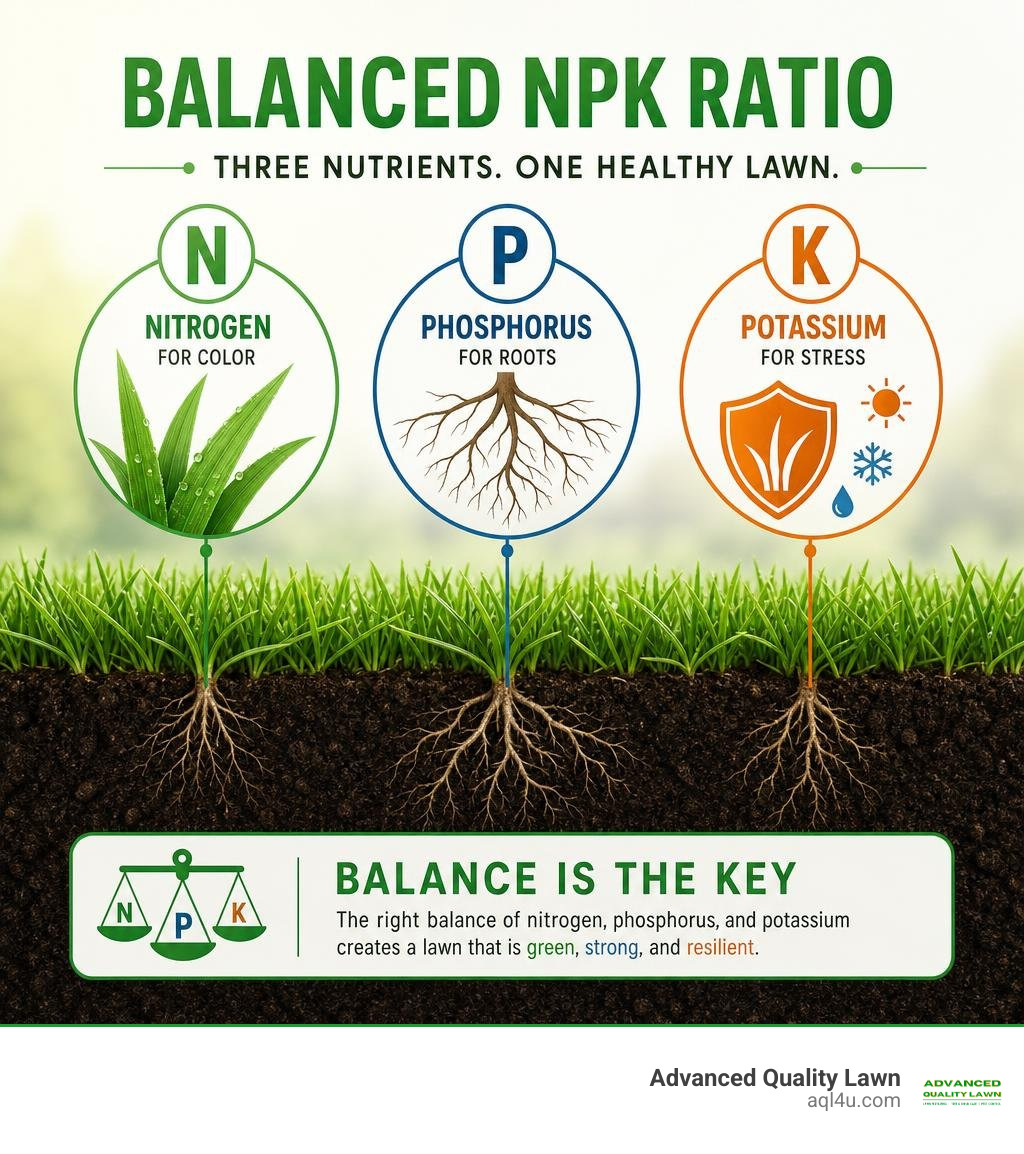
Nitrogen supports green leaf growth. Phosphorus supports roots. Potassium helps grass handle drought, heat, cold, and foot traffic. A balanced formula can be useful when a soil test shows your lawn needs all three nutrients, especially for new sod, new seed, or nutrient-poor soil.
For established Ohio lawns, more fertilizer is not always better. Many lawns need mostly nitrogen, while phosphorus and potassium should be added only when soil results or establishment needs call for them.
I am Andrew Day, owner of Advanced Quality Lawn in Northeast Ohio, where our team has more than 30 years of combined industry experience helping homeowners match balanced lawn fertilizer and other treatments to local soil, weather, and turf conditions. The right nutrient ratio starts with understanding what those three bag numbers actually tell you.
Understanding Balanced Lawn Fertilizer and NPK Ratios
When you shop for turf nutrients, the three prominent numbers printed on the front of every bag represent the guaranteed NPK analysis. This sequence tells you the exact percentage of nitrogen (N), available phosphate (P2O5), and soluble potash (K2O) by weight inside the bag.
A balanced lawn fertilizer contains equal percentages or an even ratio of these three essential macronutrients. Choosing between products like 10-10-10, 13-13-13, and 16-16-16 comes down to understanding concentration, application rates, and soil health requirements. If you want a quick primer on how nutrients interact with soil biology, check out our helpful Fertilizer 101 guide.
| Fertilizer Formula | Ratio | Nitrogen Content | Phosphate Content | Potash Content | Total Nutrient Concentration |
|---|---|---|---|---|---|
| 10-10-10 | 1:1:1 | 10% | 10% | 10% | 30% |
| 13-13-13 | 1:1:1 | 13% | 13% | 13% | 39% |
| 16-16-16 | 1:1:1 | 16% | 16% | 16% | 48% |
Decoding 10-10-10, 13-13-13, and 16-16-16 Ratios
All three of these formulas share a 1:1:1 NPK ratio. The fundamental difference lies in their nutrient concentration per pound of product. Higher numbers mean the product is more concentrated, requiring less total bulk weight to deliver the desired amount of plant food across your yard.
For example, a 50 pound bag of 10-10-10 fertilizer contains 5 pounds of actual nitrogen, 5 pounds of phosphoric acid, and 5 pounds of soluble potash. The remaining 35 pounds consist of inert filler, carrier materials, or micronutrients designed to help distribute the prills evenly across your lawn.
By comparison, a 50 pound bag of 16-16-16 fertilizer contains 8 pounds of each macronutrient. Because 16-16-16 has a 48% total active nutrient concentration compared to 30% in 10-10-10, you spread fewer total pounds of fertilizer over the same square footage. Higher concentration formulas can be more economical for larger residential properties in Akron or Medina, but they also require careful spreader calibration to avoid accidental over-application.
Nitrogen, Phosphorus, and Potassium Breakdown
Every grass plant requires a steady supply of macronutrients to survive and thrive throughout our changing seasons. Each component in a balanced lawn fertilizer performs specific physiological duties within the grass plant:
- Nitrogen (N): Drives leaf growth and chlorophyll production. Chlorophyll gives grass its deep green color and captures sunlight for energy through photosynthesis.
- Phosphorus (P): Stimulates root vigor and cellular energy transfer. It plays an essential role during seed germination and root establishment for fresh sod.
- Potassium (K): Enhances environmental stress tolerance. It strengthens cell walls, improves water regulation inside tissues, and helps grass resist heat, drought, severe cold, and heavy foot traffic.
According to extensive University extension research on lawn fertilization, plants can only absorb nitrogen in the forms of ammonium or nitrate. Established lawns usually require more nitrogen than phosphorus. In fact, many Midwestern soils naturally hold adequate phosphorus reserves. Adding equal parts phosphorus year after year on an established lawn can lead to excess nutrient buildup, making routine soil testing an important step before choosing high-concentration triple formulas.
When and How to Apply Balanced Turf Food

Knowing when to use a balanced lawn fertilizer depends heavily on the lifecycle stage of your turf and your underlying soil chemistry. Applying a 13-13-13 or 16-16-16 blend makes tremendous sense in specific scenarios, such as prepping a newly prepped seedbed, laying fresh sod, or amending soil that tests deficient in phosphorus and potassium.
Selecting the Right Balanced Lawn Fertilizer Formula
Cool-season grasses like Kentucky Bluegrass, Perennial Ryegrass, Fine Fescue, and Tall Fescue dominate lawns across Cuyahoga, Summit, and Portage counties. These grasses enter periods of rapid active growth during spring and early autumn.
Selecting the proper formula depends on your soil organic matter levels and current turf health. You can explore our detailed Best grass fertilizer guide to see how various nutrient blends align with specific cool-season grass varieties.
Soil testing provides clear guidance. If your soil report shows low phosphorus or low potassium, a balanced lawn fertilizer supplies all three primary nutrients simultaneously. However, if your soil already contains high levels of phosphorus, switching to a high-nitrogen maintenance blend with zero phosphorus protects nearby streams and local waterways from excess agricultural runoff.
Application Timing for Established Turf vs New Sod
The ideal application window for a balanced lawn fertilizer changes significantly between established turfgrass and newly established grass installations.

When establishing new turf from seed or laying fresh sod, root development takes top priority. A balanced starter formula or a high-purity 16-16-16 blend delivers immediate phosphorus and potassium right to the root zone. Applying a balanced blend directly under new sod or over fresh seed speeds up establishment and encourages deep root anchoring. You can read more about fall seed preparation in our Best fertilizer for new grass seed guide.
For established lawns, nitrogen needs range from 0.5 to 4 pounds of actual nitrogen per 1,000 square feet per year. This rate varies based on whether you return grass clippings to the lawn, irrigation frequency, and lawn maintenance goals. Returning clippings recycles up to 1 pound of nitrogen back into the soil naturally each season.
Quick-Release vs Slow-Release Nitrogen Delivery
Fertilizers feature different nitrogen delivery methods that impact how fast your grass greens up and how long the nutrients last.
- Quick-Release Nitrogen: Soluble compounds break down rapidly upon contact with soil moisture. Products with quick-release nitrogen deliver rapid green-up within days, making them popular for quick boost treatments. However, they feed the lawn for a shorter window, typically up to 6 weeks, and carry a higher risk of burning grass if applied improperly during hot weather.
- Slow-Release Nitrogen: Coated prills, polymer-coated urea, or organic nitrogen sources release nutrients gradually over 8 to 12 weeks. Slow-release formulas promote steady growth, build strong roots, and drastically reduce the risk of nutrient leaching into groundwater.
For instance, professional grade options like PGF 10-10-10 product specs feature small prill sizes for uniform particle coverage with fast-acting availability. Choosing the right release mechanism ensures your lawn receives a consistent stream of food without sudden surges in top growth that require constant mowing.
Application Best Practices to Prevent Lawn Damage
Even the highest quality balanced lawn fertilizer can damage your turf if applied incorrectly. Applying heavy amounts of fast-acting mineral salts in hot, dry weather causes severe moisture loss in plant tissues, leading to foliage scorch or unsightly yellow burn streaks.
Benefits of Organic vs Synthetic Balanced Lawn Fertilizer
Homeowners often choose between synthetic granular fertilizers and organic products. Both options deliver essential nutrients, but they interact with your soil ecosystem in different ways:
- Synthetic Fertilizers: Derived from mineral salts and synthesized compounds, products like 13-13-13 or 16-16-16 deliver predictable, immediate nutrition. They dissolve quickly in soil water, making them ideal when fast root uptake is required.
- Organic Fertilizers: Derived from natural animal meals, feather meal, bone meal, or fish emulsion, organic options like a 5-3-2 ratio enrich soil microbiology. They build soil structure, feed beneficial microbes, and release nutrients slowly as organisms break down organic matter.
Many natural products comply with strict organic standards, such as those meeting OMRI organic lawn fertilizer guidelines. Synthetic blends work quickly and cost less per pound of actual nutrient, while organic options enhance long-term soil structure and microbial health.
Spreader Calibration and Avoid Turf Burn
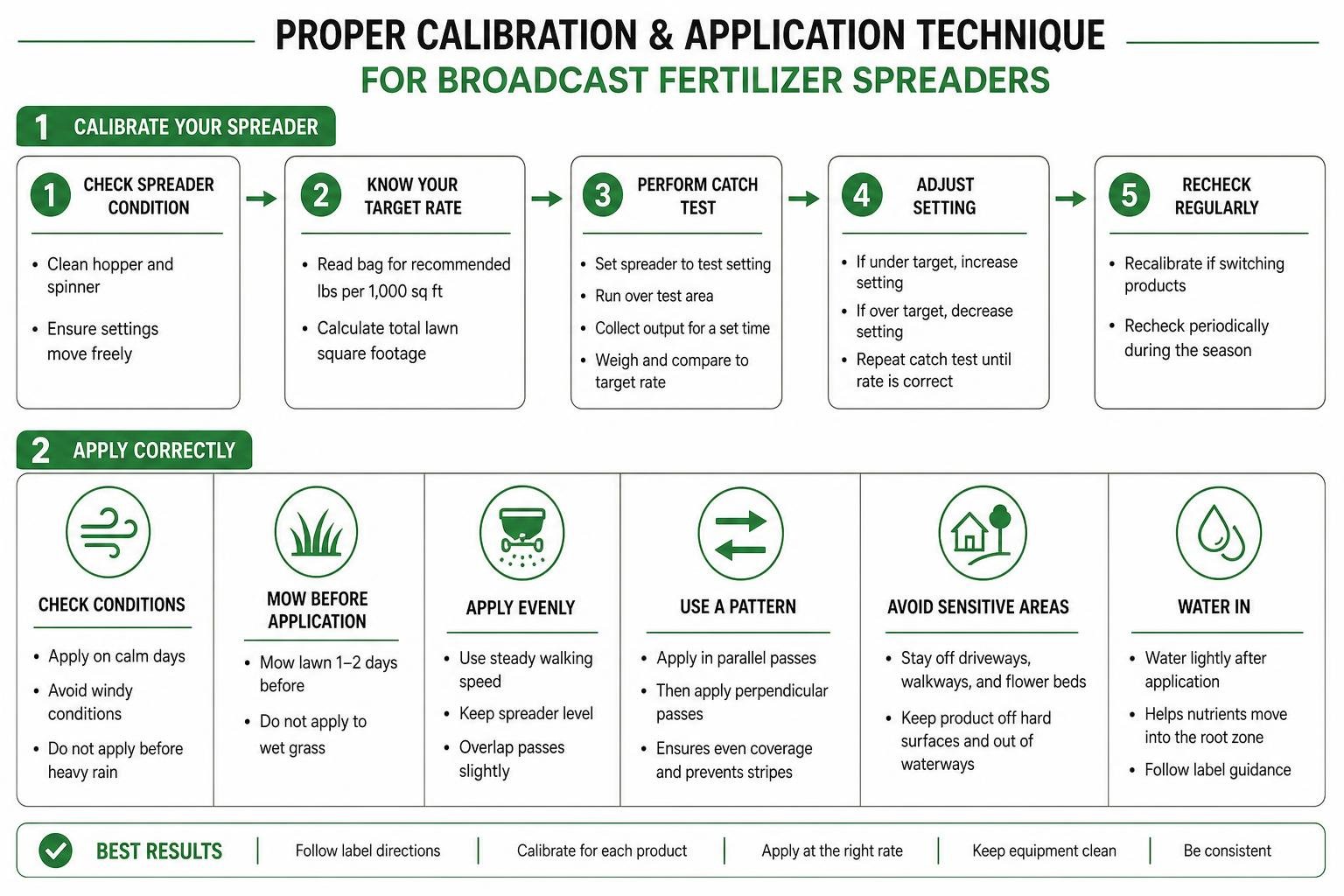
To prevent fertilizer burn and achieve seamless, stripe-free greening across your yard, follow these core application steps:
- Test Soil Moisture: Mow your lawn and ensure the soil has adequate moisture 1 to 2 days before applying granular fertilizer. Never apply synthetic products during extreme summer heat or drought stress.
- Calibrate the Spreader: Set your rotary broadcast spreader to the precise recommended rate on the bag. Overlapping passes too closely can double the intended nitrogen dose, risking salt burn.
- Establish Perimeter Headers: First, broadcast a outer header pass around the entire perimeter of your lawn. Then walk back and forth in parallel lines across the interior, overlapping passes slightly for uniform prill distribution.
- Clean Hard Surfaces: Sweep or blow stray fertilizer granules off concrete driveways, stone patios, and sidewalks back onto the grass. Granules left on hard surfaces wash into storm drains during rainstorms, contributing to environmental water pollution.
- Water In Thoroughly: Apply at least 0.2 to 0.5 inches of water immediately after spreading fertilizer. Watering dissolves active prills, settles nutrients into the root zone, and washes residual salt dust off delicate leaf blades.
Frequently Asked Questions About Lawn Feeding
How often should I fertilize my grass?
Most cool-season lawns in Northeast Ohio thrive on 3 to 4 fertilizer applications per year during active spring and autumn growth periods. Space applications roughly 4 to 6 weeks apart, starting in early spring once soil temperatures reach 55 degrees Fahrenheit. Avoid fertilizing cool-season turf during high heat in July unless you maintain an irrigation system and apply slow-release formulations at reduced rates.
Can balanced fertilizers harm the soil?
Repeatedly using high-phosphorus or high-synthetic salt formulas without a soil test can cause nutrient imbalances over time. Certain nitrogen fertilizers slightly lower soil pH. While soil pH below 5.0 can reduce beneficial earthworm activity, many Midwestern soils tend toward slightly alkaline conditions where mild acidifying effects cause no harm. Always follow label directions and base long-term feeding programs on accredited soil test results.
What is the difference between balanced and high-nitrogen lawn food?
A balanced lawn fertilizer contains equivalent ratios of nitrogen, phosphorus, and potassium, such as 10-10-10 or 16-16-16. High-nitrogen maintenance products feature elevated first numbers with minimal or zero middle numbers, such as 32-0-5 or 24-4-10. High-nitrogen blends focus primarily on top leaf greening and leaf density for established lawns, whereas balanced blends support root building and new turf setup. If you need dual control for weeds while feeding, review our detailed 3 in 1 weed and feed guide.
Conclusion
Achieving a vibrant, healthy lawn across Hudson, Brecksville, Medina, or anywhere in Summit, Cuyahoga, and Portage counties requires matching the right nutrient formula to your soil condition. While concentrated triple blends like 13-13-13 and 16-16-16 serve as excellent tools for establishing new sod, seeding, and correcting verified nutrient deficiencies, established lawns often benefit from tailored maintenance programs.
At Advanced Quality Lawn, we take the guesswork out of turf management. Our team brings decades of local experience, custom seasonal programs, full-program guarantees, and reliable service calls to homeowners across 99 plus regional zip codes. Contact us today to explore our Professional lawn care maintenance services and build the dense green lawn your home deserves.