
The Ultimate Guide to Crabgrass and Broadleaf Weed Control
Identifying Dual Lawn Invaders: Crabgrass and Broadleaf Weeds
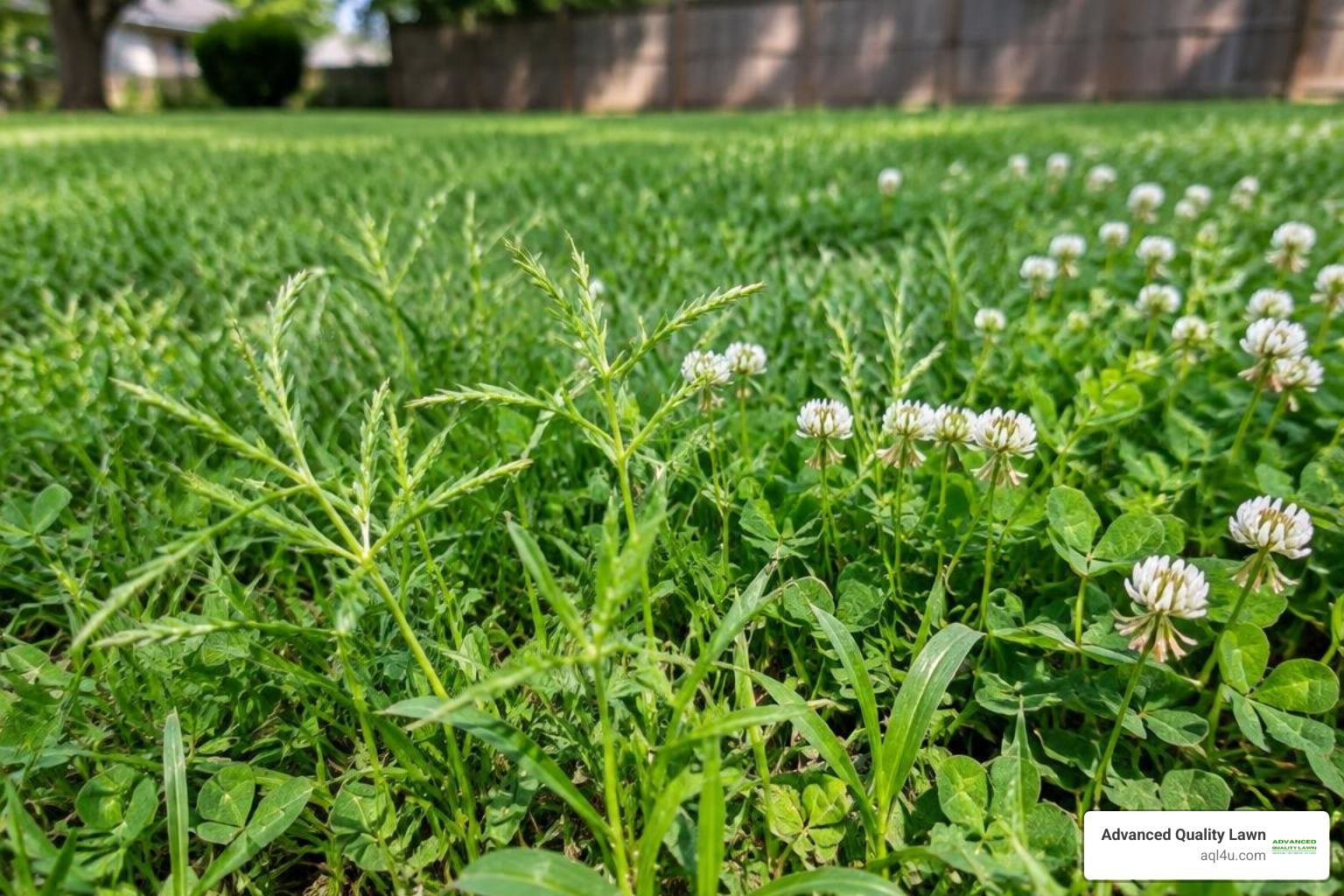
To eliminate crabgrass and clover together, apply a selective dual-action herbicide that combines quinclorac for grassy weeds with 2,4-D for broadleaf weeds during active growth. This single treatment targets both weed types without harming established turf. Tackling weeds in your yard can feel like fighting a war on two entirely different fronts. One week you spot light green crabgrass blades invading the warm edges of your driveway, and the next week patches of white clover are spreading across your lawn. Treating these invaders requires understanding their distinct biological profiles.
Crabgrass belongs to the Digitaria genus and behaves as a warm-season annual grass. It sprouts in late spring when soil temperatures reach about 55 degrees, spreads rapidly through aggressive tillering during hot summer months, produces thousands of seeds, and drops dead with the first heavy frost in autumn.
White clover (Trifolium repens) is a perennial broadleaf weed. It establishes a persistent creeping root system known as stolons, which weave through your turf canopy. Because clover produces its own nitrogen, it easily thrives in low fertility turf where desired grass struggles to compete.
Using a combined broadleaf and crabgrass herbicide allows you to target these two completely different plant structures in a single treatment.
The Difference Between Grassy and Broadleaf Turf Invaders
Grassy weeds share many physiological traits with the turfgrasses you want to protect. Crabgrass produces parallel leaf veins, fibrous root clusters, and low growing crowns that dodge mower blades effortlessly. Because it matches the basic botany of desirable turf, eliminating it without scorching the surrounding turf requires specialized chemistry.
Broadleaf weeds display wider leaves with net-like veins and often produce flowers. Clover develops a central taproot alongside branching stolons that root at the nodes. This growth pattern allows clover to steal water, sunlight, and root space directly from your turf.
When both weed types take hold simultaneously, standard single target weed sprays fall short. A grassy weed formula will leave clover completely untouched, while a standard broadleaf killer will leave crabgrass free to choke out your lawn.
How a Crabgrass Clover Killer Works on Mixed Weeds
A selective dual weed killer uses multiple modes of action to eradicate both grassy and broadleaf invaders while leaving your turf unharmed.
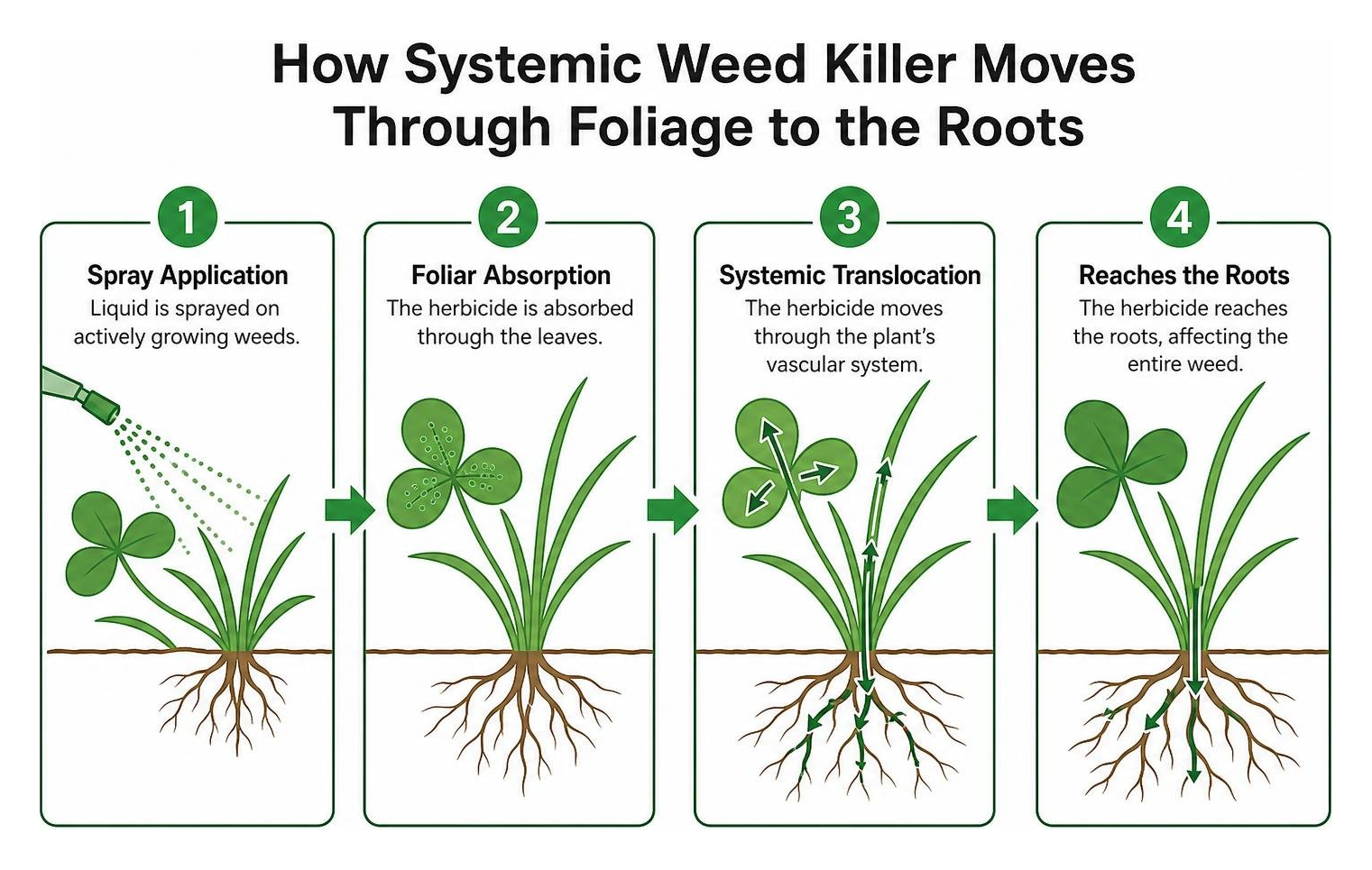
When you spray actively growing weeds, the liquid enters the plant through foliar absorption and moves internally via systemic translocation.
Once inside, the chemical agents disrupt essential plant processes:
- Grassy weed inhibitors halt cell division at the growing tips of crabgrass tillers.
- Broadleaf regulators trigger uncontrollable, irregular cell elongation in clover leaves and stems.
- The combined active ingredients travel down through vascular pathways to destroy the root system completely.
Because healthy turf species can rapidly break down and metabolize these specific chemical compounds, your grass stays green while the target weeds wither and decay.
Key Active Ingredients for Simultaneous Weed Eradication
Achieving dual weed control requires choosing formulas built on chemical synergy. Rather than relying on a single compound to do all the heavy lifting, high performing herbicides combine specific active ingredients that specialize in broadleaf disruption and grassy weed suppression. You can learn more about selecting specialized products in our guide on the best herbicide for crabgrass.
Quinclorac and 2,4-D Combinations
The gold standard combination for dual control pairs quinclorac with 2,4-D.
Quinclorac is a standout active ingredient because it provides post-emergence control over crabgrass while also delivering strong activity against white clover. It works by stimulating excessive production of ethylene and abscisic acid inside the weed tissue, leading to plant collapse.
When manufacturers blend quinclorac with 2,4-D amine, the mixture delivers an exceptional knock-down punch. The 2,4-D mimics natural plant growth hormones (auxins), triggering rapid stem twisting and foliar curling in broadleaf species within hours of contact.
For exact mixing ratios and safety details on these powerful blends, always refer to herbicide application rate guidelines before filling your sprayer.
Triclopyr, Dicamba, and Sulfentrazone
For particularly stubborn patches of clover, wild violet, or ground ivy, other active ingredients often join the mix:
- Triclopyr: A systemic auxin mimic that penetrates tough, waxy broadleaf foliage and translocates down to the root tips.
- Dicamba: An efficient benzoic acid herbicide that enhances broadleaf control by disrupting protein synthesis.
- Sulfentrazone: A fast acting compound that inhibits the PPO enzyme, creating rapid foliar necrosis and noticeable weed yellowing within 24 to 48 hours.
Combining these ingredients with quinclorac gives you comprehensive coverage across more than 200 weed varieties without having to purchase multiple specialty sprays.
Choosing the Best Crabgrass Clover Killer Formulation

Selecting the right packaging and concentration format depends on the size of your lawn, the density of the weeds, and how much time you want to spend applying treatments. For a broader look at managing invasive summer annuals, explore our breakdown of the best way to get rid of crabgrass.
Ready-to-Use vs Ready-to-Spray vs Liquid Concentrates
Herbicides are generally sold in three primary formulations:
- Ready-to-Use (RTU): These products come pre-mixed with a trigger sprayer or battery operated wand. They require no measuring, making them ideal for quick spot treatments when you only have a dozen weeds scattered across your yard.
- Ready-to-Spray (RTS): These bottles attach directly to your standard garden hose. The water flow automatically siphons and mixes the herbicide at the proper ratio. RTS bottles are great for medium sized lawns that need blanket coverage across 5,000 to 10,000 square feet.
- Liquid Concentrates: This is the most cost effective option for large properties. You measure and mix the product with clean water inside a calibrated pump or backpack sprayer. Concentrates give you total control over application rates, droplet size, and surfactant additions.
Turfgrass Safety and Grass Type Compatibility
Always verify that your lawn variety is approved on the product label. Using an incompatible weed killer can severely stress or kill your turf.
| Grass Type | Quinclorac + 2,4-D + Dicamba | Triclopyr Combinations | DSMA + MCPA Blends |
|---|---|---|---|
| Kentucky Bluegrass | Safe when used as directed | Safe for established turf | Safe at labeled rates |
| Tall Fescue | Highly tolerant | Highly tolerant | Safe at labeled rates |
| Perennial Ryegrass | Safe when used as directed | Safe for established turf | Safe at labeled rates |
| Zoysiagrass | Safe at labeled rates | May cause temporary yellowing | Safe on select cultivars |
| Bermudagrass | Safe (may yellow temporarily) | Use caution, follow label | Safe on common types |
| Fine Fescue | Moderate tolerance | Use lower labeled rates | Check product label |
Cool-season grasses throughout Ohio, including Kentucky bluegrass, tall fescue, and perennial ryegrass, display strong tolerance to quinclorac and 2,4-D blends. However, fine fescues can experience slight discoloration if you apply treatments during warm weather.
Optimal Timing and Application Guidelines
Getting top tier results from a dual weed killer comes down to precise timing. Applying treatments at the wrong stage of weed development or during weather extremes will waste product and leave weeds standing. You can review full seasonal strategies in our crabgrass control guide 2026.
Seasonal Application Windows and Growth Stages
Post-emergence herbicides perform best when weeds are small and actively metabolizing nutrients.
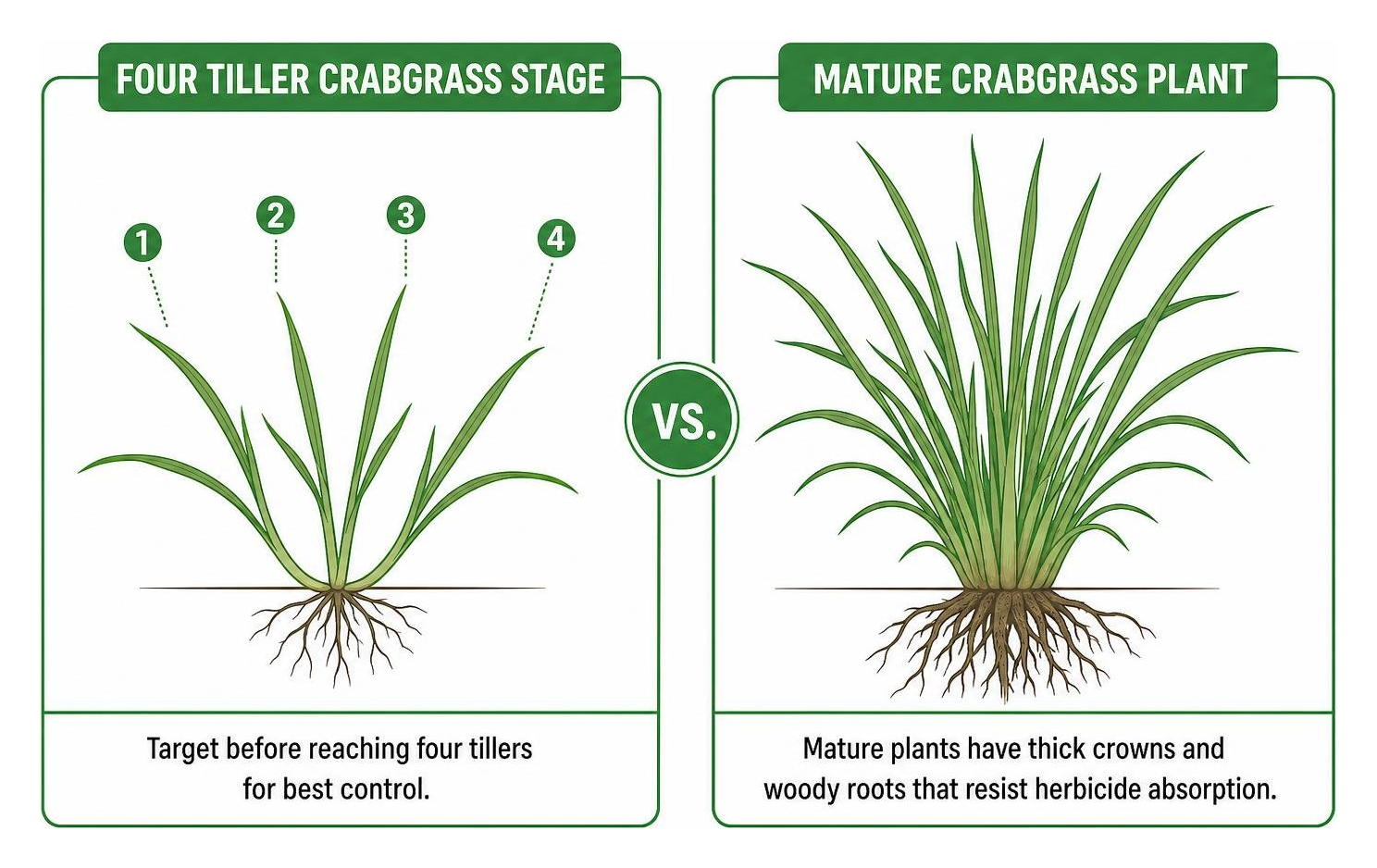
Target crabgrass when it is in the two to three leaf stage, before it reaches the four-tiller threshold. Once a crabgrass plant matures beyond four tillers, its thick crown and woody root mass resist absorption, often requiring a second treatment 21 days later.
For white clover, late spring and early autumn provide the ideal application windows. During early fall, clover actively pulls carbohydrates downward into its root system to prepare for winter dormancy. Spraying during this seasonal window ensures the herbicide translocates deep into the taproots for complete eradication.
Check out this video on post-emergence timing and weed growth stages to help identify weed growth phases in your yard.
Apply herbicides when ambient daytime temperatures sit between 50 and 85 degrees. If temperatures climb above 90 degrees, turfgrass enters heat stress, making it vulnerable to chemical burn while weeds close their leaf pores to conserve moisture.
Step-by-Step Application of Crabgrass Clover Killer Sprays
Follow this methodical routine to maximize weed absorption and protect the surrounding environment:
- Step 1: Calibrate and Inspect. Check your sprayer tank, hose, and nozzle for leaks. Adjust the spray nozzle to deliver a medium to coarse droplet pattern to minimize wind drift.
- Step 2: Check Soil Moisture. Ensure the lawn has adequate soil moisture. If your yard is suffering from a prolonged dry spell, water lightly 24 hours prior to spraying.
- Step 3: Put on Safety Gear. Wear long pants, a long-sleeved shirt, chemical-resistant gloves, protective eye goggles, and closed-toe footwear.
- Step 4: Spray the Foliage. Target the weeds directly, coating the leaves evenly until moist without letting the liquid run off onto the soil.
- Step 5: Avoid Drift. Spray on calm mornings when wind speeds remain under 5 miles per hour to keep the mist away from prized flower beds, vegetable gardens, and ornamental shrubs.
Post-Treatment Care: Mowing, Irrigation, and Reseeding
Proper care before and after spraying ensures the active ingredients work their magic without interruption:
- Mowing Schedule: Do not mow your lawn for two days prior to application so the weeds have plenty of leaf surface area to absorb the spray. Wait at least two full days after spraying before mowing again.
- Irrigation Timing: Keep the treated area completely dry for the label's stated rainfast window, which is typically 1 to 24 hours depending on the formula. Avoid running sprinklers or applying liquid fertilizer during this critical absorption period.
- Reseeding Intervals: If you plan to overseed thin patches left behind by dying weeds, consult our crabgrass preventer safe seeding guide. Most post-emergence broadleaf and grassy weed formulas require a waiting period of three to four weeks before sowing new grass seed.
To prevent next season's weed seeds from ever sprouting, pair your post-emergence spot treatments with a quality application of the best pre-emergent weed killer for lawns early each spring.
Frequently Asked Questions About Dual Weed Control
How long does it take to see visible results after treatment?
Most homeowners notice initial weed responses within 24 to 48 hours. Broadleaf weeds like clover will show twisted stems, curled leaves, and stem elongation. Crabgrass will begin to turn yellow or purple at the base within a few days. Complete root death and plant breakdown generally take between 14 and 28 days. Hard-to-kill perennial weeds or mature crabgrass may require a follow-up spot treatment three weeks after the initial pass.
Can I spray weeds immediately before or after reseeding?
No, you should not spray standard post-emergence weed killers immediately before or after reseeding. Young grass seedlings are extremely sensitive to herbicide absorption and lack the root structure to metabolize chemical stress. Wait until your newly sprouted grass has been mowed at least three times before applying post-emergence products. When spraying established turf prior to seeding, allow a minimum safety window of 21 to 28 days so chemical residues in the topsoil can dissipate.
When is it safe for children and pets to re-enter treated lawns?
Children and family pets should stay completely off the treated lawn until the spray has dried entirely. Under warm, sunny conditions with low humidity, drying takes roughly one to two hours. Once the chemical spray has dried on the leaf surface, the active ingredients bind securely to the plant tissue and will not track onto paws or footwear.
Conclusion
Controlling aggressive crabgrass and persistent white clover does not have to mean managing separate chemical applications or spending your weekends hand-pulling stubborn roots. By selecting a high performance multi ingredient formula, applying it during optimal growth windows, and maintaining strong turf density, you can clear out unwanted invaders and restore a lush lawn.
For homeowners throughout Summit County, Medina County, Cuyahoga County, Portage County, Wayne County, Geauga County, Lorain County, and Stark County, our team is always here to handle the heavy lifting. Explore our professional lawn care and maintenance services to keep your yard thick, healthy, and weed free all season long.