The Best Fertilizer for Lawn Grass: Quick Picks for a Greener Yard

Finding the best fertilizer for lawn grass does not have to be complicated. Here are the top picks based on expert testing and real-world results:
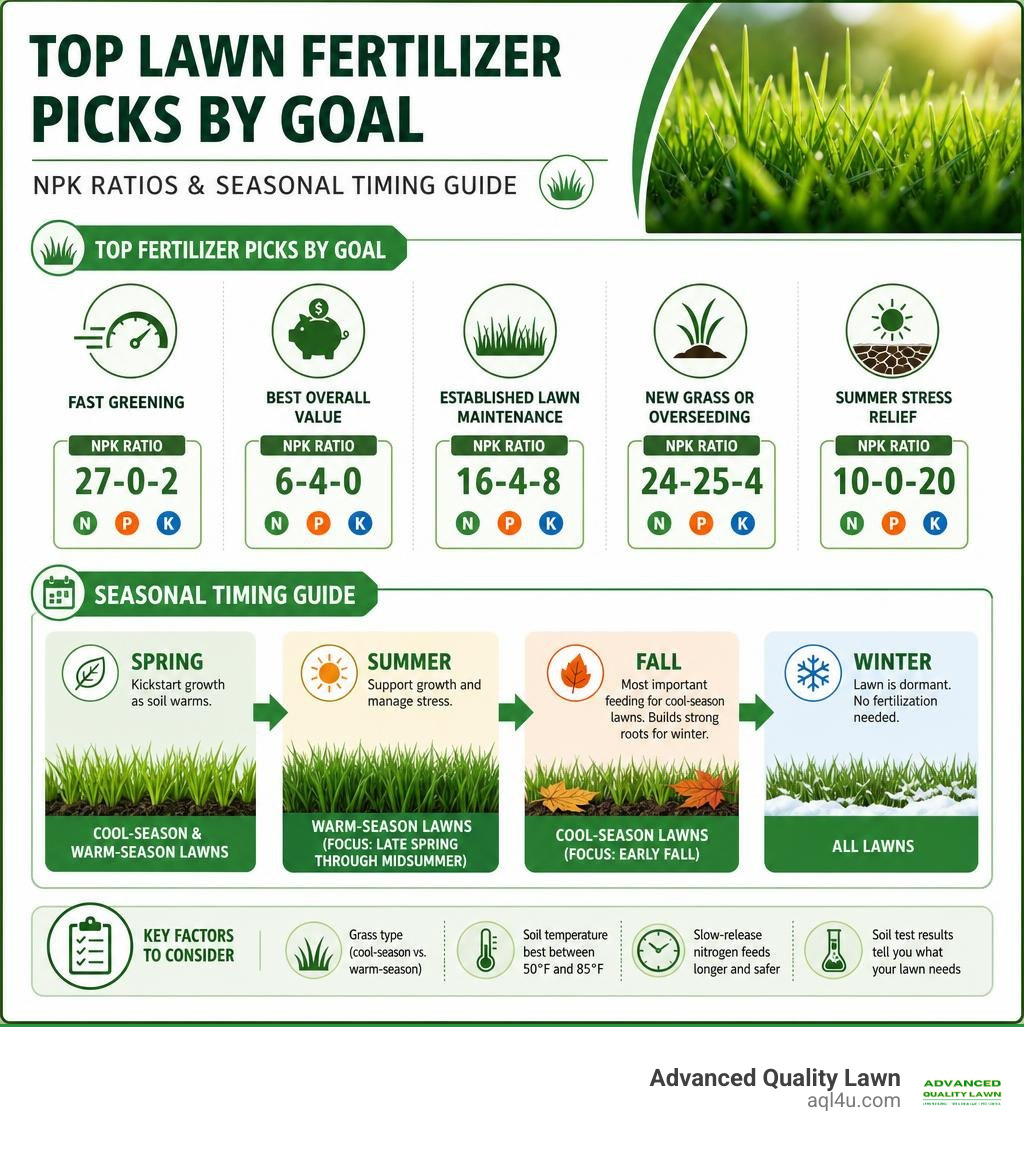
| Goal | Best Pick | NPK Ratio |
|---|---|---|
| Fast greening | Scotts Green Max Lawn Food | 27-0-2 |
| Best overall value | Milorganite Organic Fertilizer | 6-4-0 |
| Established lawn maintenance | The Andersons PGF Complete | 16-4-8 |
| New grass or overseeding | Scotts Turf Builder Starter Food | 24-25-4 |
| Summer stress relief | Low-nitrogen, high-potassium blend | 10-0-20 |
Most lawns need 2 to 4 fertilizer applications per year. The single most important application for cool-season lawns (like fescue or bluegrass) is early fall. For warm-season grasses like Bermuda or St. Augustine, focus on late spring through midsummer.
A few things matter most when choosing a fertilizer:
- Grass type (cool-season vs. warm-season)
- Season and soil temperature (nutrients absorb best between 50°F and 85°F)
- Slow-release vs. fast-release nitrogen (slow-release is safer and feeds longer)
- Soil test results (tells you exactly what your lawn is missing)
I'm Andrew Day, owner of Advanced Quality Lawn, and with more than 30 years of hands-on lawn care experience in Northeast Ohio, I've seen how choosing the right fertilizer transforms thin, struggling turf into thick, healthy grass. In this guide, I'll walk you through the best fertilizer for lawn grass based on real results, not just marketing claims.
Understanding NPK Ratios and Essential Lawn Nutrients
When you look at a fertilizer bag, you will see three bold numbers separated by hyphens. These numbers represent the guaranteed analysis of primary nutrients: Nitrogen (N), Phosphorus (P), and Potassium (K). For a complete breakdown, check out our guide on More info about lawn fertilization to master these basic principles.
The three numbers tell you the percentage of each nutrient by weight inside the bag. For instance, a 50 pound bag of 16-4-8 fertilizer contains 16 percent nitrogen (8 pounds), 4 percent phosphorus (2 pounds), and 8 percent potassium (4 pounds). The remaining percentage consists of micronutrients, organic matter, or carriers that help spread the nutrients evenly.
Primary Nutrients Breakdown
Each macronutrient performs a distinct biological job in your turfgrass ecosystem:
- Nitrogen (N): Nitrogen drives top growth, leaf expansion, and deep green pigmentation by fueling chlorophyll production. It is the fuel that powers healthy turf. However, too much fast nitrogen causes rapid growth spurts that require constant mowing and weaken root structure.
- Phosphorus (P): Phosphorus promotes robust root development and early seedling establishment. It is essential when starting new grass from seed or installing sod. Because established lawns retain phosphorus well, many state environmental laws now limit phosphorus applications on established turf to protect local waterways from runoff.
- Potassium (K): Potassium acts as a guardian nutrient. It thickens cell walls, helping your lawn resist heat, extreme cold, drought, foot traffic, and disease. Applying potassium ahead of summer heat waves or winter freezing is essential for long-term turf survival.
In addition to macronutrients, micronutrients like iron play a massive role in turf health. Adding chelated iron gives grass a dark green color within days without triggering unnecessary surge growth. Following Scientific guidelines for optimal lawn growth helps build strong roots alongside vibrant foliage.
Slow-Release Versus Fast-Release Formulas
Understanding how fast nutrients release into your soil separates high quality fertilizers from cheap alternatives. To decide which style fits your yard, you can Compare organic vs synthetic options before purchasing.
Fast-release nitrogen sources (like uncoated urea or ammonium sulfate) dissolve immediately in water. They provide a quick greening response within 24 to 48 hours. However, they carry a high salt index, which increases the risk of chemical leaf burn if applied improperly. They also exhaust their nutrient supply within 2 to 4 weeks, often leading to patchy growth spurts.
Slow-release nitrogen sources use physical polymer coatings, sulfur coatings, or complex organic molecules to regulate nutrient delivery. Products containing polymer-coated urea feed turf steadily over 6 to 10 weeks. They provide uniform color, eliminate surge growth, and lower the salt index to protect roots from burning.
Selecting the Best Fertilizer for Lawn Grass

Choosing the best fertilizer for lawn grass requires looking beyond attractive retail packaging. We always advise homeowners across Summit County and Cuyahoga County to begin with three simple calculations: lawn square footage, grass species requirements, and soil testing.
To calculate how much fertilizer product you need for a target application of 1 pound of actual nitrogen per 1,000 square feet, use this simple formula:
100 divided by the first NPK number on the bag equals pounds of product per 1,000 square feet.
For example, if you buy a 32-0-4 fertilizer:
100 / 32 = 3.125 pounds of product per 1,000 square feet.
If your lawn in Medina or Stow measures 5,000 square feet, multiply 3.125 by 5 to get 15.6 pounds of total product needed. Measuring your lawn accurately with a tape measure or online mapping tool prevents over-application and saves money.
Finding the Best Fertilizer for Lawn Grass by Species
Grass species fall into two major categories, and each requires a tailored feeding program. You can consult our comprehensive Guide on lawn fertilizer options to match formulations with seasonal timing.
- Cool-Season Grasses (Kentucky Bluegrass, Turf-Type Tall Fescue, Perennial Ryegrass): These grasses thrive in northern climates like Northeast Ohio, growing actively during spring and fall when soil temperatures range between 55°F and 65°F. Cool-season turf requires 2 to 4 pounds of total nitrogen per 1,000 square feet annually. Fall applications are critical because nutrients fuel root storage rather than excessive top growth.
- Warm-Season Grasses (Bermuda, Zoysia, St. Augustine, Centipede): These grasses thrive in Southern heat, actively growing from late spring through midsummer. Bermuda grass requires high summer nitrogen (such as a 20-0-10 blend), while Centipede requires very light feeding. Warm-season owners can review our St Augustine fertilizer guide for specific nutrient ratios like 15-0-15 that prevent thatch buildup and iron deficiency.
The Best Fertilizer for Lawn Grass in Summer Heat
Summer heat waves present a unique challenge for cool-season grass across communities like Solon, Chagrin Falls, and Parma. When air temperatures cross 85°F, cool-season turf growth slows dramatically as plants enter stress survival mode.
Applying heavy fast-release nitrogen during summer heat forces the lawn to expend energy on foliage growth when roots are struggling to draw water. This weakens turf and creates ideal conditions for fungal diseases like Brown Patch.
Instead, practice a slow play approach during summer months:
- Reduce nitrogen rates by half or switch to slow-release organic formulas like Milorganite (6-4-0).
- Apply low-nitrogen, high-potassium stress blends (such as 10-0-20) to strengthen root cell membranes.
- Supplement with chelated iron to maintain rich color without pushing foliage growth.
Choosing Starter Fertilizers for New Turf
Establishing new grass from seed or installing fresh sod requires specialized nutrition. Fresh seedlings lack mature root systems, making high-nitrogen maintenance fertilizers dangerous.
Starter fertilizers feature elevated phosphorus levels (such as 24-25-4 or 15-20-10 ratios). Phosphorus promotes root elongation, enabling new grass seedlings to establish firm anchor systems in soil. Refer to our complete Guide for new grass seeding when planning late summer or fall overseeding projects. Apply starter fertilizer right at seeding time, then transition back to zero-phosphorus maintenance formulas 6 to 8 weeks later once turf matures.
How and When to Apply Lawn Fertilizer Correctly
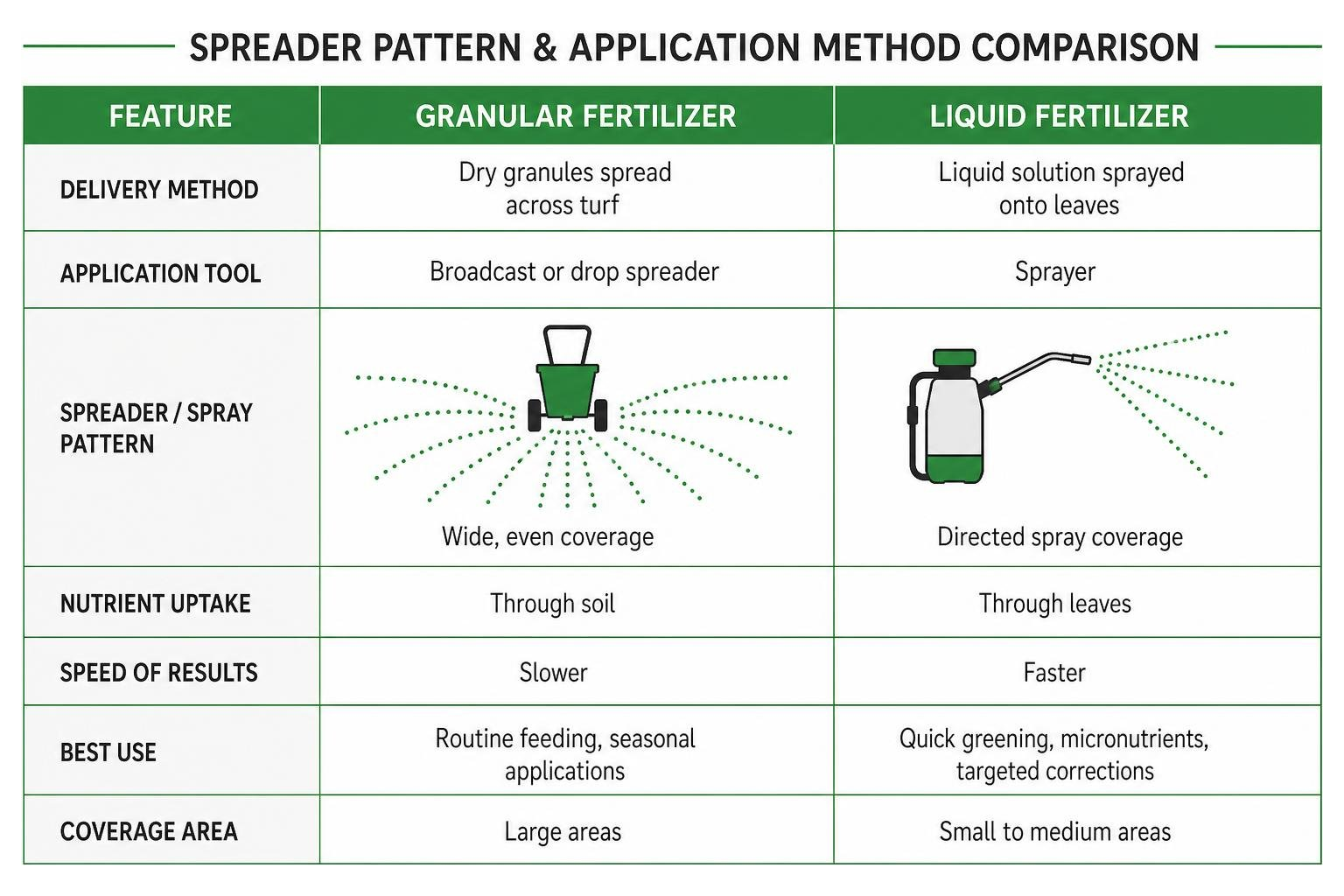
Applying fertilizer properly is just as important as selecting the right product. The method you choose dictates how evenly nutrients reach your soil:
| Feature | Granular Fertilizer | Liquid Fertilizer |
|---|---|---|
| Delivery Method | Dry granules spread across turf | Liquid solution sprayed onto leaves |
| Feeding Duration | 6 to 10 weeks (sustained release) | 2 to 4 weeks (rapid foliar intake) |
| Best Utility | Seasonal maintenance and soil building | Quick greening before events and micronutrients |
| Watering Requirement | Water immediately after spreading | Allow 3 to 24 hours to dry on leaf blades |
| Equipment Used | Rotary broadcast or drop spreader | Hose-end or backpack sprayer |
Timing Applications Throughout the Growing Season
Timing determines how efficiently grass roots absorb nutrients. Turfgrass cannot absorb nutrients effectively when soil temperatures drop below 50°F or rise above 85°F. You can read more about When to feed grass to build a calendar that aligns with regional growing windows.
For cool-season lawns across Hudson, Brecksville, and Twinsburg, structure your annual feeding schedule around four target milestones:
- Early Spring (April to May): Apply a light slow-release feeding or pre-emergent combination once soil temperatures reach 55°F to support initial green-up.
- Late Spring (Late May to June): Apply a balanced maintenance fertilizer (like 16-4-8) to build energy reserves before summer heat arrives.
- Early Fall (September): This is the most valuable application of the year. Apply 1 pound of actual nitrogen per 1,000 square feet to rebuild turf density following summer stress.
- Late Fall (October to November): Apply a late-season winterizer after leaf growth halts but while roots remain active to store carbohydrates for early spring recovery.
Step-by-Step Spreader Application and Safety
To avoid burning your grass or leaving patchy green stripes, follow these practical steps outlined in this Step by step application tips resource:
- Mow First: Mow the lawn to standard height before fertilizing so granules drop cleanly to soil level rather than catching on tall leaf blades.
- Fill Spreader Safely: Always load fertilizer spreaders on a driveway or patio. If you accidentally spill granules, scoop them up and sweep the area clean to prevent concentrated dead spots on turf.
- Apply Perimeter Header Passes: Walk two perimeter passes around the outer boundaries of your lawn with your spreader. This creates a safety border for turning around.
- Use Half-Rate Crisscross Patterns: Set your spreader dial to half the target rate on the bag label. Apply the product in parallel straight lines, then complete a second pass perpendicular to the first pass in a crisscross pattern. This guarantees seamless, streak-free coverage.
- Clean Hardscapes and Water In: Immediately sweep or blow stray granules off driveways and sidewalks back onto the grass to protect local waterways. Water granular fertilizers in with roughly 1/4 inch of water to wash nutrients down to the root zone.
Frequently Asked Questions About Lawn Fertilization
How often should lawn fertilizer be applied?
Most established lawns require 2 to 4 fertilizer applications per year spaced 6 to 8 weeks apart during active growth periods. Cool-season turf benefits most from strong fall applications, whereas warm-season turf thrives on late spring and midsummer feeding. Avoid over-fertilizing, as excess nitrogen creates soft growth susceptible to insect activity and fungal disease.
Should a lawn be watered immediately after fertilizing?
Yes, granular lawn fertilizers should be watered in with approximately 1/4 inch of irrigation within 24 hours of application. Watering activates slow-release coatings and washes nitrogen salts off leaf blades directly into soil roots. However, if you apply liquid foliar fertilizers or weed-and-feed combination products, wait 24 hours before watering or mowing to allow herbicides to absorb into weed leaves.
Is organic fertilizer safer for children and pets?
Organic fertilizers (like Milorganite or feather meal formulas) carry a significantly lower salt index than fast-release synthetics, eliminating the risk of leaf burn and chemical exposure. Once granular organic products are watered into the soil and allowed to dry completely, the lawn is safe for children and pets. Always check product safe-use labels for specific drying guidelines.
Conclusion

Achieving a vibrant, healthy lawn across Northeast Ohio comes down to selecting the best fertilizer for lawn grass, calculating accurate application rates, and timing treatments with natural grass growth cycles. By pairing proper soil nutrition with aeration and correct watering habits, you build strong turf roots that resist weeds, drought, and disease naturally.
At Advanced Quality Lawn, we take the guesswork out of yard care. Serving homeowners in Akron, Copley, Bainbridge, Cuyahoga Falls, Macedonia, and across Summit, Medina, Cuyahoga, Portage, Wayne, Geauga, and Stark counties, our experienced team provides custom fertilizing plans backed by full-program guarantees and exceptional customer service.
Ready to transform your yard into the envy of the neighborhood? Explore our Professional lawn maintenance services today or contact us to schedule your personalized lawn evaluation!