The Right Bahia Grass Weed and Feed Can Make or Break Your Lawn

Choosing the correct bahia grass weed and feed product is one of the most important decisions you can make for a southern warm-season lawn. Pick the wrong formula and you can kill the very grass you are trying to protect.
Here is a quick-reference guide to help you choose safely:
| Product | Active Herbicide | Safe for Bahia? | N-P-K |
|---|---|---|---|
| Ferti-lome Weed Out with Trimec | Trimec (2,4-D, MCPP, Dicamba) | Yes | 25-0-4 |
| Lesco Bahia Lawn Weed & Feed | 2,4-D, MCPP-p, Dicamba | Yes | 21-0-11 |
| Greenleaf Bahia Weed & Feed | 2,4-D, Dicamba, MCPP-P | Yes | Varies |
| Scotts Turf Builder Bonus S | Atrazine | No | 29-0-10 |
| Hi-Yield 15-0-10 Weed & Feed | Trimec | Check label | 15-0-10 |
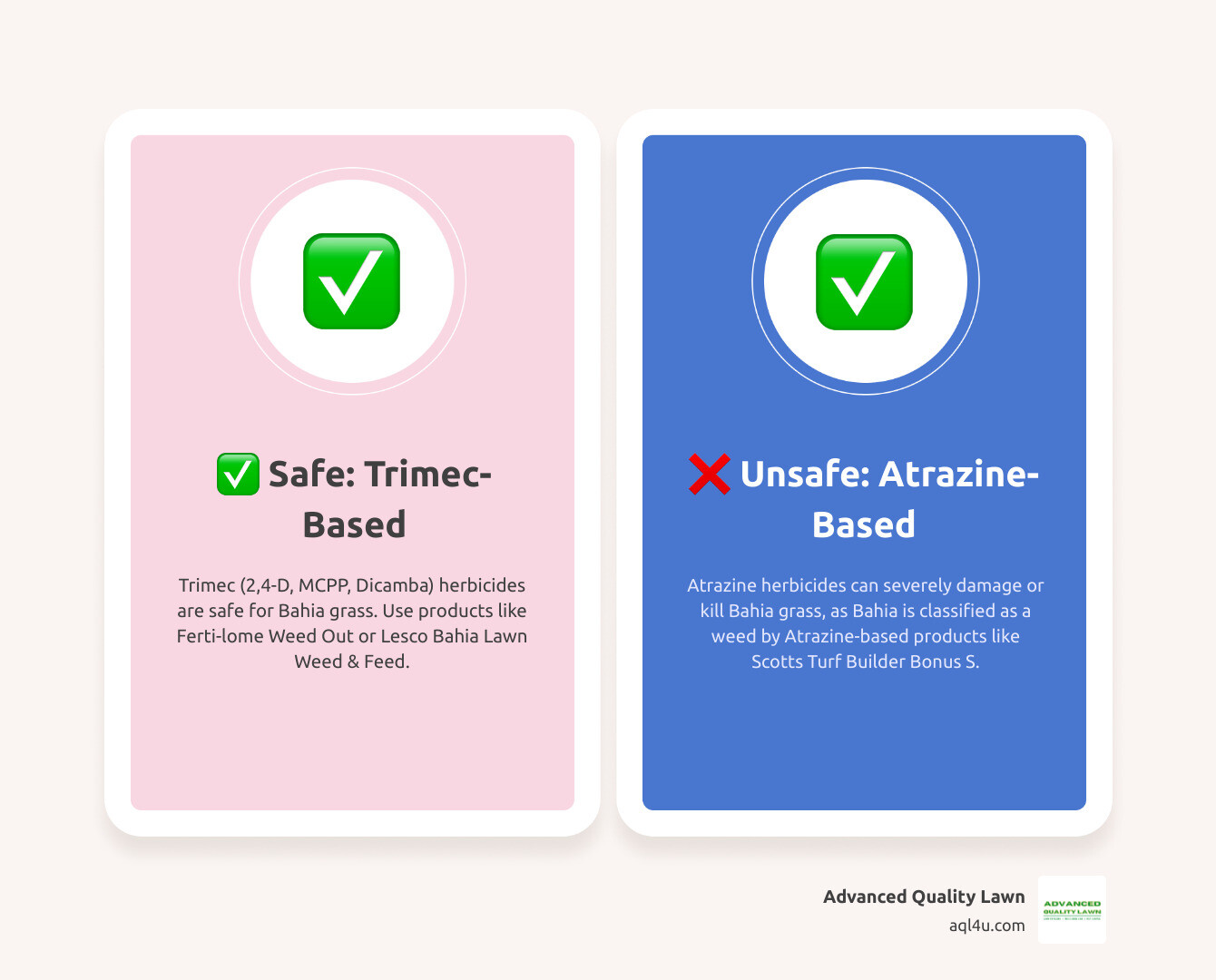
The golden rule: Trimec-based formulas are generally safe for Bahia grass. Atrazine-based products are not.
Many homeowners in the South grab a bag of popular "Southern" weed and feed off the shelf, not realizing that products like Scotts Turf Builder Bonus S contain Atrazine, which can severely damage or kill Bahia grass. As one lawn care source puts it, Bahia grass is actually classified as a weed by Atrazine-based products, which is why it reacts so badly to them.
I'm Andrew Day, owner of Advanced Quality Lawn, and with more than 30 years of industry experience, I have seen how the wrong bahia grass weed and feed choice can set a lawn back by an entire growing season. In this guide, I will walk you through exactly which products work, which ones to avoid, and when and how to apply them correctly.
Understanding Bahia Grass Weed and Feed Requirements
To keep Bahia grass healthy, we must first understand what it needs to grow. Bahia grass is a tough, drought-resistant warm-season grass that thrives in sandy soils. While it is highly popular in southern states like Florida, it is important to note that Bahia grass is not native to our home region of Northeast Ohio.
If you live in Akron, Hudson, Medina, or Cuyahoga Falls, your lawn consists of cool-season grasses like Kentucky Bluegrass or Tall Fescue. However, many of our local Ohio clients own seasonal properties down south, or they simply want to understand turf management. We believe in sharing our expert knowledge to help you care for any lawn, anywhere.
Bahia grass has very specific nutrient requirements. It requires 2 to 4 pounds of nitrogen per 1,000 square feet each year in Central and South Florida, and 2 to 3 pounds in North Florida. Unlike other warm-season grasses, Bahia grass does not do well with excessive fertilization, which can cause weak root systems and pest problems.
To help you visualize how Bahia grass compares to Bermuda grass, another common southern turf, we have put together this simple nutrient comparison:
| Grass Type | Annual Nitrogen Need (per 1,000 sq. ft.) | Potassium Requirement | Soil pH Preference |
|---|---|---|---|
| Bahia Grass | 2 to 4 pounds | Moderate (helps root health) | 5.5 to 6.5 (Acidic) |
| Bermuda Grass | 4 to 6 pounds | High (promotes wear recovery) | 6.0 to 7.0 (Slightly Acidic to Neutral) |
When you are looking to feed your lawn, understanding these numbers is critical. If you want to dive deeper into how fertilizers work in general, you can Learn more about fertilizer basics.
Selecting the Best Bahia Grass Weed and Feed Formula
When choosing a bahia grass weed and feed, the chemical formula is everything. The ideal product must use a selective herbicide that targets broadleaf weeds without touching your grass.
Trimec is the industry standard for this task. It is a highly effective combination of three active ingredients: 2,4-D, MCPP, and Dicamba. This combination is designed to target over 100 types of broadleaf weeds while keeping your Bahia grass perfectly safe.
For a balanced feeding, we often look at the N-P-K ratio, which represents the percentages of Nitrogen, Phosphorus, and Potassium in the bag. For example, you can review the Hancock Seed 15-0-10 fertilizer specifications to see how a low-nitrogen, high-potassium formula is structured. An 18 pound bag of this particular formula covers up to 5,000 square feet. It provides a gentle feeding that will not trigger excessive leaf growth, which is exactly what Bahia grass needs to stay strong and drought-resistant.
When to Apply Bahia Grass Weed and Feed for Maximum Efficacy
Timing is the secret to successful weed control. If you apply a weed and feed too early in the spring, the grass will not be active enough to absorb the nutrients, and the weeds will not be growing enough to absorb the herbicide.
You should wait to apply your weed and feed until the spring green-up is fully underway. This happens when outdoor temperatures are consistently above 65 degrees Fahrenheit. At this point, the grass has broken its winter dormancy and is actively growing.
For the weed-killing portion of the product to work, the targeted weeds must also be actively growing. If you are dealing with winter weeds or want to stop weeds before they even sprout, you should look into pre-emergent options. You can Discover the best pre-emergent weed killers to understand how to build a complete defense system for your lawn.
Herbicide Safety and Chemical Compatibility for Bahia Lawns
The biggest mistake we see homeowners make with Bahia lawns is applying Atrazine. Atrazine is a highly effective weed killer for St. Augustine and Centipede lawns, but it is toxic to Bahia grass. If you apply an Atrazine-based product, your Bahia grass will turn yellow, suffer severe root damage, and likely die.
Instead, always verify that the product you buy uses Trimec or a similar Bahia-safe chemical mixture. For example, the Greenleaf Bahia Weed and Feed registration details show that this product is EPA-approved for nine different turf types, including Bahia grass. It contains a very low concentration of active ingredients, with 0.18% 2,4-D, 0.08% Dicamba, and 0.32% MCPP-P. This low concentration is highly effective at clearing out weeds without putting stress on your lawn.
Managing weeds safely requires a careful approach. If you want to learn more about the absolute best ways to clear your yard of invasive plants, you can Explore our best solutions to kill weeds.
Best Practices for Applying Weed and Feed to Warm-Season Lawns
Applying a granular weed and feed is not as simple as throwing it on the grass and hoping for the best. To get the best results, you must follow a few professional steps.
First, you need to calibrate your spreader. Using the wrong setting can lead to over-application, which can burn your lawn, or under-application, which will leave the weeds untouched.
Second, pay attention to moisture. For a granular weed and feed to kill existing weeds, the granules must physically stick to the weed leaves. The best way to achieve this is to apply the product in the early morning when the lawn is covered in dew, or to lightly mist the lawn before spreading.
Once the product is down, do not water the lawn or allow rain to fall on the treated area for at least 24 hours. This gives the herbicide enough time to be absorbed by the weeds. After that initial 24-hour window, you should water the lawn thoroughly to wash the fertilizer down into the soil, where the grass roots can reach it.
If you are looking for general advice on choosing the right fertilizer for other grass types, check out our Guide to the best fertilizer for grass.
Frequently Asked Questions About Bahia Grass Care
Is atrazine safe for bahia grass lawns?
No. Atrazine is not safe for Bahia grass lawns. Bahia grass is highly sensitive to this chemical, and applying it will cause severe yellowing, root damage, and lawn death. Always read the active ingredients on the label and choose Trimec-based products instead.
What is the best weed and feed for bahia grass?
The best weed and feed for Bahia grass is one that uses a Trimec herbicide mixture and has a balanced N-P-K ratio. Excellent options include Ferti-lome Weed Out with Trimec, which has a 25-0-4 ratio and covers up to 10,000 square feet per 20 pound bag, and Lesco Bahia Lawn Weed & Feed, which features a 21-0-11 ratio.
Can I use weed and feed on newly seeded bahia grass?
No, you should never apply a weed and feed to newly seeded or sprigged Bahia grass. The herbicides in these products will damage the young, developing root systems of new grass seedlings. You should wait until the new grass is fully established, which usually means waiting until you have mowed the lawn at least three to four times, before applying any chemical weed control. To learn more about caring for young grass, you can Learn about new turf fertilizer guidelines.
Conclusion
Caring for a Bahia grass lawn requires a careful hand and the right knowledge. By choosing Bahia-safe, Trimec-based products and avoiding toxic chemicals like Atrazine, you can keep your southern lawn green, thick, and completely free of weeds.
While Bahia grass is a fantastic choice for southern climates, our lawns here in Northeast Ohio require a completely different approach. Cool-season grasses like Kentucky Bluegrass, Ryegrass, and Fescue need specialized fertilization, aeration, and weed control programs to survive our cold winters and hot summers.
At Advanced Quality Lawn, we provide premium lawn care, tree, and shrub services across Northeast Ohio. We serve clients in Hudson, Brecksville, Copley, Bainbridge, Solon, Chagrin Falls, Broadview Heights, Parma, Medina, Macedonia, Cleveland, Richfield, Stow, Twinsburg, Streetsboro, Boston Heights, Cuyahoga Falls, Peninsula, Independence, Seven Hills, North Royalton, and Sagamore Hills. Our services cover Summit County, Medina County, Cuyahoga County, Portage County, Wayne County, Geauga County, Lorain County, and Stark County.
We pride ourselves on our excellent customer service, which includes prompt service calls and full-program guarantees. If you want to take the guesswork out of your lawn care, we are here to help. You can Schedule professional lawn care maintenance with us today and let our local experts give your yard the professional treatment it deserves.