
Apply Lawn Fertilizer Evenly for Healthier Grass

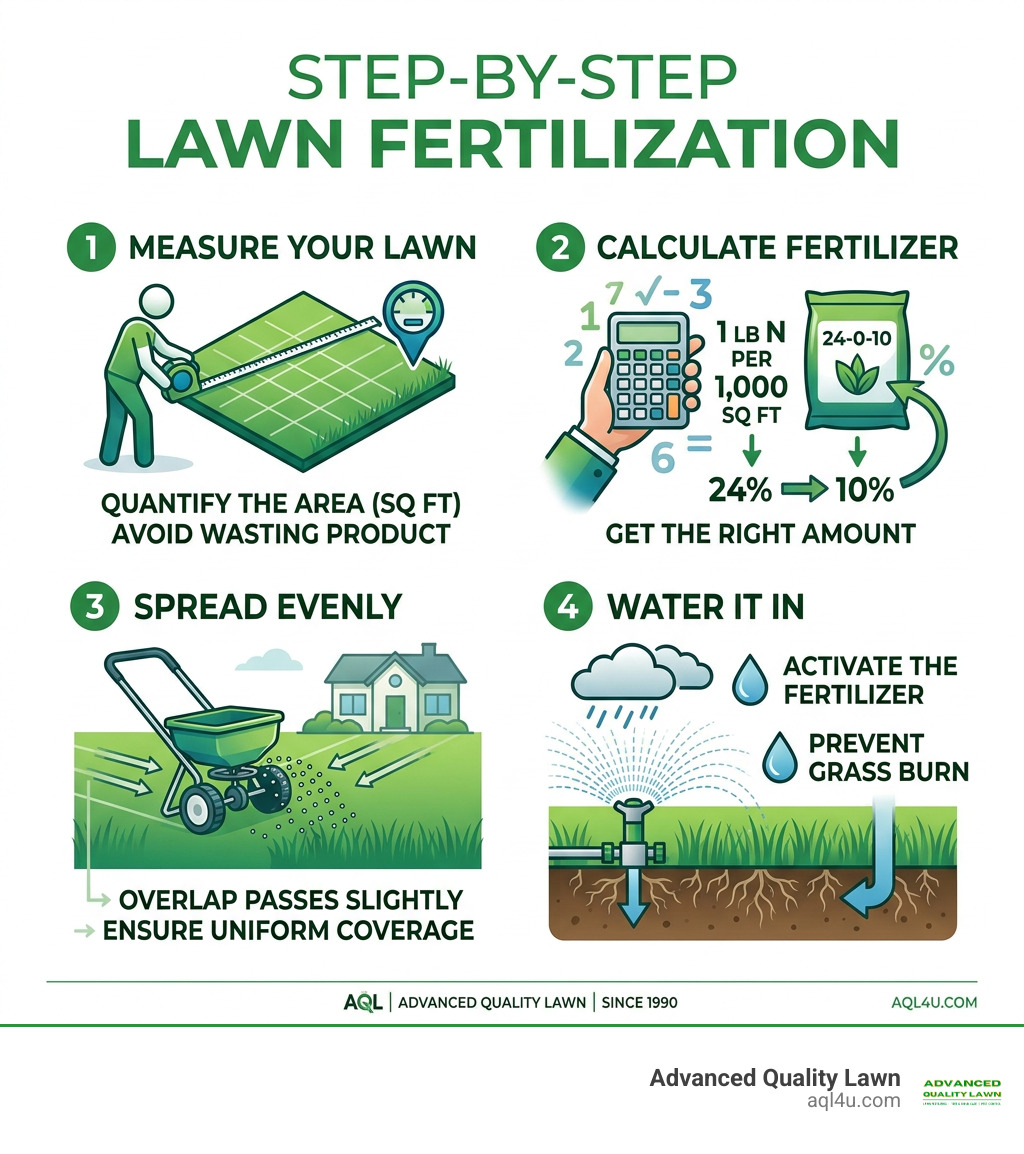
For successful applying lawn fertilizer, measure your lawn, choose a turf fertilizer that fits its needs, and apply no more than the label rate with a calibrated spreader. Apply granules to dry grass during active growth, overlap passes slightly, sweep stray fertilizer off pavement, and water it into the soil afterward unless the product label says otherwise.
Most lawns need about 1 pound of actual nitrogen per 1,000 square feet per application, but the right product amount depends on the nitrogen percentage printed on the bag. Good timing matters too. In Northeast Ohio, cool-season lawns such as bluegrass, fescue, and ryegrass get their most valuable feeding in fall.
A careful application can take a typical suburban lawn less than 20 minutes. The payoff is thicker turf, stronger roots, and fewer openings for weeds, without wasted fertilizer or burn marks.
I am Andrew Day of Advanced Quality Lawn. With more than 30 years of lawn care experience behind our locally operated Northeast Ohio team, I help homeowners make applying lawn fertilizer safer, more accurate, and better suited to Ohio's changing seasons.
Understanding Nutrients and Fertilizer Selection
When you pick up a bag of grass food, the first detail you notice is three bold numbers across the label. This NPK ratio represents the percentage by weight of nitrogen (N), phosphate (P), and potash (K).
Nitrogen drives vegetative blade growth and rich green color. Phosphorus supports early root system development, though established lawns across Northeast Ohio rarely need extra phosphorus unless a soil test confirms a deficit. Potassium strengthens overall plant health, bolstering cell walls so turf can resist cold winters, summer heat, and foot traffic.
To understand the core components behind these ratios, reviewing our guide on fertilizer fundamentals and seasonal needs provides helpful baseline context. A soil test kit from a garden center ($10 to $30) or a county extension laboratory test ($15 to $50) will clarify your lawn's exact nutrient requirements and pH level, which ideally stays between 6.0 and 7.0.
Choosing between nitrogen delivery methods is another critical decision. Quick-release nitrogen acts like a fast shot of energy, greening the turf in a few days. However, quick-release forms carry higher salt indexes that can scorch grass blades if misapplied, and they deplete within 2 to 4 weeks. Slow-release nitrogen, such as sulfur-coated urea or natural organic materials, feeds the turf steadily across 6 to 10 weeks. It dramatically lowers burn risk, supports deep root expansion, and prevents excess nitrates from leaching past the root zone.
Deciding between granular products and liquid sprays depends on your project goals. Selecting a balanced lawn fertilizer guide will help you determine the right physical format for your schedule.
| Feature | Granular Fertilizer | Liquid Fertilizer |
|---|---|---|
| Feeding Duration | 6 to 10 weeks (slow release) | 2 to 4 weeks (quick response) |
| Application Equipment | Rotary or drop spreader | Hose-end or pump sprayer |
| Foliar Burn Risk | Low to moderate (if dry applied) | Low if diluted accurately |
| Cost per Treatment | Economical for large lawns | Higher cost for extensive acreage |
| Primary Advantage | Sustained root and turf nourishment | Rapid green-up and foliar absorption |

How to Calculate Proper Fertilizer Rates and Lawn Area
Applying grass nutrients requires accurate math. Spreading by guesswork often results in yellow salt-burned streaks or an underfed yard.
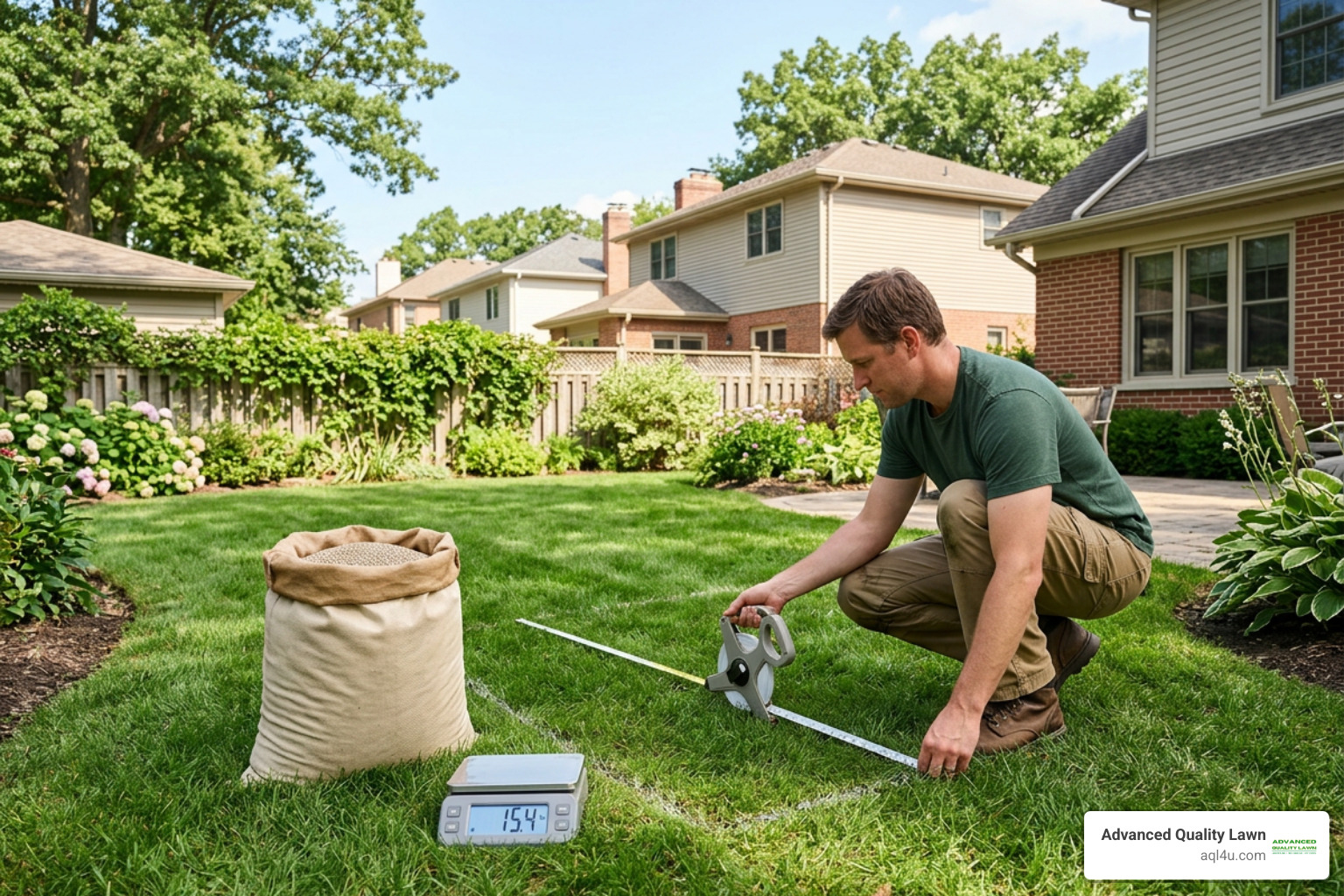
First, measure your property dimensions to calculate total square footage. Subtract driveways, patios, and house footprints. For a simple rectangular yard of 100 feet by 50 feet, your area is 5,000 square feet.
The agronomic gold standard for most lawns is 1 pound of actual nitrogen per 1,000 square feet per feeding. To find out how much product you need, divide your target nitrogen weight by the decimal percentage of nitrogen on the bag.
For instance, if your product has an NPK rating of 20-5-10, the nitrogen percentage is 20 percent (0.20):
$$ \frac{1.0\text{ lb target nitrogen}}{0.20\text{ nitrogen percentage}} = 5\text{ lbs of fertilizer product per 1,000 sq ft} $$
If your lawn measures 5,000 square feet, multiply 5 pounds by 5 to arrive at 25 pounds of fertilizer for the full application.
Similarly, for a high-nitrogen 32-0-4 formulation:
$$ \frac{1.0\text{ lb target nitrogen}}{0.32} = 3.125\text{ lbs of fertilizer product per 1,000 sq ft} $$
For that same 5,000-square-foot lawn, you would spread 15.6 pounds of product total. For more detailed calculation formulas across non-standard ratios, check university guidelines on calculating lawn fertilizer rates to match your bag specs.
Step-by-Step Guide to Applying Lawn Fertilizer
Mow your lawn 1 to 2 days before fertilizing, keeping grass at standard heights of 3 to 3.5 inches. Ensure the grass blades are completely dry before loading your spreader. Granules that touch moist foliage will stick, dissolve quickly, and create chemical blade burn.
Follow this sequential application method for uniform turf feeding, as outlined in our comprehensive lawn fertilizer guide:
- Sweep and Prep: Close the spreader hopper shut-off lever before adding product. Fill the hopper on a concrete driveway or patio rather than on the lawn so accidental spills do not kill grass patches.
- Set the Flow Dial: Adjust your spreader dial to the manufacturer setting listed on the product label. If you are uncertain of the calibration, set the rate to half the recommended output and plan for two cross-hatch passes.
- Walk the Perimeter: Apply two header passes along the perimeter borders of the property. If your spreader features an edge shield, engage it to keep product out of landscape beds and off sidewalks.
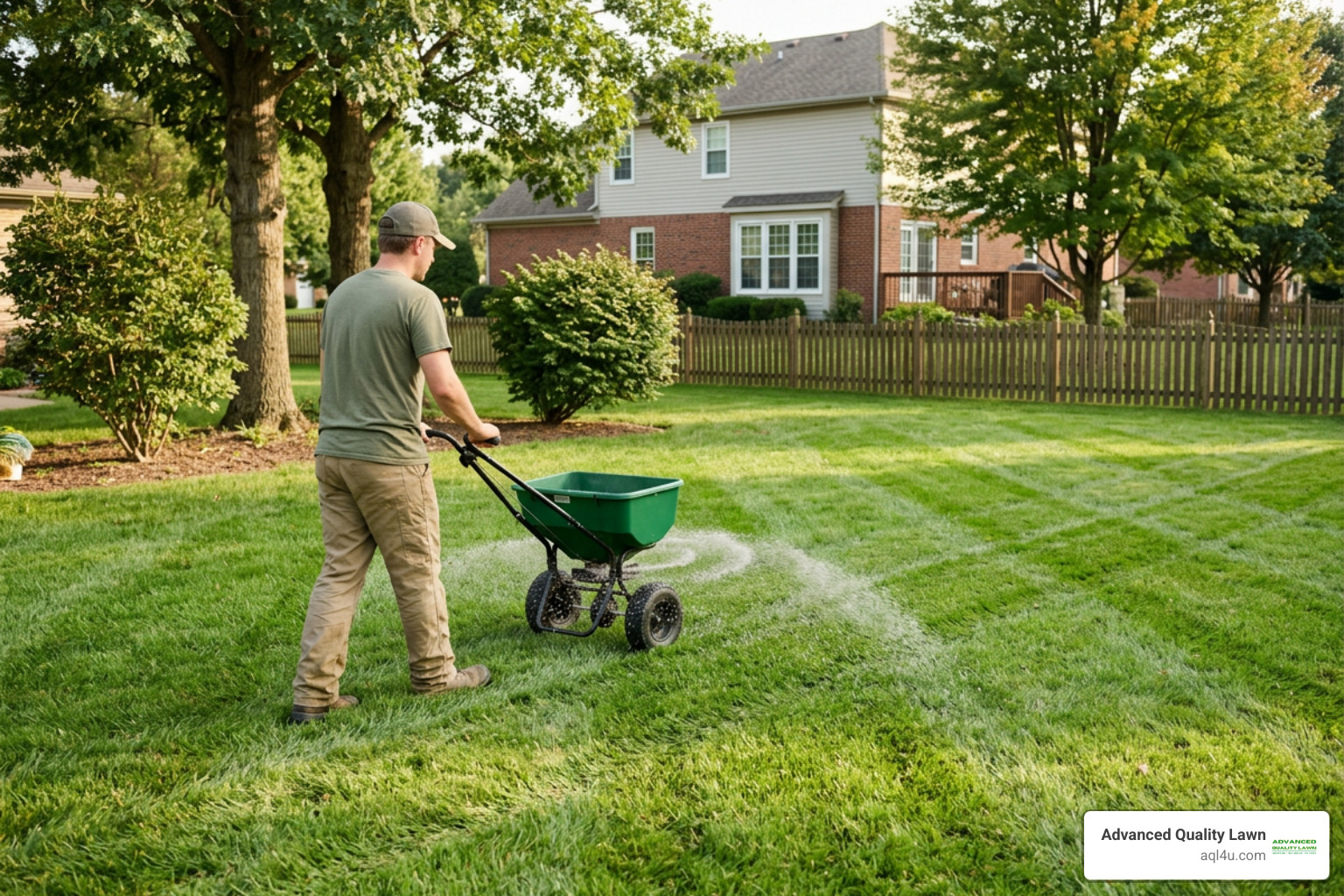
- Fill the Center Rows: Push the spreader up and down the lawn in straight parallel lines, releasing the trigger as you approach turning points at each header strip. Overlap each pass so the wheel path aligns with the outer edge of the previous spread pattern.
- Cross-Hatch Pattern: For optimal uniformity, apply half the product traveling north-to-south and the remaining half traveling east-to-west.
- Clean Paved Surfaces: Sweep or blow stray granules from hard surfaces back into the turf immediately.
Equipment Setup for Applying Lawn Fertilizer Accurately
Broadcast rotary spreaders use a spinning disc beneath the hopper to fan granules outward over a 6 to 12-foot swath. They are ideal for medium and large properties in Cuyahoga and Summit counties. Drop spreaders deposit fertilizer straight downward between the wheels, making them superior for tight, narrow yards or areas right beside delicate flower borders. Small urban patches under 1,000 square feet can be fed using a handheld rotary unit.
Always calibrate your spreader hopper before initial spring use. Check that the sliding shut-off plate opens evenly and closes fully when the handle lever is released.
Best Timing When Applying Lawn Fertilizer by Grass Type
Cool-season grasses like Kentucky bluegrass, perennial ryegrass, and fine fescues dominate Northeast Ohio. These varieties thrive in moderate soil temperatures between 55 and 70 degrees Fahrenheit.
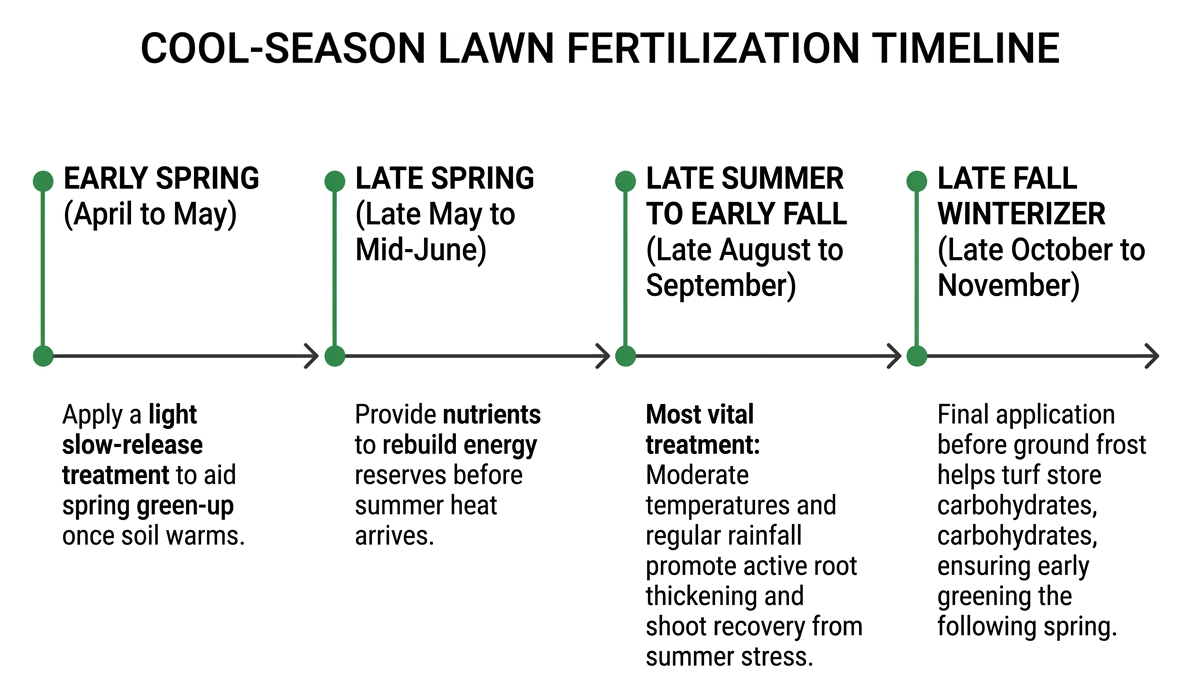
A high-performing cool-season program includes 2 to 4 feedings per season:
- Early Spring (April to May): Apply a light slow-release treatment to aid spring green-up once soil warms.
- Late Spring (Late May to Mid-June): Provide nutrients to rebuild energy reserves before summer heat arrives.
- Late Summer to Early Fall (Late August to September): The most vital treatment of the entire year. Moderate temperatures and regular rainfall promote active root thickening and shoot recovery from summer stress.
- Late Fall Winterizer (Late October to November): A final application before ground frost helps turf store carbohydrates, ensuring early greening the following spring.
You can learn more about university recommendations on seasonal feeding through extension recommendations for seasonal lawn fertilization to keep root zones healthy. Pair this with our detailed advice on autumn feeding strategies for cold-hardy turf.
Post-Application Care and Common Mistakes to Avoid
Once your spreader is parked, water the yard lightly with roughly one-quarter to one-half inch of water. Moisture washes granules off grass foliage and moves nutrients down into the upper root zone.
Keep people and pets off the lawn until the grass has dried thoroughly. Delay mowing for at least 24 to 48 hours after application so mower blades do not suction up or scatter granules.
Understanding the difference between organic vs synthetic fertilizer will also help you plan appropriate post-care and watering schedules.
Watch out for these common fertilization mistakes:
- Applying granular fertilizer to damp or morning-dew-covered grass, which causes salt burn.
- Fertilizing within 24 hours of an incoming torrential thunderstorm, washing valuable nutrients into storm drains.
- Leaving scattered fertilizer granules on driveways, walkways, and street gutters.
- Applying fast-release high-nitrogen blends during the extreme heat of July or August.
- Guessing spreader settings instead of calculating nitrogen weight by property square footage.
Frequently Asked Questions About Lawn Fertilization
Can you apply fertilizer to wet grass?
You should not apply standard granular fertilizer to wet grass blades. Moisture causes granules to cling to foliar tissue. As the salt dissolves on the blade, it pulls internal moisture out of the leaf through osmosis, resulting in brown scorched streaks. Always wait until the turf is completely dry before spreading granules, then water the lawn to wash the product down to the soil.
How soon should you water after applying fertilizer?
For granular products, water the lawn immediately or within 24 to 48 hours. Applying about one-quarter inch of irrigation dissolves the nutrient coating and activates root absorption. If you applied a liquid foliar fertilizer or a combination weed-and-feed product designed to stick to weed foliage, wait 24 to 48 hours before watering or running an irrigation cycle.
How many times a year should you fertilize your lawn?
Most residential lawns perform best with 2 to 4 applications per year. Cool-season turf thrives with a schedule focused on late summer, mid-fall, and light spring feedings. High-maintenance lawns in full sun benefit from 3 to 4 balanced treatments totaling 3 pounds of actual nitrogen per 1,000 square feet across the full growing season.
Conclusion
A well-planned fertilization routine builds dense, resilient turf that handles weed pressure, foot traffic, and changing weather conditions with ease. By calculating your square footage accurately, choosing the proper slow-release formulations, and spreading your passes in an even grid, your lawn will stay healthy throughout the entire growing season.
If you prefer to save time on calculating rates, hauling bags, and calibrating equipment, our team at Advanced Quality Lawn is here to help. We provide custom fertilization programs, free service calls, and full-program guarantees across Akron, Cleveland, Medina, and surrounding Northeast Ohio communities. Explore our professional lawn care and maintenance programs today to give your turf the expert care it deserves.