
Best Crabgrass Killer Roundup: From Commercial Grade to DIY
Commercial vs. DIY Crabgrass Herbicides: Key Differences

The best crabgrass killer for large or mature infestations is concentrated quinclorac, while ready-to-use multi-active sprays offer the best solution for quick DIY spot treatments. Choosing between commercial-grade concentrates and store-bought formulas comes down to the size of your lawn, your equipment, and the maturity of invasive crabgrass you need to tackle. While both categories aim to give you a pristine yard, their chemical strength, cost efficiency, and preparation requirements differ significantly.
Commercial formulations typically feature higher concentrations of active ingredients like quinclorac, fenoxaprop-p-ethyl, or topramezone. These professional products are packaged as liquid concentrates or dispersible granules designed for precision tank mixing. Because of their potency, they can tackle aggressive weed infestations and multi-tiller plants that weaker products fail to eliminate. Achieving effective crabgrass control for lawns often requires these concentrated formulas when weeds have spread across large properties.
DIY options usually come in convenient ready-to-use spray bottles with battery-powered wands or hose-end attachments. These formulas are pre-diluted to ensure safety for the average homeowner. They lower the risk of accidentally burning your grass, making them ideal for quick spot treatments along driveway borders and sidewalk cracks. However, because they contain a lower percentage of active ingredients, mature weeds may survive a single DIY application.
| Feature | Commercial Concentrates | DIY Ready-to-Use Sprays |
|---|---|---|
| Primary Active Ingredients | Concentrated Quinclorac, Mesotrione, Fenoxaprop | Diluted Quinclorac, 2,4-D, Dicamba, Sulfentrazone |
| Target Weed Maturity | Seedlings up to mature plants with 4+ tillers | Early seedlings to young 1-2 tiller weeds |
| Preparation Required | Tank mixing, measuring, adding surfactants | None, connect wand or shake and spray |
| Cost per Treated Gallon | Extremely low, often under $2.00 per mixed gallon | Higher per square foot due to premixed water weight |
| Application Method | Calibrated pump or backpack sprayers | Battery trigger wand, trigger bottle, garden hose |
| Lawn Area Best Suited For | Half-acre to multi-acre properties, heavy infestations | Small suburban lawns, localized spot treatment |
When it comes to cost efficiency, commercial products win by a wide margin. A commercial bottle may have a higher initial purchase price, but one container can yield dozens of finished gallons. When mixed with an appropriate adjuvant, commercial quinclorac costs around $1.60 per finished gallon. By contrast, buying multiple single-use jugs for large infestations quickly becomes expensive.
Equipment and additives represent another clear difference. Commercial options require a dedicated pump sprayer and often need an adjuvant, such as methylated seed oil or non-ionic surfactant, to penetrate the waxy outer layer of grassy weeds. DIY ready-to-use sprays include built-in wetting agents and require zero math. When choosing the right lawn spray for crabgrass, decide whether you want the turnkey ease of a trigger bottle or the raw economic power of a commercial concentrate.
Top Contenders for the Best Crabgrass Killer in 2026
Every yard faces different weed pressures, grass varieties, and seasonal timing challenges. Testing top formulas across cool-season turf demonstrates that no single chemical fits every possible scenario. Our comprehensive crabgrass control guide for 2026 evaluates these standout options based on speed, grass safety, and overall killing power.
Commercial Quinclorac Herbicide: Best Crabgrass Killer for Commercial Power
For stubborn summer infestations, liquid quinclorac formulations like Drive XLR8 represent the gold standard in modern weed management. This commercial-grade post-emergent targets difficult annual grassy weeds along with several troublesome broadleaf invaders such as clover, dandelion, and bindweed.
Quinclorac works through both foliar absorption and root uptake, disrupting plant growth enzymes rapidly. It controls newly emerged summer annual grasses as well as mature plants that have developed past the four-tiller stage. At maximum label application rates, it delivers up to 45 days of residual soil activity, stopping late-germinating seeds in their tracks.
- Active Ingredient: Quinclorac (18.92%)
- Target Weeds: Large and smooth crabgrass, foxtail, barnyardgrass, clover, dandelion, torpedograss
- Application Rate: 1.45 fluid ounces per 1,000 square feet (64 fl oz per acre) mixed in 1 to 2 gallons of water
- Surfactant Needed: Requires methylated seed oil (MSO) or crop oil concentrate for full leaf penetration
- Turf Tolerance: Excellent safety on Kentucky bluegrass, tall fescue, fine fescue, and perennial ryegrass
The standard mixing ratio is 1.45 fl oz per gallon of water per 1,000 square feet. A single half-gallon container treats an entire acre of turf, delivering unbeatable value for large properties. To get the best results, always pair quinclorac with a quality methylated seed oil. This adjuvant breaks surface tension on the thick, upright blades of grassy weeds, ensuring the active chemical enters the plant vascular system. Pair this commercial concentrate with a dedicated postemergence broadleaf and crabgrass herbicide strategy to keep your lawn clean all summer.
Triple-Active Ready-to-Use Herbicide: Best Crabgrass Killer for DIY Convenience
Homeowners who want immediate results without measuring concentrates frequently turn to Bayer Advanced All-In-One Lawn Weed & Crabgrass Killer RTU. This premixed product blends three powerful weed-fighting ingredients into a single spray container, providing a simple way to knock out mixed weed patches.
The combination of 2,4-D, quinclorac, and dicamba attacks both broadleaf weeds and nuisance grasses at the cellular level. Broadleaf targets show visible curling and twisting within hours of contact, while crabgrass begins wilting shortly after application. Target weeds dry up and die completely within 14 to 28 days.
- Active Ingredients: 2,4-D (0.313%), Quinclorac (0.104%), Dicamba (0.029%)
- Target Weeds: Crabgrass, dandelions, plantain, clover, chickweed, and over 200 common yard weeds
- Coverage: Ready-to-use bottle treats up to 5,000 square feet of problem spots
- Rainfast Time: Dries and becomes rainproof within 1 hour of application
- Grass Safety: Safe for northern lawns like Kentucky bluegrass and fescues. Do not use on St. Augustine or centipedegrass
This ready-to-use formula shines as a spot treatment for random weed flare-ups. Because the solution is already balanced, you avoid accidental over-application that could scorch desirable turf. If you need the best way to get rid of crabgrass without investing in professional spray rigs, this triple-action option provides reliable performance straight out of the box.
Broad-Spectrum Lawn Weed and Crabgrass Killer
When speed is your top priority, Spectracide Weed Stop For Lawns Plus Crabgrass Killer Concentrate stands out by producing visible leaf wilting in as fast as 5 hours. It utilizes a four-way active ingredient blend to wipe out both tough grassy invaders and persistent broadleaf species.
This formula incorporates sulfentrazone alongside quinclorac, 2,4-D, and dicamba. Sulfentrazone works as a contact cell-membrane disruptor that causes rapid desiccation on weed foliage. Meanwhile, the systemic components move deep into root systems, preventing target weeds from regenerating from the crown.
- Active Ingredients: 2,4-D (3.74%), Quinclorac (1.79%), Dicamba (0.43%), Sulfentrazone (0.22%)
- Weed Spectrum: Kills over 470 types of weeds as listed, including crabgrass, foxtail, and yellow nutsedge
- Packaging and Coverage: 32 oz concentrate container treats up to 5,000 square feet
- Application Window: Apply during mild weather when daytime temperatures stay between 45°F and 90°F
- Speed of Action: Fast knockdown with leaf yellowing noticeable the same afternoon
This multi-ingredient concentrate is an affordable option for mixed weed populations. It allows you to address dandelions, clover, and young crabgrass in one pass. However, avoid applying it to northern lawns during intense summer heat waves above 90°F to prevent temporary lawn yellowing. Incorporating a top pre-emergent weed killer for lawns early in the season can significantly cut down on the amount of broad-spectrum spray needed later in the summer.
Dithiopyr Lawn Crabgrass Control
Prevention remains the most effective long-term weed strategy, and Preen Lawn Crabgrass Control delivers dual-action performance using granular dithiopyr. Unlike standard pre-emergents that only stop unsprouted seeds, this chemistry offers both preventative and early post-emergent power.
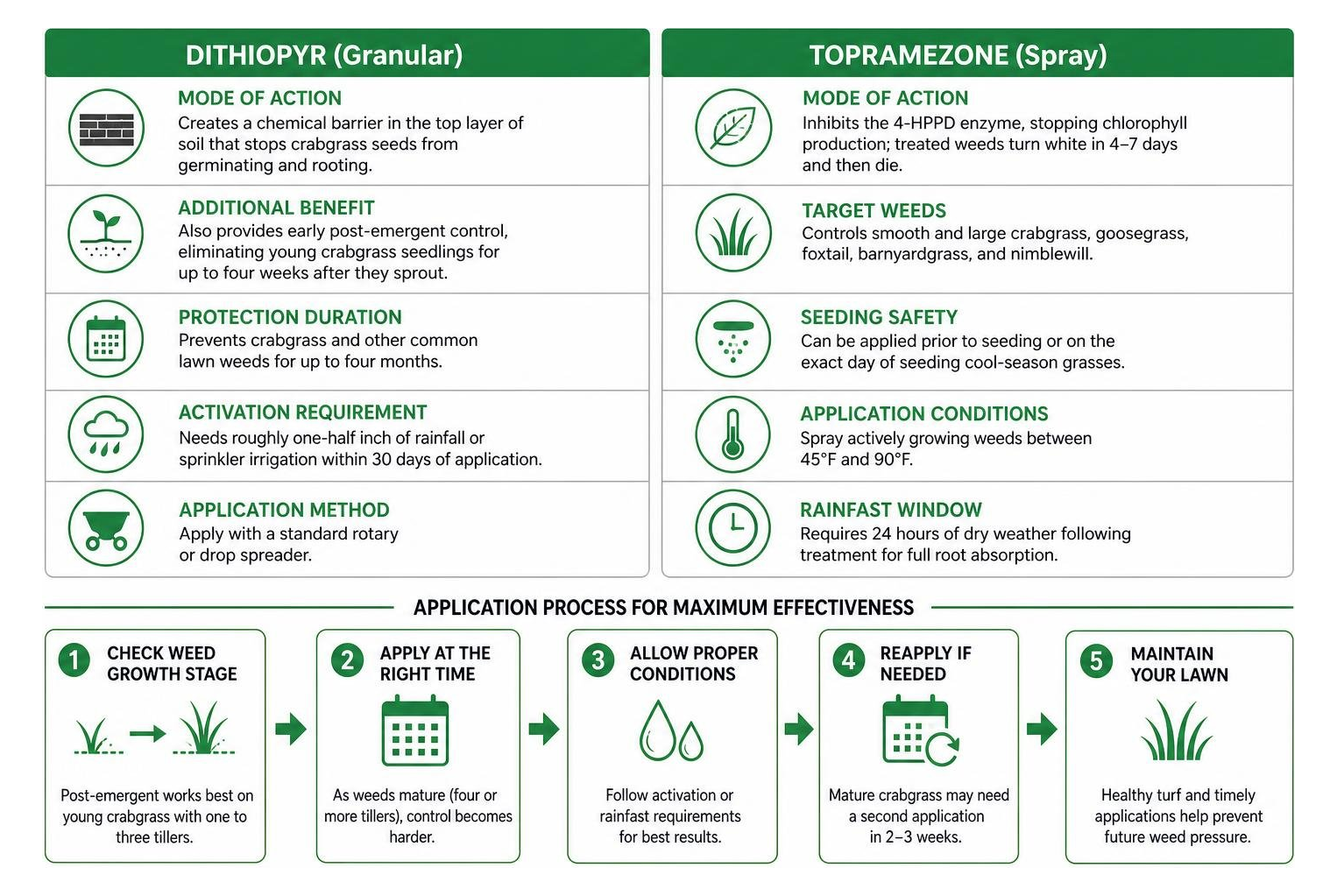
Dithiopyr creates an invisible chemical barrier across the top layer of soil that stops germinating seeds from developing roots. Additionally, it offers early post-emergence control, eliminating young crabgrass seedlings for up to four weeks after they sprout. This extended window gives homeowners a valuable safety cushion if spring weather delays their initial application.
- Active Ingredient: Dithiopyr (0.19%)
- Coverage: A 15 lb bag provides uniform coverage across 5,000 square feet
- Protection Duration: Prevents crabgrass and other common lawn weeds for up to four months
- Application Method: Standard rotary or drop lawn spreader
- Activation Requirement: Needs roughly one-half inch of rainfall or sprinkler irrigation within 30 days of application
Granular dithiopyr is an excellent option for property owners who prefer using a broadcast spreader rather than mixing liquid sprays. It controls more than 40 common lawn weeds including chickweed, henbit, and yellow foxtail. Applying this product in early spring establishes a dependable four-month barrier that keeps your turf clean through midsummer.
Topramezone Crabgrass Destroyer
For targeted grassy weed removal without harming newly sown grass seed, Roundup for Lawns Crabgrass Destroyer2 uses specialized topramezone chemistry. This selective post-emergent is engineered specifically to eliminate competitive grassy weeds in cool-season turf.
Topramezone inhibits the 4-HPPD enzyme inside target plants, breaking down their chlorophyll production. Without chlorophyll, treated weeds turn striking white within 4 to 7 days of application before withering away completely. Desirable cool-season grasses like Kentucky bluegrass and fine fescue process the chemical safely, maintaining their natural green color.
- Active Ingredient: Topramezone (0.0092%)
- Target Grasses: Smooth and large crabgrass, goosegrass, foxtail, barnyardgrass, nimblewill
- Seeding Safety: Can be applied prior to seeding or on the exact day of seeding cool-season grasses
- Application Conditions: Spray actively growing weeds between 45°F and 90°F
- Rainfast Window: Requires 24 hours of dry weather following treatment for full root absorption
This herbicide is uniquely suited for fall renovation and spring overseeding projects. While most post-emergent weed killers require you to wait several weeks before or after spreading grass seed, topramezone allows you to treat invasive grasses on the day of seeding. This gives your new grass seed room to establish without battling aggressive weed competition.
How to Apply Crabgrass Killer for Maximum Effectiveness
Applying an effective chemical is only half the battle. Proper timing and technique determine whether weeds die completely or quickly recover. Following basic turf management practices ensures your herbicide performs at its absolute best while protecting desirable grass.
First, check the growth stage of the weed before spraying. Post-emergent herbicides work best on young plants that have one to three tillers. As crabgrass matures and develops four or more tillers, its thick root crowns become harder to kill, often requiring a second application two to three weeks later. Inspect your turf frequently in early summer to catch weed seedlings when they are smallest and most vulnerable.
Weather conditions play a crucial role during application. Apply liquid sprays when daytime temperatures remain consistently between 65°F and 85°F. Spraying turf during severe summer heat above 90°F stresses cool-season grasses and can cause temporary lawn browning. Never treat lawns experiencing drought stress. Ensure the soil has adequate moisture from rainfall or watering a day or two prior to treatment.
Mowing schedules also affect how well the plant absorbs the chemical. Avoid mowing your lawn for two days before spraying. Leaving adequate leaf surface area gives the herbicide plenty of foliage to land on and absorb. After spraying, hold off on mowing for another two days so the active ingredients can travel down into the root system undisturbed.
Pay close attention to moisture and rainfast windows. Most liquid concentrates dry within one to two hours, but they need roughly 24 hours without rainfall or overhead irrigation to achieve maximum root absorption. If you are mixing a concentrated herbicide like quinclorac, always add the recommended surfactant to prevent the spray droplets from beading up and rolling off waxy weed leaves. For comprehensive seasonal strategies, consult our ultimate crabgrass removal guide for summer to stay ahead of tough weed cycles.
Frequently Asked Questions About Crabgrass Control
What kills crabgrass without killing desired turfgrass?
Selective post-emergent herbicides containing active ingredients like quinclorac, topramezone, or fenoxaprop-p-ethyl kill crabgrass without damaging common cool-season turfgrasses. Kentucky bluegrass, tall fescue, and perennial ryegrass tolerate these selective compounds when applied according to the manufacturer label rates. Always verify your specific turf species on the product package before application to avoid unwanted lawn injury.
When is the best time to apply crabgrass killer?
The best time to apply a pre-emergent killer is in early spring when 2-inch soil temperatures reach 50°F to 55°F for several consecutive days, just before weed seeds sprout. For post-emergent treatments, spray in late spring or early summer when weeds are actively growing and have fewer than four tillers. Applying treatments on calm, mild mornings ensures excellent leaf absorption and prevents spray drift onto garden plants.
Can pre-emergent herbicides kill existing crabgrass?
Most traditional pre-emergent herbicides create a barrier that stops new seeds from sprouting, but they cannot kill weeds that have already broken through the soil. However, specialty pre-emergents formulated with dithiopyr provide early post-emergence knockdown on young crabgrass seedlings up to four weeks after germination. If crabgrass has developed multiple tillers, you must use a dedicated selective post-emergent spray.
Conclusion
Choosing the right weed control product keeps your lawn looking its best all season long. Concentrated quinclorac herbicides offer unmatched power and cost efficiency for widespread infestations, while premixed formulas provide quick convenience for everyday spot treatments. Pairing pre-emergent barriers with targeted post-emergent sprays gives you a complete defense against aggressive summer weeds.
Maintaining thick, healthy turf through balanced fertilization, proper watering, and correct mowing heights is the ultimate defense against weed invasion. If you want a weed-free yard without the guesswork of handling chemicals and equipment, our local team at Advanced Quality Lawn is ready to help. Explore our professional lawn care and maintenance programs to protect your lawn with proven, season-long care.