
Understanding the 4 Step Lawn Fertilizer System
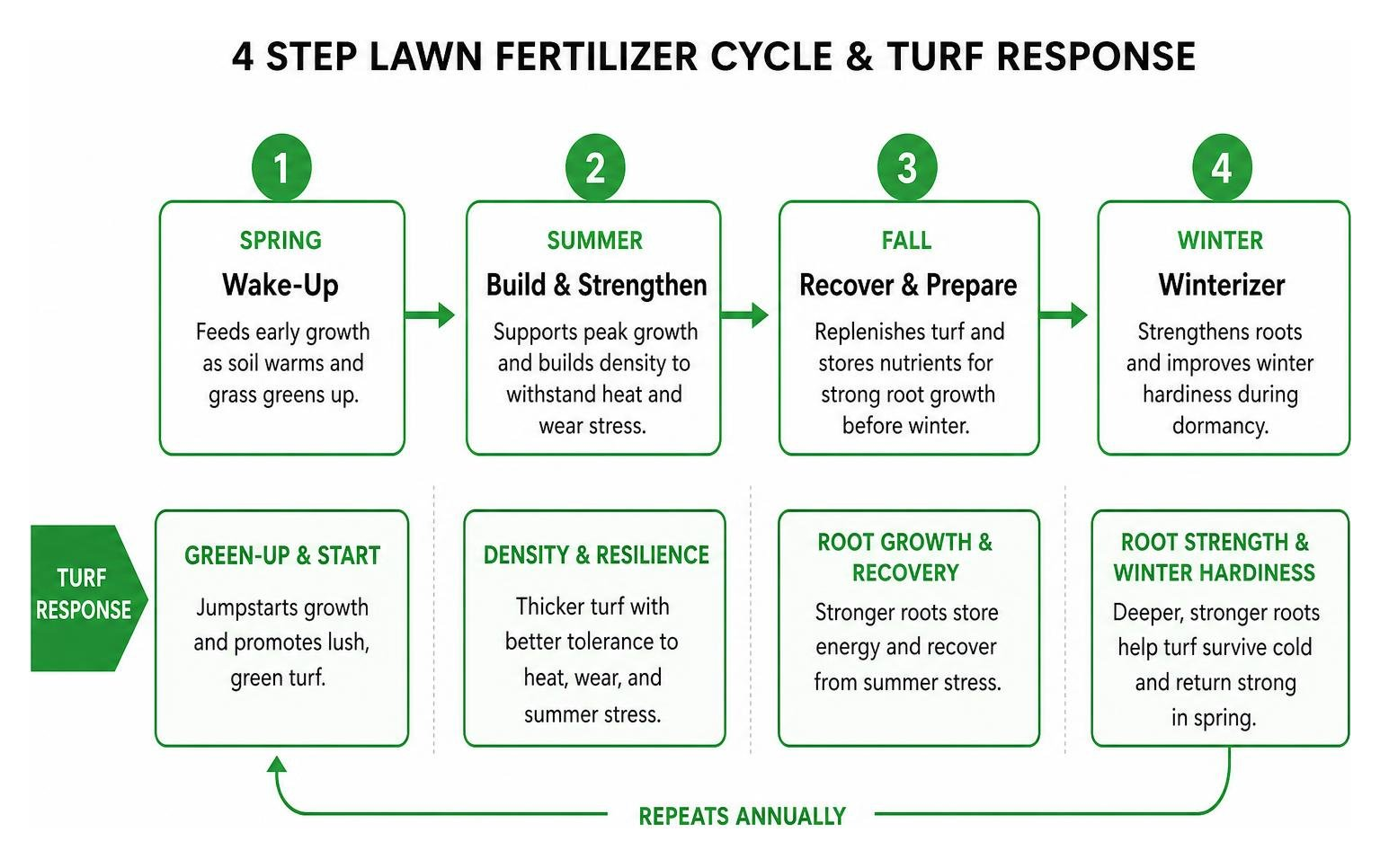
A 4 step lawn fertilizer program delivers targeted nutrition and weed control at four key points in the growing season. Step 1 is an early spring feeding with a pre-emergent to block crabgrass. Step 2 is a late spring weed and feed that controls broadleaf weeds like dandelions. Step 3 is a mid-summer application with potassium and iron to defend against heat stress. Step 4 is a late fall winterizer that builds root reserves for winter survival and early spring green-up.
Maintaining a thick, resilient lawn across Northeast Ohio requires working alongside the natural biological cycle of cool-season turf. Grass plants do not consume nutrients at a flat rate throughout the calendar year. Instead, their metabolic needs shift as soil temperatures warm up in spring, peak during summer heat, and cool down in autumn.
A four-step feeding system is designed to deliver specific macronutrients and control agents precisely when turfgrass can utilize them most effectively. By aligning nutrient inputs with natural growth spurts and recovery windows, property owners can build dense turf that naturally crowds out opportunistic weeds and resists environmental stress. To better understand how individual nutrients function within your soil, take a look at our comprehensive lawn fertilizer guide.
The Core Agronomic Principles
Every bag of granular fertilizer displays three numbers known as the N-P-K ratio. These numbers represent the percentage by weight of nitrogen, phosphorus, and potassium. Reviewing our guide on fertilizer basics provides a solid foundation for understanding why these three elements form the backbone of any feeding program.
Nitrogen drives vegetative shoot growth, chlorophyll production, and overall turf density. Cool-season grasses like Kentucky bluegrass, perennial ryegrass, and turf-type tall fescue thrive best with an annual total of 2.5 to 4.0 pounds of actual nitrogen per 1,000 square feet. Fine fescues require significantly less, performing well on 1.0 to 2.0 pounds annually.
Phosphorus promotes deep root development, which is critical during early establishment. Potassium functions as an internal regulator, strengthening plant cell walls, improving water retention, and helping grass endure temperature extremes. A standard seasonal program delivers approximately 2.96 to 3.0 pounds of nitrogen per 1,000 square feet across the entire season, splitting this total into targeted fractions that protect grass crowns from chemical stress.
Slow-Release vs. Quick-Release Nitrogen
The form of nitrogen inside each fertilizer granule dictates how quickly the plant absorbs it. Quick-release nitrogen sources like ammonium sulfate dissolve rapidly in the presence of soil moisture. They produce a fast green color within days, but they also trigger excessive top growth that demands frequent mowing and exhausts root energy reserves. Quick-release forms carry a higher salt index, increasing the risk of foliage burn if applied unevenly or left unwatered.
Slow-release nitrogen sources such as methylene urea, sulfur-coated urea, and polymer-coated technologies break down gradually through microbial activity or temperature-dependent diffusion. These sources feed grass steadily over six to eight weeks, promoting balanced root growth and preventing nitrogen leaching into local waterways. Consumer retail programs typically contain 20% to 35% slow-release nitrogen, whereas commercial-grade turf blends incorporate 35% to 50% or more to ensure sustained color without damaging growth spikes.
The Seasonal Breakdown: Four Steps to Year-Round Health
Following a predictable four-stage routine eliminates guesswork by pairing plant nutrition with seasonal turf threats like emerging crabgrass, broadleaf weeds, summer drought, and winter cold.
| Program Step | Primary Function | Typical N-P-K | Target Timing | Key Objective |
|---|---|---|---|---|
| Step 1 | Early Spring Feeding + Pre-Emergent | 30-0-4 | Feb to April (Soil at 50°F to 55°F) | Block crabgrass seeds while stimulating spring green-up |
| Step 2 | Late Spring Weed and Feed | 28-0-3 | May to June (4 to 6 weeks after Step 1) | Knock down dandelions, clover, and nourish actively growing blades |
| Step 3 | Mid-Summer Heat Defense | 20-0-8 (with Iron) | June to August (Near mid-summer) | Fortify cell walls against heat, drought, and surface pests |
| Step 4 | Late Fall Root Winterizer | 32-0-10 | Sept to November (Before ground freeze) | Build carbohydrate reserves and fuel rapid early spring recovery |
Step-by-Step Schedule for 4 Step Lawn Fertilizer Applications
In regions like Summit County, Cuyahoga County, and Medina County, the seasonal schedule follows distinct weather transitions. Spacing applications roughly six to eight weeks apart ensures continuous nutrient availability throughout the active growing season. Discover more tips about starting the year strong in our spring lawn feeding breakdown.
Step 1: Early Spring Pre-Emergent and Feeding
Step 1 wakes up turf after winter dormancy while laying down an invisible chemical barrier against annual weed seeds. The granular blend delivers about 0.83 pounds of nitrogen per 1,000 square feet alongside a pre-emergent herbicide like prodiamine or pendimethalin.
Timing is everything with this application. Crabgrass seeds begin germinating when soil temperatures stay at 55 degrees Fahrenheit for several consecutive days at a depth of four inches. A reliable natural cue is the blooming of local yellow forsythia bushes. Applying Step 1 too late, after seeds have already sprouted, renders the pre-emergent barrier ineffective against newly emerged weeds.
Step 2: Late Spring Weed and Feed
Applied between late May and early June, Step 2 combines a moderate nitrogen dose of roughly 0.80 pounds per 1,000 square feet with post-emergent broadleaf herbicides like 2,4-D and mecoprop-p. You can explore how these combination products work in our guide to weed and feed products.
Broadleaf weed killers must physically stick to the leaves of dandelions, plantain, and clover to be absorbed. For best results, apply Step 2 early in the morning when the grass is damp with morning dew. Avoid watering or mowing for at least 24 hours afterward so the active ingredients can penetrate weed tissue without washing off into the soil.
Step 3: Mid-Summer Heat Defense and Iron Boost
Mid-summer conditions present serious stress for cool-season turf. High temperatures and dry spells slow down vegetative growth, making heavy nitrogen applications risky. Step 3 delivers a lighter nitrogen charge, roughly 0.53 pounds per 1,000 square feet, coupled with elevated potassium levels and 2% iron.
Potassium acts as an internal stress shield, helping turfgrass regulate water loss through leaf pores during prolonged dry periods. The inclusion of chelated iron gives the lawn a deep green appearance without forcing excessive blade growth that could deplete root moisture reserves. Many summer blends also include low-dose surface insecticides like bifenthrin to manage pests such as chinch bugs and sod webworms.
Step 4: Late Fall Winterizer and Root Nourishment
The final application of the year is arguably the most critical feeding for cool-season grass. Learn more about autumn nutrient strategies in our guide to the best fall lawn fertilizer. Step 4 delivers around 0.80 pounds of nitrogen and higher potassium rates per 1,000 square feet to prepare turf for freezing temperatures.
During late fall, top blade growth slows and stops, but root systems remain active beneath the soil. Turfgrass channels nutrients inward, building dense carbohydrate reserves inside the root crowns. This stored energy improves winter survival and fuels a rapid, naturally thick green-up the following spring. Review proper fertilizing techniques and rates to ensure this final application is applied accurately before winter dormancy sets in.
Application Best Practices and Rate Calculations
Applying granular lawn care products requires proper equipment setup, accurate yard measurements, and careful rate calculations. Applying too little fertilizer leaves your turf undernourished, while applying too much risks fertilizer burn, salt accumulation, and nutrient runoff into storm drains.
Calculating Rates for Your 4 Step Lawn Fertilizer Plan
Most suburban lawns in Northeast Ohio measure between 3,000 and 6,000 square feet, though many homeowners unintentionally overestimate their yard size. To calculate how much product you need, subtract non-grass areas like driveways, patios, and garden beds from your total property lot size. To explore broader nutrient ratios, read our guide on balanced turf nutrients.
To find the exact weight of fertilizer needed to deliver 1.0 pound of actual nitrogen per 1,000 square feet, divide 1 by the nitrogen percentage printed on the bag in decimal form:
- For a bag marked 30-0-4, divide 1.0 by 0.30 to get 3.33 pounds of product per 1,000 square feet.
- For a 5,000 square foot lawn, multiply 3.33 by 5 to find that you need 16.65 pounds of product.
- For a product marked 20-0-8, divide 1.0 by 0.20 to get 5.0 pounds of product per 1,000 square feet.
- Always verify your calculations before opening bags to prevent accidental over-application.
Spreader Calibration and Avoiding Fertilizer Burn
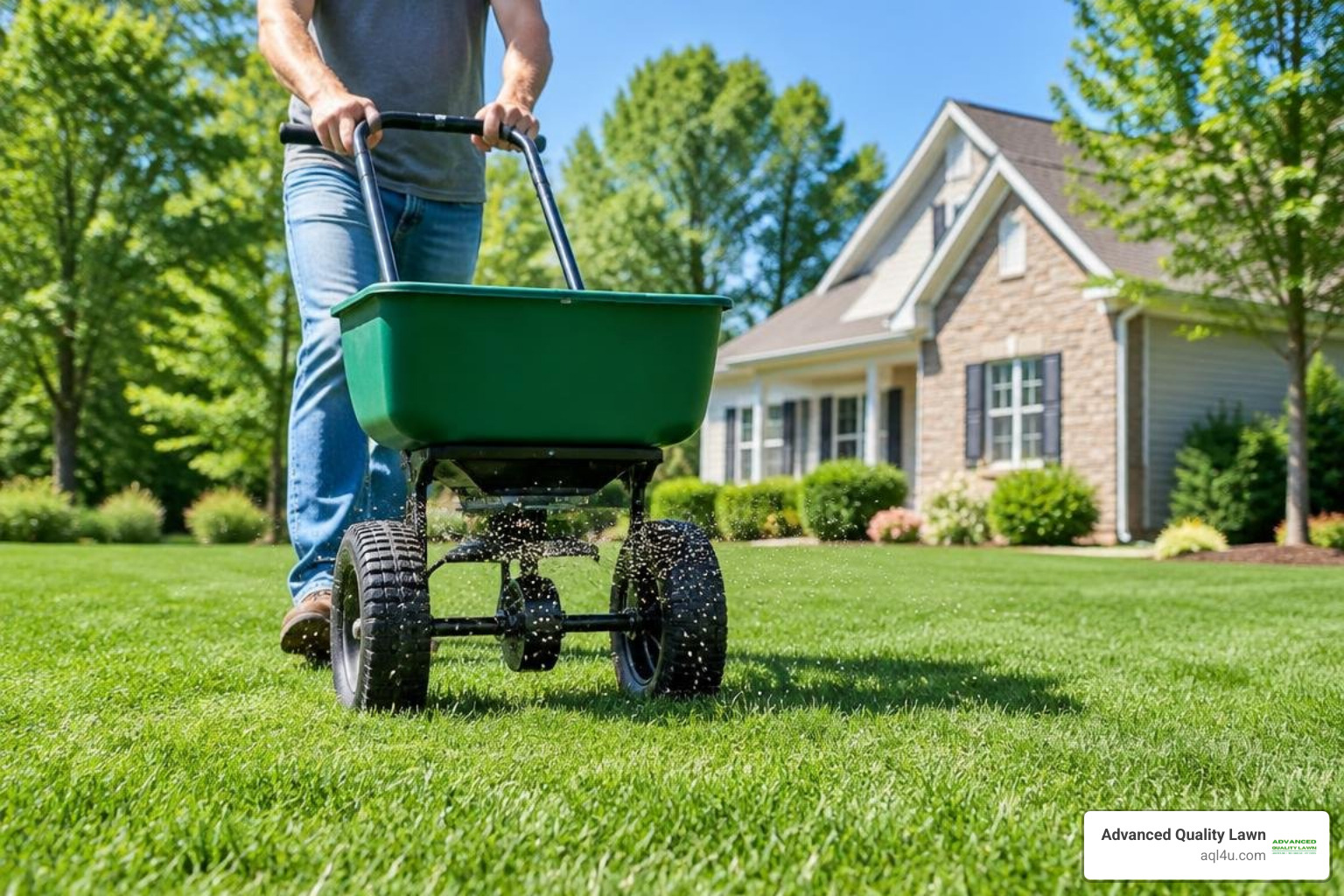
A broadcast rotary spreader is ideal for large, open turf areas, while a drop spreader offers precise edge control near garden borders and sidewalks. Always consult local guidelines like community environmental and turf management standards to prevent chemical runoff near municipal waterways.
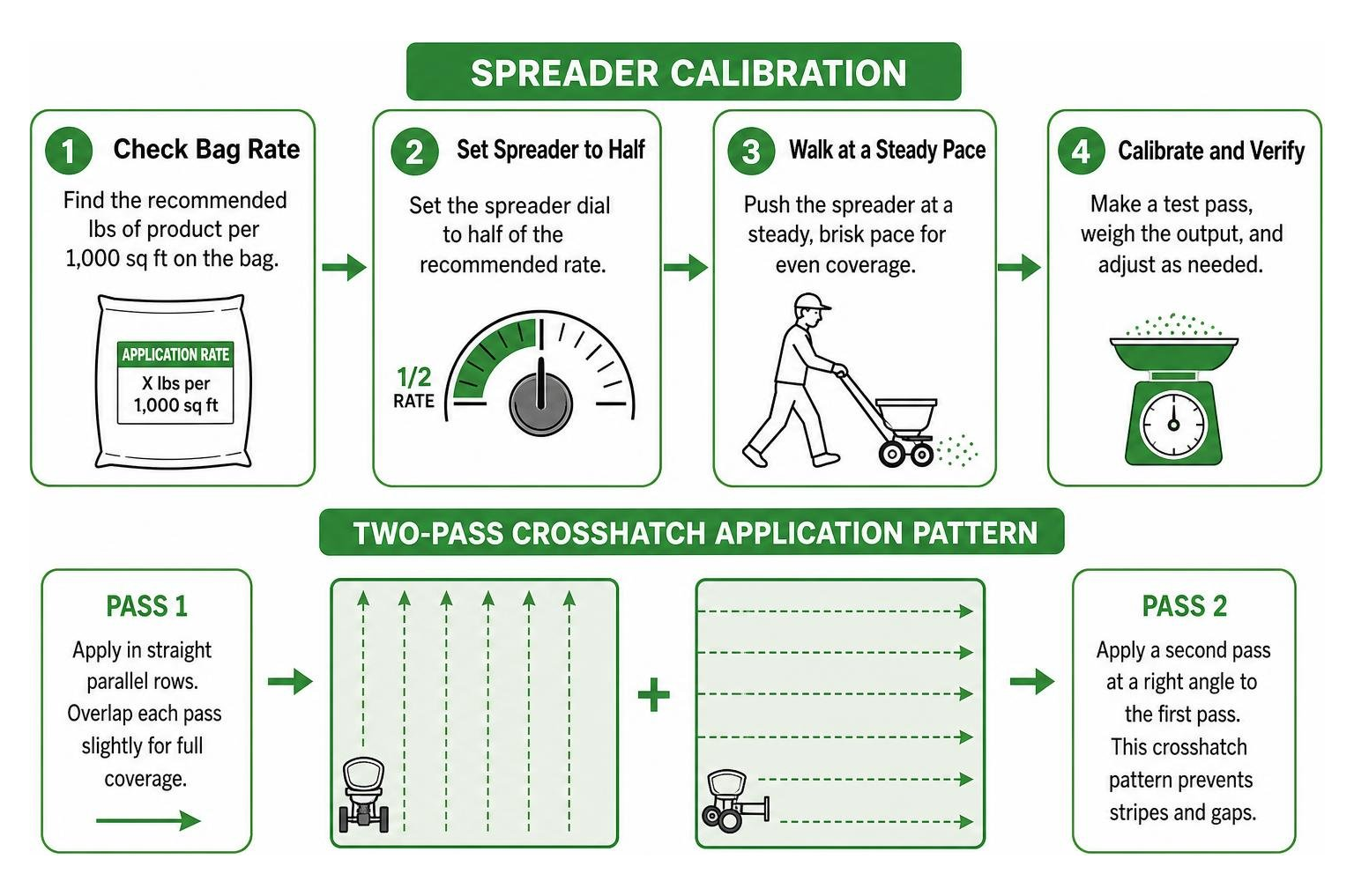
To avoid patchy application lines and chemical burn, set your spreader dial to half of the recommended application rate on the bag. Walk at a steady, brisk pace and apply the product in two separate passes at right angles to one another in a crosshatch pattern.
Always fill your hopper on a driveway or patio so any spilled granules can be easily swept up. Apply granular products only when grass blades are completely dry, except when using a late-spring weed and feed that specifically requires damp foliage. After applying Steps 1, 3, or 4, water the lawn lightly with about one-quarter inch of water to wash granules down into the root zone.
The Limitations of Granular Programs: What Four Steps Skip
While standard four-step programs provide a dependable feeding routine, they are not a cure-all for every lawn problem. Relying exclusively on boxed granular steps leaves several fundamental agronomic issues unaddressed.
| Lawn Factor | Standard 4-Step Granular Program | Comprehensive Professional Lawn Care |
|---|---|---|
| Nutrient Delivery | Fixed ratio of 20% to 35% slow-release nitrogen | Customized blends with 35% to 50%+ slow-release nitrogen |
| Soil Chemistry | Does not test or correct underlying soil pH | Lab soil testing paired with custom agricultural lime treatments |
| Soil Physical Health | Ignores soil compaction and thatch layers | Mechanical core aeration to relieve compaction and boost root depth |
| Turf Density | Relies on existing grass tillering | Targeted autumn overseeding with elite tall fescue and bluegrass |
| Pest and Disease | Limited to surface insects in mid-summer | Targeted subsurface grub defense and specialized fungicide programs |
| Application Accuracy | Homeowner calibrated with high burn risk | Certified technicians using calibrated commercial equipment |
Soil pH Testing and Amendments
Heavy clay soils throughout Northeast Ohio, including Cuyahoga, Lorain, and Geauga counties, frequently suffer from soil acidity. When soil pH drops below 6.0, chemical bonds lock essential macronutrients into soil particles. Grass roots cannot absorb nitrogen, phosphorus, or potassium efficiently when the soil is overly acidic, regardless of how much fertilizer you apply.
A basic four-step program includes no soil testing or corrective amendments. Performing a laboratory soil test every two to three years identifies exact nutrient deficiencies and pH levels. Applying agricultural pelletized lime at 25 to 50 pounds per 1,000 square feet raises soil pH into the ideal 6.2 to 7.0 range, unlocking trapped nutrients and improving natural microbial activity.
Core Aeration, Overseeding, and Pest Control
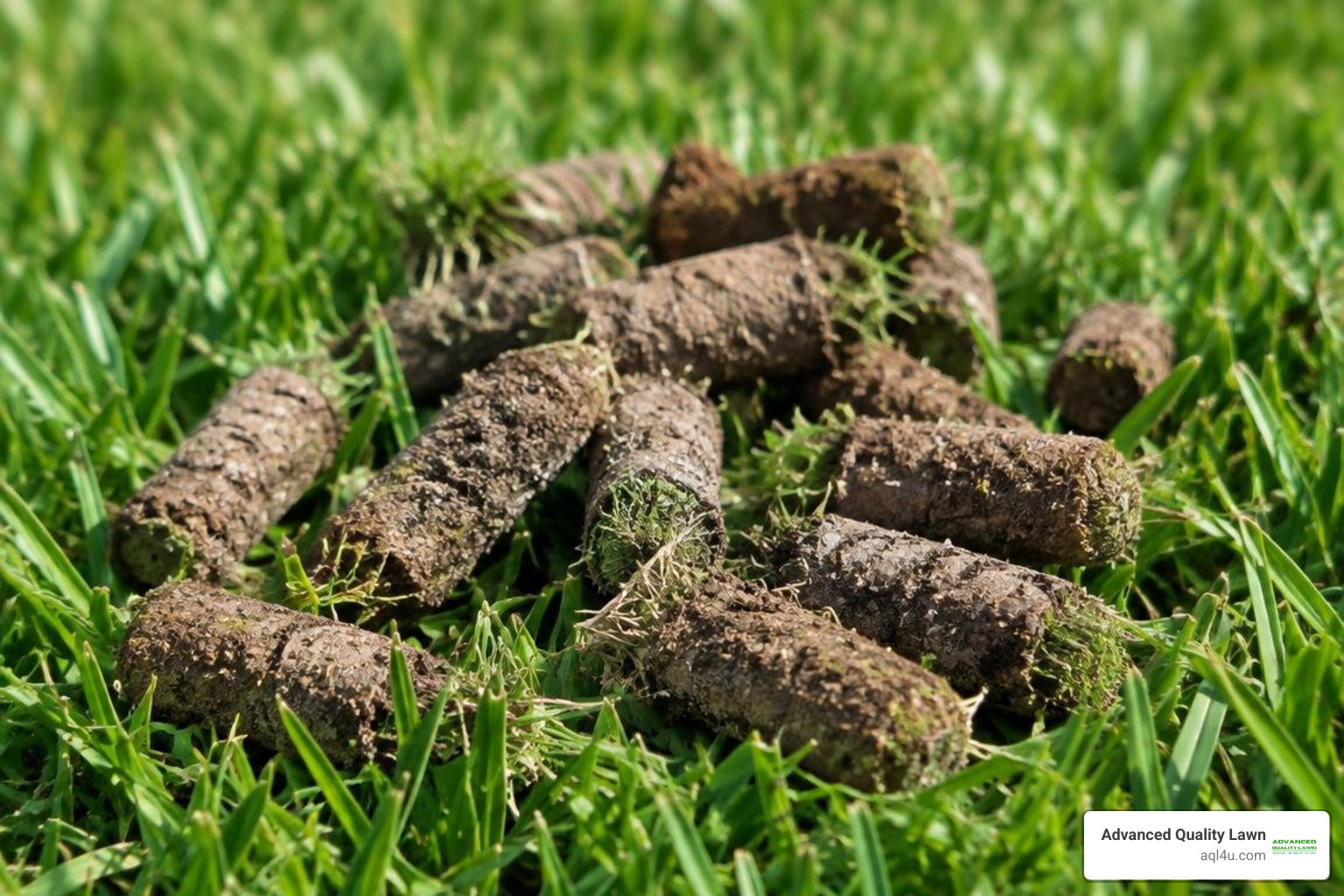
Over time, heavy lawn traffic and dense clay create compacted soil that suffocates root systems and encourages thick thatch buildup. Granular fertilizers cannot fix hard, compacted soil on their own. Annual mechanical core aeration pulls thousands of soil plugs across your yard, opening pathways for air, water, and nutrients to reach deep into the root zone.
Furthermore, standard consumer programs lack solutions for subsurface pests like white grubs, which feed aggressively on turf root systems during late summer. Surface insect controls will not reach root-dwelling grubs. Combining mechanical core aeration, late summer overseeding with resilient grass blends, and dedicated grub preventative treatments creates a complete lawn care approach that far exceeds the results of four basic fertilizer bags alone.
Frequently Asked Questions About Seasonal Lawn Feeding
Can I start a 4-step program mid-season?
Yes, you can begin a seasonal program at any point during the growing year. Check the current month and start with the product designed for that specific seasonal window, such as applying Step 3 during mid-summer. Continue with the subsequent steps spaced roughly six to eight weeks apart rather than trying to apply missed spring products out of season.
Is a 4-step program suitable for warm-season grasses?
Standard four-step programs sold in northern retail stores are formulated specifically for cool-season grasses such as Kentucky bluegrass, fescue, and perennial ryegrass. Warm-season species like Bermudagrass and Zoysiagrass have completely different growth cycles and higher annual nitrogen demands, requiring an entirely different feeding calendar.
Why do weeds still appear after completing all four steps?
Weed breakthroughs generally occur because of improper application timing, thin turf density, or difficult weed species. If Step 1 is applied after spring soil temperatures exceed 55 degrees Fahrenheit, crabgrass seeds will have already sprouted. Additionally, broadleaf products in Step 2 require direct leaf contact on damp foliage to work effectively, meaning dry applications or rain immediately after treatment will sharply reduce weed control.
Conclusion
A well-timed four-step seasonal fertilizer plan provides the essential nutrients needed to keep cool-season grass green and resilient. By matching nitrogen delivery, weed prevention, and root conditioning to the natural rhythms of the seasons, property owners can enjoy a healthier yard from early spring through late autumn.
Achieving a truly healthy lawn requires more than just spreading granular fertilizer. Balancing soil pH, relieving soil compaction through mechanical core aeration, and protecting against subsurface grubs are vital pieces of a complete turf management plan. For homeowners seeking tailored treatments, guaranteed results, and dependable care across Northeast Ohio, partnering with the experienced team at Advanced Quality Lawn for professional lawn care and maintenance services ensures your turf receives the expert attention it deserves all year long.