
The Early Bird Gets the Green: Spring Fertilizing Tips
What Is the Best Early Spring Lawn Fertilizer for Your Grass?
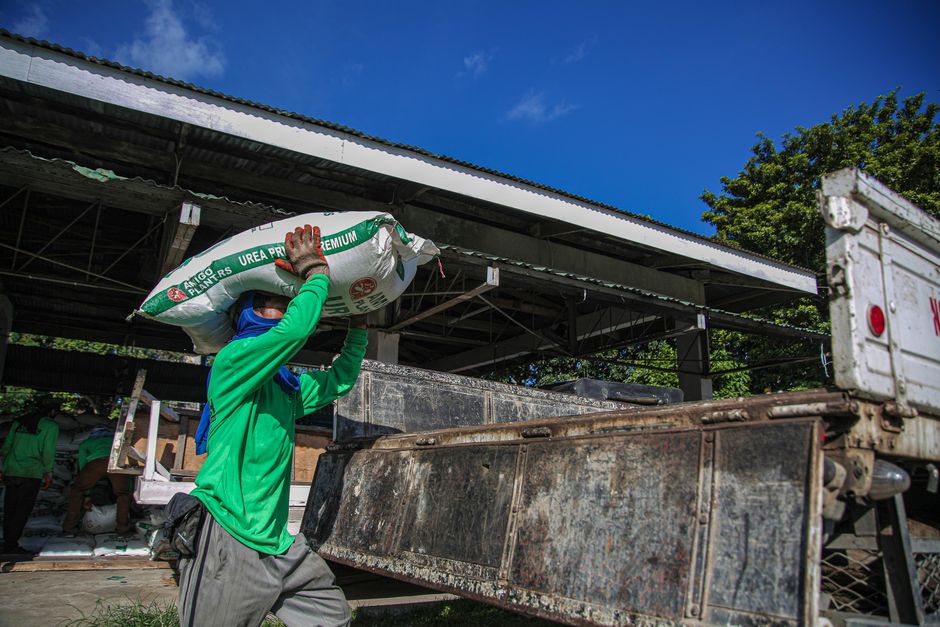
The best early spring lawn fertilizer is a slow-release, phosphorus-free blend matching a 2-0-1 nutrient ratio, such as a 20-0-10 or 21-0-4 formula, enriched with potassium and iron. When you select a fertilizer, bags display three distinct numbers known as the N-P-K ratio. These digits represent the percentage by weight of three primary macronutrients: nitrogen (N) for emerald leaf growth, phosphorus (P) for root system development, and potassium (K) for internal cellular strength and stress tolerance.
A typical cool-season grass blade maintains a natural internal nutrient ratio close to 2-0-1. Replenishing your lawn with a matching ratio supplies essential nutrients without creating excess waste. To explore nutrient profiles further, review our Lawn Fertilizer Ultimate Guide 2026 to see how individual minerals interact with your soil structure.
Established lawns across Northeast Ohio almost never require additional phosphorus. Most local soils already contain plentiful natural phosphorus reserves. Omitting phosphorus from spring lawn applications protects local streams, lakes, and reservoirs from nutrient runoff that fuels harmful summer algae blooms. In contrast, potassium is vital in early spring because it hardens the grass plant against fluctuating temperatures, late cold snaps, and summer drought stress. Including iron in your early mix is also beneficial, as iron stimulates rich chlorophyll production and deep greening without demanding excessive nitrogen top-growth surges. For an in-depth breakdown of nitrogen-heavy blends, check out Spring Grass Fertilizer: Best Nitrogen-Rich Options For Early Growth to understand how proper balancing maintains plant energy.
Choosing the Best Early Spring Lawn Fertilizer by Grass Type
Your lawn species dictates its nutritional appetite in early spring. In Northeast Ohio communities like Hudson, Brecksville, Solon, and Medina, residential lawns consist of cool-season grasses such as Kentucky bluegrass, turf-type tall fescue, and fine fescues or perennial ryegrass.
Cool-season grasses wake up as soon as ground frost clears and soil temperatures rise above 45 degrees Fahrenheit. These varieties direct their early energy into repairing root structures damaged by winter freezing before initiating heavy top growth. They thrive on moderate nitrogen formulas that deliver steady nutrition rather than an overwhelming jolt.
Warm-season varieties like Bermuda or Zoysia, while rare in our northern climate, follow an entirely different biological clock. They remain brown and dormant well into late spring until soils reach sustained 65-degree temperatures. Applying high-nitrogen fertilizer to a dormant warm-season lawn can damage tender crowns and promote early weed infestations. Homeowners managing specialty southern turf can consult our Best Fertilizer for St Augustine Grass Guide to compare warm-season nutritional programs.
Slow-Release vs. Fast-Release Nitrogen Formulas
The form of nitrogen inside the bag determines how evenly your lawn feeds over several weeks.
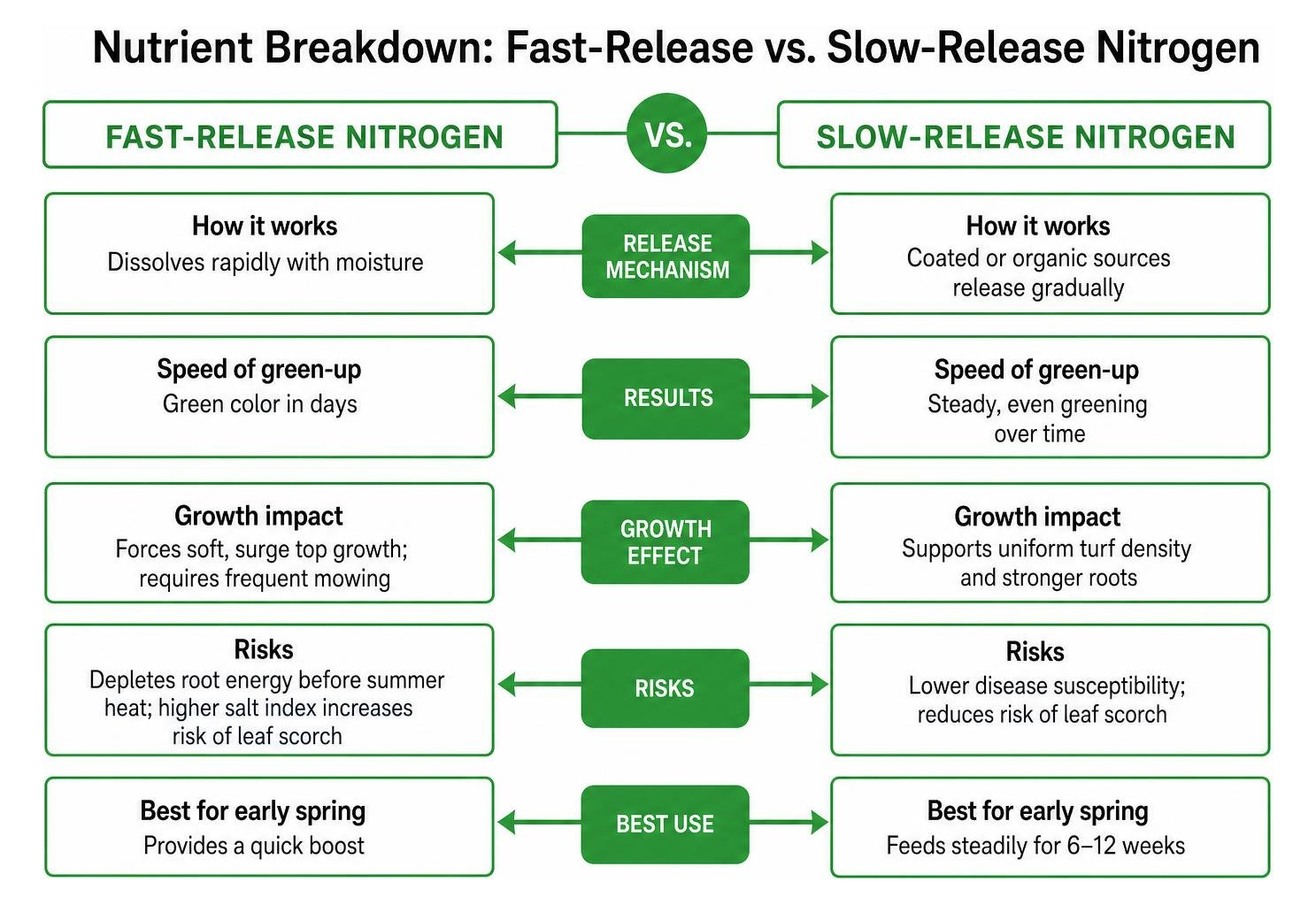
Fast-release nitrogen sources such as urea or ammonium sulfate dissolve rapidly when exposed to moisture. They provide an immediate green color within days. However, quick-release nitrogen forces soft, surge growth that requires frequent mowing and depletes stored root energy right before summer heat arrives. Fast-release granules also carry a high salt index, which increases the danger of chemical leaf scorch if not watered in promptly.
Slow-release nitrogen sources rely on sulfur or polymer coatings that regulate moisture entry, or they utilize organic meal bases that require active soil microbes to break down nutrients over 6 to 12 weeks. Polymer-coated granules meter out small rations of plant food, ensuring uniform turf density and lower disease susceptibility. When deciding on natural versus synthetic lawn nutrition, our guide on whether Is Organic Fertilizer Better Than Synthetic Fertilizer outlines how biological soil activity influences nutrient availability.
Granular vs. Liquid Spring Fertilizers
Homeowners frequently ask whether they should broadcast dry granules or spray liquid fertilizers across their property.
Granular fertilizers are the standard choice for early spring baseline feeding. Granules settle past the grass canopy directly onto the soil surface, releasing nutrients slowly as spring rain falls. They are easy to calibrate in rotary spreaders and provide extended feeding that spans several weeks across large suburban lots in Summit and Cuyahoga counties.
Liquid fertilizers are dissolved nutrient solutions applied directly through foliar spray equipment. Grass leaves absorb liquid nutrients almost immediately through their cell walls, making liquid applications useful for correcting specific micronutrient deficiencies like iron chlorosis. However, liquids carry a shorter residual feeding window and require careful dilution to avoid foliar burn during dry spells. For long-term soil health and consistent seasonal recovery, slow-release granular formulations remain the most practical foundation for spring turf.
Optimal Timing: When to Apply Spring Lawn Fertilizer
Timing your first fertilizer application requires patience. Rushing outside during the first mild weekend in March is a common lawn care mistake. When you apply fertilizer while turf is still waking from winter dormancy, the grass cannot absorb the nutrients. Excess nitrogen then sits unutilized or leaches downward through wet soil into storm drains.
The ideal window for early spring fertilization opens when soil temperatures consistently register between 50 and 55 degrees Fahrenheit at a depth of two to three inches. At this soil temperature, cool-season root systems wake up and begin active nutrient absorption.
You can track nature for helpful application cues:
- Blooming forsythia bushes with bright yellow petals indicate soil temperatures are nearing 50 to 55 degrees Fahrenheit.
- Lilac bushes beginning their initial leaf and bud swell signal active root movement in surrounding turf.
- Dandelions opening their first yellow flower heads confirm the soil has warmed sufficiently for nutrient uptake.
Another reliable operational milestone is waiting until your lawn requires its first true mowing of the year. If the grass has grown enough to remove the top third of the blade, the plant is actively synthesizing energy and is ready to process a light feeding. Our walkthrough on Preparing Your Lawn for Spring provides additional yard cleanup steps to complete before running your spreader across the turf.
If your property has heavy tree cover in Chagrin Falls, Bainbridge, or Peninsula, shaded lawn sections wake up more slowly than sunny patches. Delay fertilizer applications in heavy shade until the ground warms thoroughly, and reduce application quantities to avoid feeding shade-loving fungal spores.
Pre-Emergent Weed Control and Spring Seeding Considerations
Early spring turf management requires balancing nutrient delivery with crabgrass prevention. Crabgrass is a prolific summer annual weed that produces thousands of seeds each autumn. These seeds sit in the upper layer of your soil through winter and begin germinating once spring soil temperatures hover around 55 degrees Fahrenheit for several consecutive days.

A pre-emergent herbicide creates a chemical vapor barrier across the top half-inch of soil. When a weed seed germinates and attempts to send down an initial root, the barrier stops cell division, preventing the weed from establishing. High-quality combination fertilizers, such as GreenView Premium Formula Spring Fertilizer with Crabgrass Preventer, pair slow-release feeding with crabgrass preventers like Dimension or Prodiamine. Products formulated with Dimension provide an added safety net because they deliver pre-emergent protection and early post-emergent control on tiny crabgrass seedlings up to four weeks after germination.
Timing is critical. If you apply a pre-emergent product too early in cold March mud, the protective barrier may degrade before summer annual weeds attempt to sprout. If you wait too long and weeds grow beyond the early seedling stage, pre-emergents will not control them. For a deeper look at early weed suppression tactics, visit our Spring Lawn Care archive.
Selecting the Best Early Spring Lawn Fertilizer When Overseeding
If winter left bare, muddy patches in your lawn from snowplows or foot traffic, you might plan to overseed in early spring. Traditional pre-emergent weed preventers do not distinguish between weed seeds and desirable grass seeds. Applying a standard crabgrass preventer will stop your expensive turfgrass seed from sprouting.
When planting new seed, you must bypass standard pre-emergent fertilizers and select an intentional starter fertilizer. Using a targeted product like Scotts® Turf Builder® Starter® Food for New Grass delivers balanced nutrition tailored to young seedlings. Research shows that specialized starter foods can grow new grass 70% thicker and 35% quicker on average compared to unfed seed beds.
For existing lawns receiving supplemental seed, an eco-friendly formulation like Early Spring Lawn Fertilizer 21-0-4 |- Top Spring Grass Fertilizer provides clean slow-release energy without interfering with seed emergence. If crabgrass has historically invaded your seeding areas, select a starter fertilizer featuring the active ingredient Mesotrione, which prevents weeds like crabgrass and broadleaf varieties while allowing new grass seedlings to grow unhindered.
How to Calculate Rates and Apply Spring Fertilizer Safely
Applying fertilizer requires accurate math to prevent over-application, soft top growth, or lawn burning. Agronomic guidelines recommend applying no more than one pound of actual nitrogen per 1,000 square feet during a single spring application.
To calculate how much product your yard requires, divide your target nitrogen rate by the decimal percentage of nitrogen listed on the bag. For example, if you are applying a 20-0-10 fertilizer (20% nitrogen) at a target rate of 0.75 pounds of nitrogen per 1,000 square feet, divide 0.75 by 0.20 to get 3.75 pounds of fertilizer product per 1,000 square feet of lawn.
| Target N Rate (lbs / 1,000 sq ft) | Fertilizer Bag N-P-K | Lbs of Product Needed per 1,000 sq ft | Total Product for a 5,000 sq ft Lawn |
|---|---|---|---|
| 0.50 lbs N | 20-0-10 | 2.50 lbs | 12.5 lbs |
| 0.75 lbs N | 21-0-4 | 3.57 lbs | 17.8 lbs |
| 0.75 lbs N | 24-0-12 | 3.12 lbs | 15.6 lbs |
| 1.00 lbs N | 26-0-5 | 3.84 lbs | 19.2 lbs |
| Starter (0.75 lbs N) | 24-25-4 | 3.12 lbs | 15.6 lbs |
Understanding how these ratios function inside your soil is essential for long-term turf vitality. You can review basic nutrient behavior in our primer Fertilizer 101: What Is It and When Should You Use It before loading your spreader.
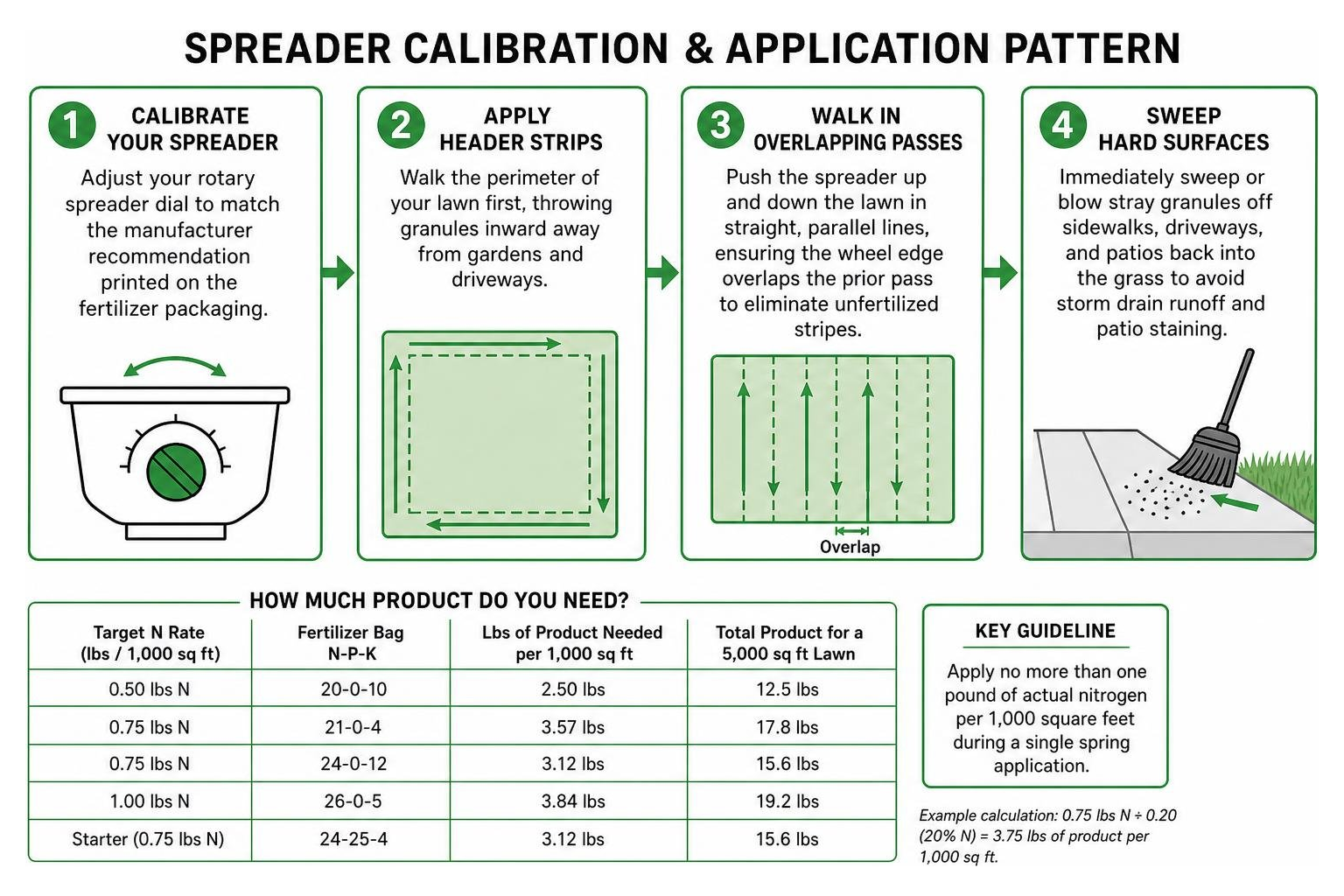
Follow these best practices to ensure safe and even distribution:
- Calibrate your spreader: Adjust your rotary spreader dial to match the manufacturer recommendation printed on the fertilizer packaging.
- Apply header strips: Walk the perimeter of your lawn first, throwing granules inward away from gardens and driveways.
- Walk in overlapping passes: Push the spreader up and down the lawn in straight, parallel lines, ensuring the wheel edge overlaps the prior pass to eliminate unfertilized stripes.
- Sweep hard surfaces: Immediately sweep or blow stray granules off sidewalks, driveways, and patios back into the grass to avoid storm drain runoff and patio staining.
- Water in thoroughly: Activate the fertilizer and pre-emergent barrier by applying roughly a quarter-inch to a half-inch of water via irrigation or natural rainfall.
Review our seasonal checklist on How to Make Your Lawn Look Great for Spring for extra maintenance guidance on mowing heights and thatch control.
Frequently Asked Questions About Early Spring Lawn Fertilizing
Find answers to common questions about early spring turf nutrition below, and check our Lawn Fertilizing hub alongside our Spring Lawn Tips for continuous seasonal guidance. You can also consult our comprehensive Best Fertiliser for Grass Guide 2026 for broader year-round turf care strategies.
Can I apply weed-and-feed fertilizer and grass seed at the same time?
You should not apply standard weed-and-feed products and grass seed together. Traditional weed-and-feed formulas contain pre-emergent herbicides that stop all seeds from forming roots, effectively destroying your new grass seed investment. If you must seed bare areas in early spring, apply a specialized starter fertilizer that either contains no herbicide or uses seed-safe Mesotrione. Postpone standard weed control until newly planted grass has been mowed at least three to four times.
How soon should I apply a second round of spring fertilizer?
Allow six to eight weeks between your early spring application and your late spring feeding. If you apply your initial slow-release fertilizer in mid to late April across Northeast Ohio, your second feeding window will land comfortably between late May and early June. This interval prevents excess nitrogen buildup while providing consistent nourishment to prepare turf for summer heat.
What should I do if my lawn is heavily shaded?
Shaded grass receives less solar energy, which reduces its rate of photosynthesis and overall growth speed. Consequently, shaded turf uses water and nutrients much more slowly than sunny lawns. Cut your fertilizer application rate in half for heavily shaded lawn areas to avoid nitrogen accumulation. Over-fertilizing shaded grass causes weak, thin blades that are vulnerable to powdery mildew and moss encroachment.
Conclusion
A vibrant summer lawn is built on deliberate, well-timed early spring care. Rather than racing the calendar, let soil temperatures, natural plant indicators, and steady root growth guide your fertilizer applications. By choosing phosphorus-free, slow-release nitrogen formulas paired with potassium, you build deep root systems capable of withstanding Northeast Ohio summers.
Whether you manage an expansive property in Medina County, a wooded lot in Geauga County, or a suburban yard in Summit, Cuyahoga, Portage, Stark, Wayne, or Lorain County, balanced spring nourishment keeps your grass dense, weed-resistant, and healthy. If you prefer to leave the math, calibration, and seasonal timing to local professionals, explore our professional lawn care and maintenance services at Advanced Quality Lawn to enjoy a worry-free, beautiful green lawn all season long.