How to Manage a Black Ant Infestation in Your Grass
Black Ants in Your Lawn: What to Do and When to Worry
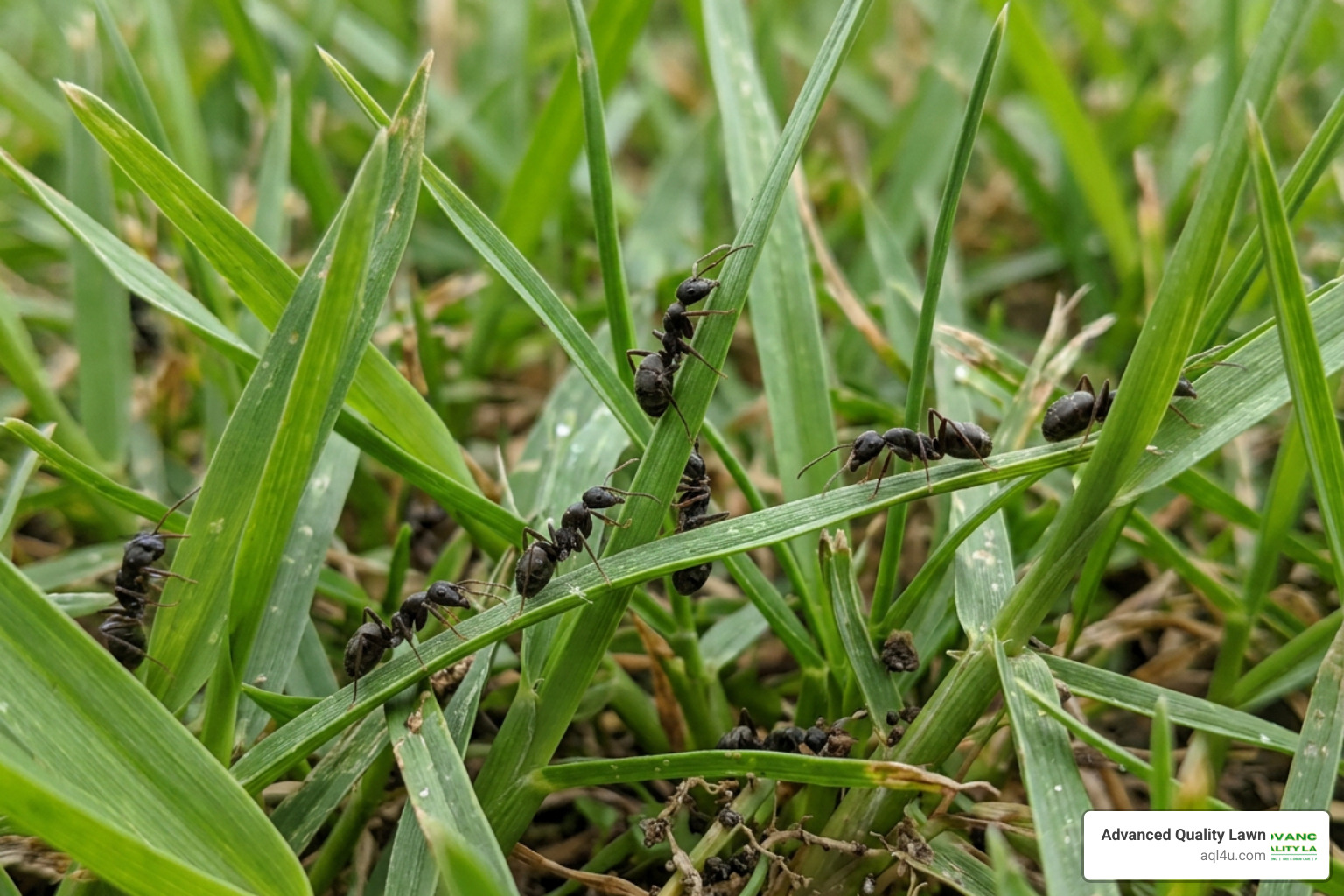
Quick answer: If you have black ants in your lawn, here is what to know right away:
- Most black ants are harmless and even beneficial to your soil and grass
- Mounds become a problem when they rise above the grass line or damage turf
- Natural fixes work well for small infestations: raking mounds flat, boiling water, or borax bait
- Chemical spot treatments are only needed for large or persistent colonies
- Prevention comes down to lawn health: thick grass, proper mowing height, and consistent watering
Spotting black ants in your lawn can be alarming, especially when ant mounds start popping up across an otherwise tidy yard. But before you reach for a pesticide, it helps to understand what you are actually dealing with.
There are dozens of ant species that nest in lawn soil. Some are barely noticeable. Others build mounds that rise above the grass and create bare, unsightly patches. A few species can even damage plant roots or protect aphid colonies that harm your garden.
The good news? Most black ants are not your enemy. They aerate your soil, break down organic matter, and serve as a food source for birds and other wildlife. The goal is not always to eliminate them. It is to know when they have crossed the line from helpful to harmful, and what to do about it.
I'm Andrew Day, owner of Advanced Quality Lawn, and after more than 30 years of helping Northeast Ohio homeowners manage black ants in their lawn and other turf pest challenges, I know how confusing it can be to tell the harmless from the harmful. In this guide, I will walk you through everything you need to identify, manage, and prevent black ant problems in your yard.
Identifying Black Ants in Lawn Soil
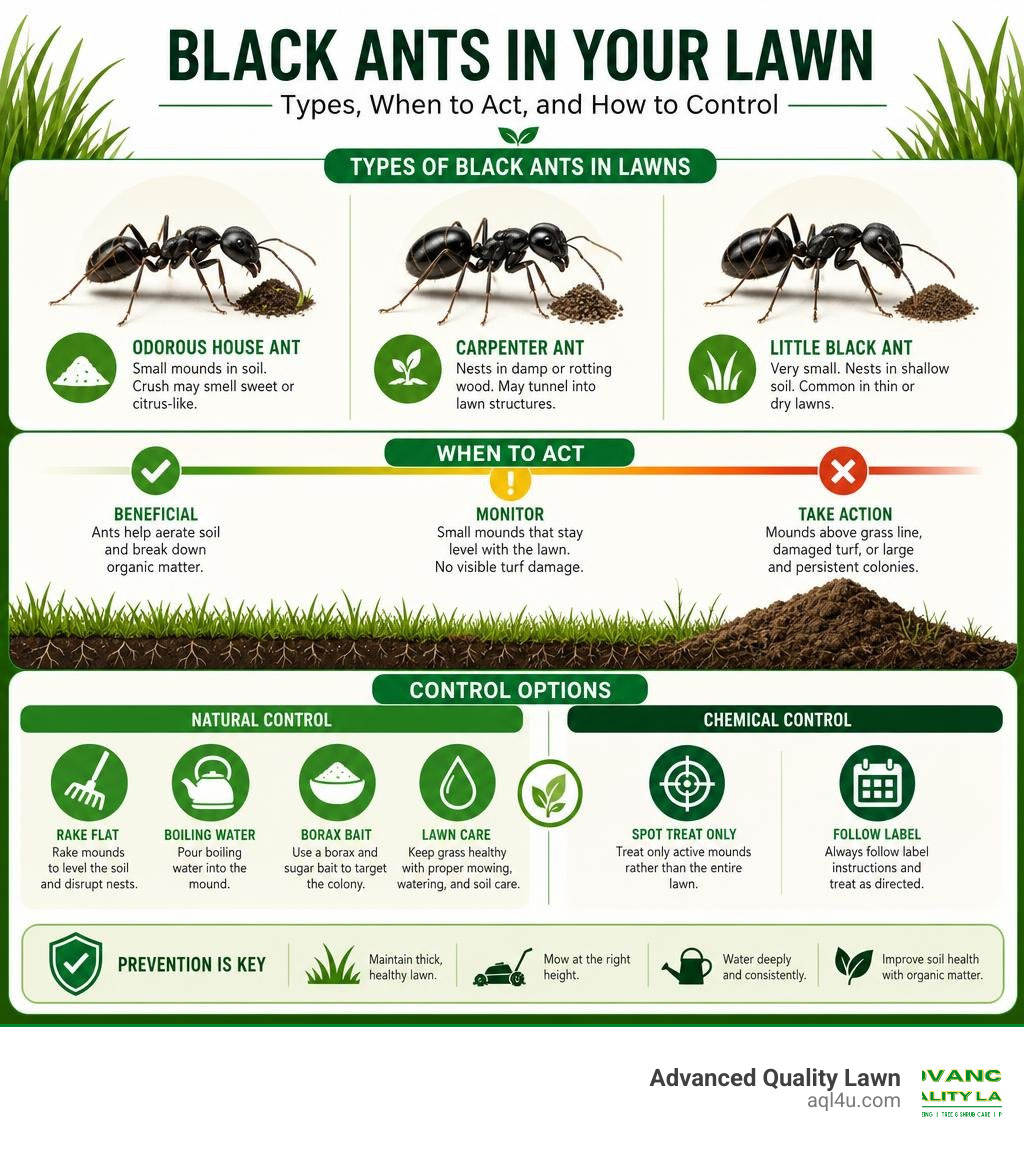
Before taking any action, we must identify the exact type of ant living in your grass. Different species have different behaviors, and treating them all the same way can lead to wasted time and money. For example, treating a soil-nesting ant the same way you treat a wood-boring ant will not yield the results you want.
We have put together a quick comparison table to help you distinguish between the three most common black ants you might find on your Northeast Ohio property.
| Ant Species | Average Size | Nesting Habit | Lawn Impact | Primary Diet |
|---|---|---|---|---|
| Black Garden Ant (Lasius niger) | 3 to 5 mm (workers) | Underground soil, under stones or roots | Creates small, soft soil mounds, aerates turf | Honeydew from aphids, nectar, small insects |
| Pavement Ant (Tetramorium caespitum) | 2.5 to 3 mm | Under sidewalks, driveways, and patios | Displaces sand and soil near hardscapes | Sweets, grease, proteins, seeds |
| Carpenter Ant (Camponotus spp.) | 6 to 12 mm | Decaying wood, logs, tree stumps | Does not nest in soil, poses structural risk | Honeydew, insects, plant juices |
Common Species and Their Differences
When we look closely at the black ants crawling through our grass, we are usually looking at one of a few key species.
The first is the black garden ant, scientifically known as Lasius niger. These are small, dark brown to jet black ants that are incredibly common in residential yards. If you want to learn more about how they look and behave, you can read this black garden ant identification guide. They are classic soil dwellers that build small, low-profile nests in the ground.
The second species we often see in Northeast Ohio is the pavement ant. These tiny pests love to build their homes under concrete slabs, driveways, and patios. They push up small piles of sand and dirt through the cracks in your pavement. While they occasionally forage in the grass, their colonies are centered around hardscapes. You can find more details on their habits in this complete guide to black ants.
Finally, we have carpenter ants. Homeowners often panic when they see large black ants in the grass, assuming they are carpenter ants. While carpenter ants are indeed large and black, they do not nest in lawn soil. They nest in moist, decaying wood like old tree stumps, firewood piles, or rotting landscape timbers. If you see large black ants crawling on your turf, they are likely field ants, which are harmless soil nesters, rather than wood-destroying carpenter ants.
The Role of the Black Garden Ant Queen and Colony Life Cycle
To truly understand how to manage these insects, we have to look at the fascinating biology of the colony. At the heart of every Lasius niger colony is a single queen.
According to scientific records, Lasius niger queens can live up to 29 years. This is the longest recorded lifespan for any eusocial insect. While the worker ants only live for one to two years, the queen can keep producing new workers for decades if the colony remains undisturbed.
A typical black garden ant colony normally ranges from 4,000 to 7,000 workers. In rare cases, a mature, highly successful colony can reach up to 40,000 workers. You can read more about this species' impressive colony structure on the Lasius niger Wikipedia page.
During the hot, humid days of mid-summer, typically between July and August, these colonies participate in what scientists call nuptial flights. Homeowners often refer to this as "flying ant day." Millions of winged male and female ants emerge from their nests simultaneously to mate in the air.
Once mating is complete, the males die, and the newly fertilized queens shed their wings to search for a suitable spot in the soil to start a new colony. To learn more about this incredible natural phenomenon, check out the Lasius niger profile on BWARS or read about their survival strategies in The Wild Files black garden ant profile.
The Impact of Ants on Your Turf and Garden Ecosystem
Many homeowners view any insect in the grass as a threat, but ants are actually a vital part of a healthy lawn ecosystem. In most cases, having a few ant colonies in your yard is a sign of a living, breathing soil structure. They act as nature's tiny rototillers, constantly moving soil and organic matter.
However, when their numbers grow too large, their underground tunneling can sometimes lead to root exposure. When ants excavate large amounts of soil to build their chambers, they can leave grass roots hanging in empty air pockets. Without contact with the moist soil, those roots dry out, leading to localized yellowing or dead patches of grass. If you suspect your turf is suffering from this kind of damage, our guide on Ants Destroying Lawn offers deeper insights into how to identify and address the issue.
When Do Black Ants in Lawn Spaces Become a Problem?
So when does a harmless colony turn into a nuisance? The primary issue is the physical mounds they build.
During periods of active nesting, ants push soil up to the surface. These mounds can rise above the mowing height of your grass. When you run your lawnmower over these mounds, you can scalp the turf, dull your mower blades, and leave bare patches of dirt that are prime real estate for weeds to take root.
Large mounds also ruin the smooth, uniform look of your turf. If you are struggling with unsightly dirt piles across your yard, you can read our tips on managing Ants In Lawn to help restore your lawn's appearance.
The Symbiotic Relationship Between Ants and Aphids
One of the most frustrating aspects of having a large black ant population in your yard is their relationship with garden pests like aphids. Ants are notorious honeydew farmers.
Aphids feed on plant sap and excrete a sweet, sticky liquid called honeydew. Black garden ants absolutely love this sugary treat. To ensure a steady supply, the ants will actively protect aphid colonies from natural predators like ladybugs and lacewings.
Some ant species will even carry aphids to new, healthy plants to help them establish new feeding grounds. This means a large ant population in your grass can directly lead to an aphid outbreak in your flowerbeds and vegetable gardens, resulting in yellowed, curled leaves and stunted plant growth.
Ecological Benefits of Having Ants in Your Yard
Despite these potential issues, we always remind homeowners that ants provide massive ecological benefits. We should not aim to completely sterilize our yards.
First, black garden ants help aerate the soil and oxygenate it. Their constant tunneling allows water, oxygen, and nutrients to reach grass roots much more easily.
Second, ants are incredibly strong. They tunnel through the ground, moving large amounts of dirt underground, hauling twenty times their weight as they work. This process naturally loosens compacted soil without the need for mechanical aeration.
Additionally, ants are active predators of other common garden pests. They hunt and eat flea larvae, termites, and small caterpillars. Finally, black garden ants are an essential food source for birds, spiders, fish, frogs, lizards, other insects, and even some mammals. Removing them entirely can disrupt the local food chain in your neighborhood.
Why Do Ants Build Mounds in Your Grass?
To manage ant mounds, we have to understand why they build them in the first place. An ant mound is not just a random pile of dirt. It is a highly engineered structure.

When worker ants excavate tunnels and chambers underground, they must put the excess soil somewhere. They carry it up piece by piece and deposit it around the entrance, creating the mound.
This mound serves three critical purposes:
- It acts as an easy entrance and exit point for the colony.
- It helps control the internal temperature of the nest, acting like a solar chimney to trap heat.
- It protects the underground chambers from rainwater and predators.
For a detailed look at how these mounds function and how to manage them across different landscapes, you can read the Iowa State University Extension guide on How to Manage Ant Mounds.
Soil Conditions and Seasonal Triggers
You are most likely to notice ant mounds during wet spring weather. When heavy rains saturate the deeper layers of soil, ants are forced to move upward to keep their larvae dry. They will quickly build up their mounds to help shed water away from the nest entrance.
Ants also prefer loose, sandy soil because it is much easier to excavate. If your lawn has thin, sandy turf or areas with low foot traffic, ants will find it to be the perfect nesting ground. Hard, compacted soils with thick grass cover are much harder for them to penetrate, which is why healthy lawn care is your best defense.
How to Manage and Eliminate Ant Mounds Naturally
If you want to reduce the presence of black ants without resorting to synthetic chemicals, you have plenty of highly effective options.
Many homeowners prefer natural methods because they are safe for children, pets, and the local environment. If you want to explore more green solutions, check out our comprehensive guide on Ants In Grass Treatment.
Natural Methods to Control Black Ants in Lawn Turf
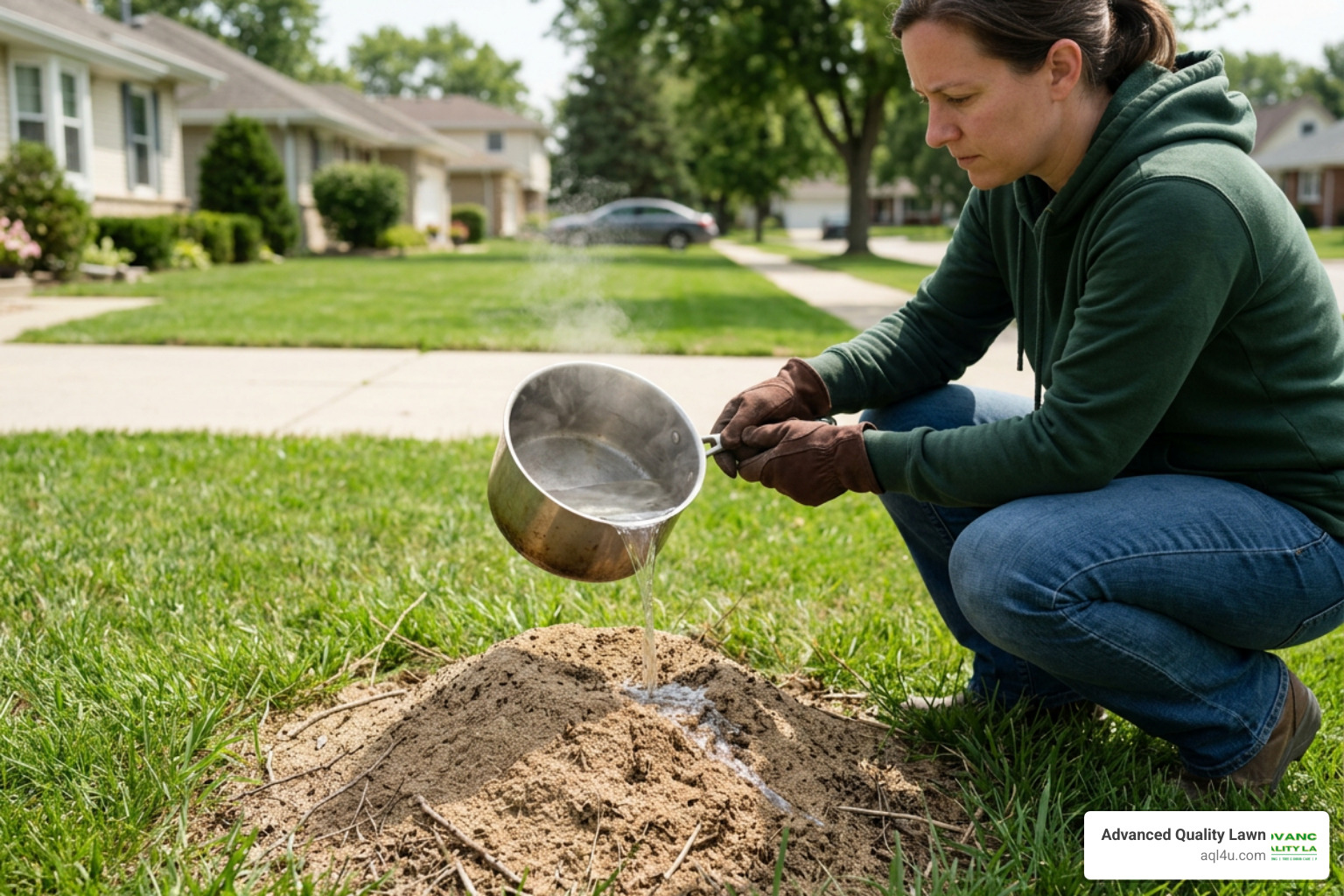
One of the simplest ways to eliminate a localized ant nest is by using boiling water. Pouring two to three gallons of boiling water directly into an active ant mound can collapse the tunnels and kill the queen instantly. However, boiling water will also kill any grass it touches, so we only recommend this method for mounds located in bare dirt, driveways, or areas where you do not mind re-seeding the turf.
Another fantastic natural option is food-grade diatomaceous earth. This is a natural powder made from fossilized algae. When ants walk through it, the microscopic, sharp edges of the powder wear away their protective outer shells, causing them to dehydrate and die. Simply sprinkle it directly on the mounds and along active ant trails. That diatomaceous earth must be reapplied after it rains.
You can also create a highly effective homemade bait using borax and sugar. Mix equal parts borax and white sugar with a little water to create a paste. Place this mixture near ant trails in a small, covered container with entry holes. The worker ants will be attracted to the sugar and carry the borax back to the nest, sharing it with the queen. This method can take up to two weeks to completely eliminate the colony, but it is incredibly effective.
For visual demonstrations of these natural techniques, you can watch these helpful videos on the Natural Way To Rid Your Entire Yard Of ANTS or Make Your Yard ANT FREE FOREVER In 3 Easy Steps.
Physical Disruption and Cultural Practices
Sometimes, you do not need to kill the ants at all. You can simply encourage them to move elsewhere through physical disruption.
Raking the mounds flat as soon as they appear is a great way to disrupt their nesting cycle. If you consistently rake the soil flat and wash it into the turf with a garden hose, the colony will eventually get tired of rebuilding and move to a less active area.
You can also adjust your lawn care habits to make your yard less appealing to ants. We recommend keeping your mowing height at a minimum of 3 inches. Taller grass shades the soil, keeping it cooler and making it harder for ants to build warm mounds. Taller grass also does a wonderful job of physically hiding small mounds from view, allowing you to live and let live.
Additionally, deep, infrequent watering is much better than shallow daily watering. Soaking the lawn deeply once or twice a week floods the upper layers of soil, discouraging ants from nesting near the surface.
Chemical and Bait Treatments for Severe Infestations
While we always advocate for natural and cultural solutions first, there are times when an ant infestation is simply too large to handle without professional-grade products. If you are dealing with dozens of mounds across your property, a targeted treatment may be necessary.
For a complete breakdown of your options, you can read our Ultimate Guide Kill Ants Yard or browse our list of the Best Lawn Insect Killer Granules.
Choosing the Safest Insecticides and Baits
When choosing an insecticide, we always recommend spot-treating the active mounds rather than blanket-spraying your entire yard. This targeted approach protects beneficial insects like bees and butterflies while still resolving your ant problem.
Look for products containing active ingredients like bifenthrin or permethrin. These are highly effective against ants and are safe for your lawn when applied according to the product label. Granular insecticides can be applied directly to the mounds and watered in to reach the underground chambers.
Liquid baits are also an excellent choice for severe infestations. Unlike contact sprays that only kill the workers on the surface, baits are designed to be carried back to the queen. This ensures the entire colony is eliminated from the inside out. For more advice on choosing the right products for your yard, read our expert recommendations on the Best Insect Control For Lawns.
Long-Term Prevention Strategies for a Pest-Free Yard
The ultimate secret to keeping black ants out of your lawn is maintaining a thick, healthy turf. Ants are opportunists. They look for thin, weak, dry turf with plenty of bare soil to build their nests.
By focusing on proper fertilization, regular overseeding, and aeration, you can create a dense lawn that leaves no room for ants to establish colonies.
Managing your lawn's thatch layer is also critical. Thatch is the layer of dead grass and organic matter that builds up between the green vegetation and the soil surface. A thick thatch layer provides the perfect warm, protected environment for ants to forage and nest. Keeping your thatch layer under half an inch will dramatically reduce ant activity. For a complete year-round plan on keeping your yard healthy and pest-free, refer to our Ultimate Bug Control Guide 2026.
Frequently Asked Questions About Lawn Ants
Do black ants in the grass bite or sting?
Most common black garden ants in Northeast Ohio do not possess a functional sting. They can bite if they are handled or if their nest is severely disturbed, but their bites are very mild and short-lived.
When they bite, they may spray a tiny amount of formic acid into the pinch, which can cause a mild, temporary itching sensation.
It is important to note that black fire ants, which do have painful stings, are native to South America and are typically only found in the southeastern United States. They are not a concern for homeowners here in Northeast Ohio. If you want to learn more about those southern pests, you can read about Black Fire Ants on WebMD.
How do I tell the difference between black garden ants and carpenter ants?
The easiest way to tell them apart is by their size and where you find them. Black garden ants are quite small, usually measuring around 3 to 5 mm, and they nest exclusively in soil.
Carpenter ants are much larger, ranging from 6 to 12 mm. More importantly, carpenter ants do not nest in lawn soil. They build their nests inside decaying wood, such as old logs, tree stumps, or rotting fence posts.
If you see large black ants crawling on your grass, they are likely field ants, which are harmless soil nesters that pose no threat to your home.
Will boiling water kill my grass along with the ants?
Yes. Boiling water is extremely effective at destroying ant nests, but the extreme heat will cook and kill any grass, plants, or beneficial soil microbes it touches.
Because of this, we only recommend using boiling water on mounds located in paved areas, cracks in sidewalks, or bare dirt garden beds where you do not mind replacing the surrounding vegetation. If you use it on your lawn, be prepared to rake out the dead spot and apply new grass seed.
Conclusion
Managing black ants in your lawn does not have to be a stressful battle. In most cases, these tiny insects are working hard behind the scenes to keep your soil aerated, healthy, and rich in nutrients. By learning to identify the species in your yard and using simple cultural practices like raising your mowing height, you can co-exist with these beneficial creatures without letting them ruin your curb appeal.
If an ant infestation has gotten out of hand on your Northeast Ohio property, you do not have to tackle it alone. At Advanced Quality Lawn, we provide expert pest control and turf management services tailored to the unique climate of Akron, Hudson, Brecksville, and the surrounding communities.
Let us help you achieve the thick, green, pest-free lawn you deserve. Contact us today to learn more about our comprehensive Lawn Care and Maintenance Services.