
Why 2,4-D Won't Work and the Best Way to Kill Crab Grass Instead
Why 2,4-D Won't Kill Crabgrass (And What Actually Works)

The best way to kill crab grass is not with 2,4-D. It starts with a pre-emergent herbicide applied before seeds sprout in spring, followed by a selective post-emergent like quinclorac if crabgrass is already growing.
Here is the fastest path to crabgrass control:
- Spring (soil temp at 50 to 55°F): Apply a pre-emergent herbicide containing prodiamine or dithiopyr to stop seeds before they sprout.
- Early summer (1 to 4 tillers): Spot-treat any breakthrough plants with a quinclorac-based post-emergent mixed with a non-ionic surfactant.
- Mid-to-late summer (mature plants): Hand-pull, solarize, or simply wait for the first frost to kill plants naturally.
- Fall: Overseed bare spots and fertilize to build a dense lawn that crowds out weeds next season.
Why not 2,4-D? It only kills broadleaf weeds like dandelions. Crabgrass is a grassy weed with completely different biology, and 2,4-D simply does not affect it.
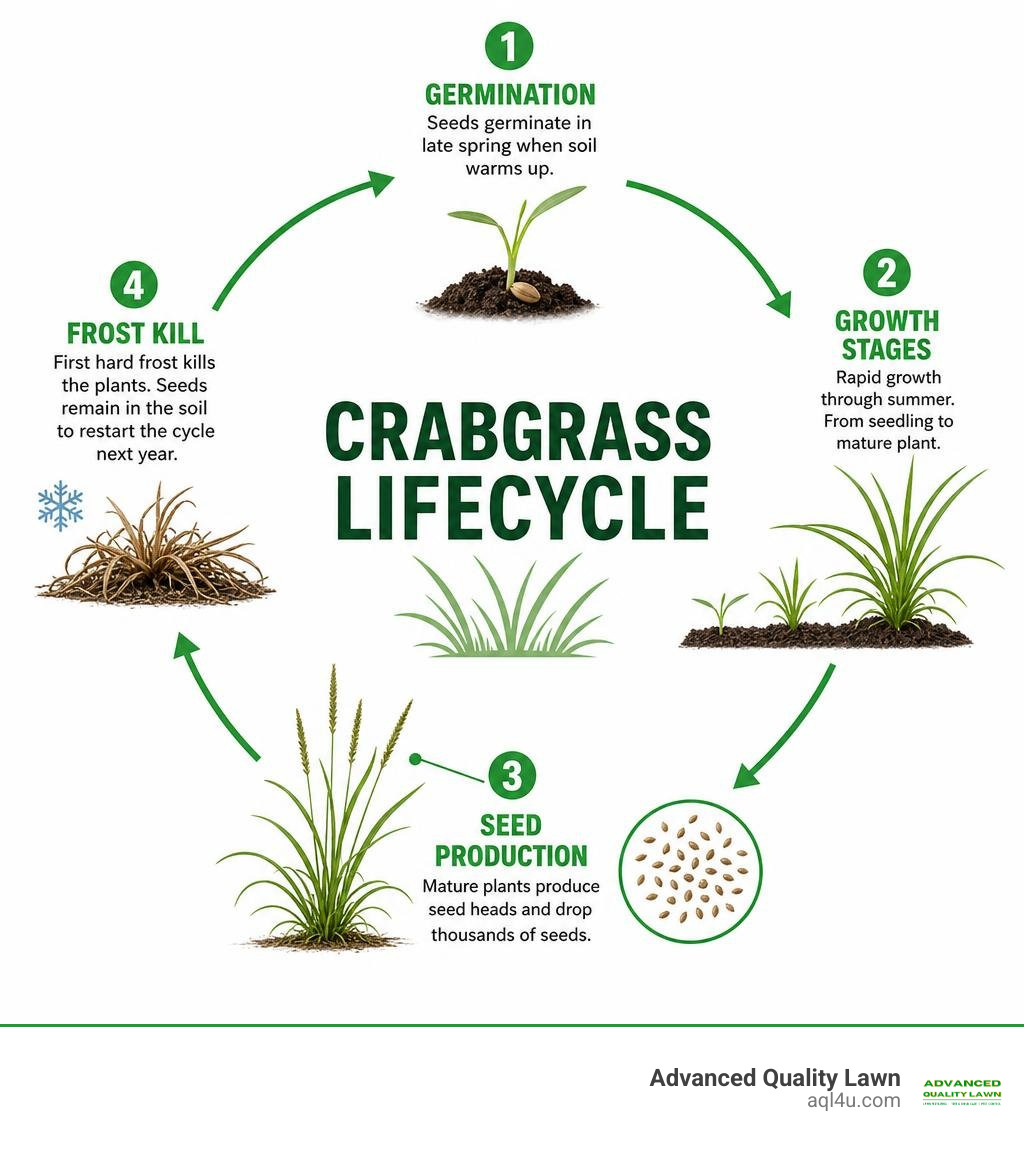
Crabgrass is a warm-season annual. It sprouts each spring, explodes through summer, drops up to 150,000 seeds per plant, and then dies with the first frost. Those seeds sit in your soil for three or more years waiting to germinate again. That is why one bad season can haunt your lawn for years.
I'm Andrew Day, owner of Advanced Quality Lawn in Akron, Ohio, with over 30 years of hands-on experience helping Northeast Ohio homeowners find the best way to kill crab grass in cool-season turf. In this guide I'll walk you through exactly what works, what does not, and how to protect your lawn season after season.
Why 2,4-D Fails on Crabgrass
To understand why 2,4-D fails so spectacularly on crabgrass, we have to look at the basic biology of plants. Herbicides are formulated to target specific plant pathways. The chemical 2,4-D is a selective herbicide designed to target broadleaf weeds, which are dicots.
Dicots emerge from the seed with two leaves, and they have wide leaves with branching veins. Common examples include dandelions, clover, and wild violet. When you spray 2,4-D on these plants, it mimics growth hormones, causing the weed to grow rapidly and warp until it starves and dies.
Grassy weeds like crabgrass are monocots. Monocots emerge with a single leaf blade and have narrow leaves with parallel veins. Because their cellular structure and growth pathways are entirely different, crabgrass simply ignores 2,4-D. Spraying it on crabgrass is a waste of time and money, and it can even stress your desirable lawn grass if applied in high summer heat.
To eliminate this weed, you need a selective herbicide that targets grassy weed physiology. If you want to know more about matching the right chemical to your specific weed problems, check out our guide on the Best Herbicide for Crabgrass.
How to Identify Crabgrass and Avoid Look-Alikes
Before you purchase any specialty herbicides, you must confirm that the weed in your lawn is actually crabgrass. Applying targeted grassy weed killers on look-alikes can lead to disappointing results.
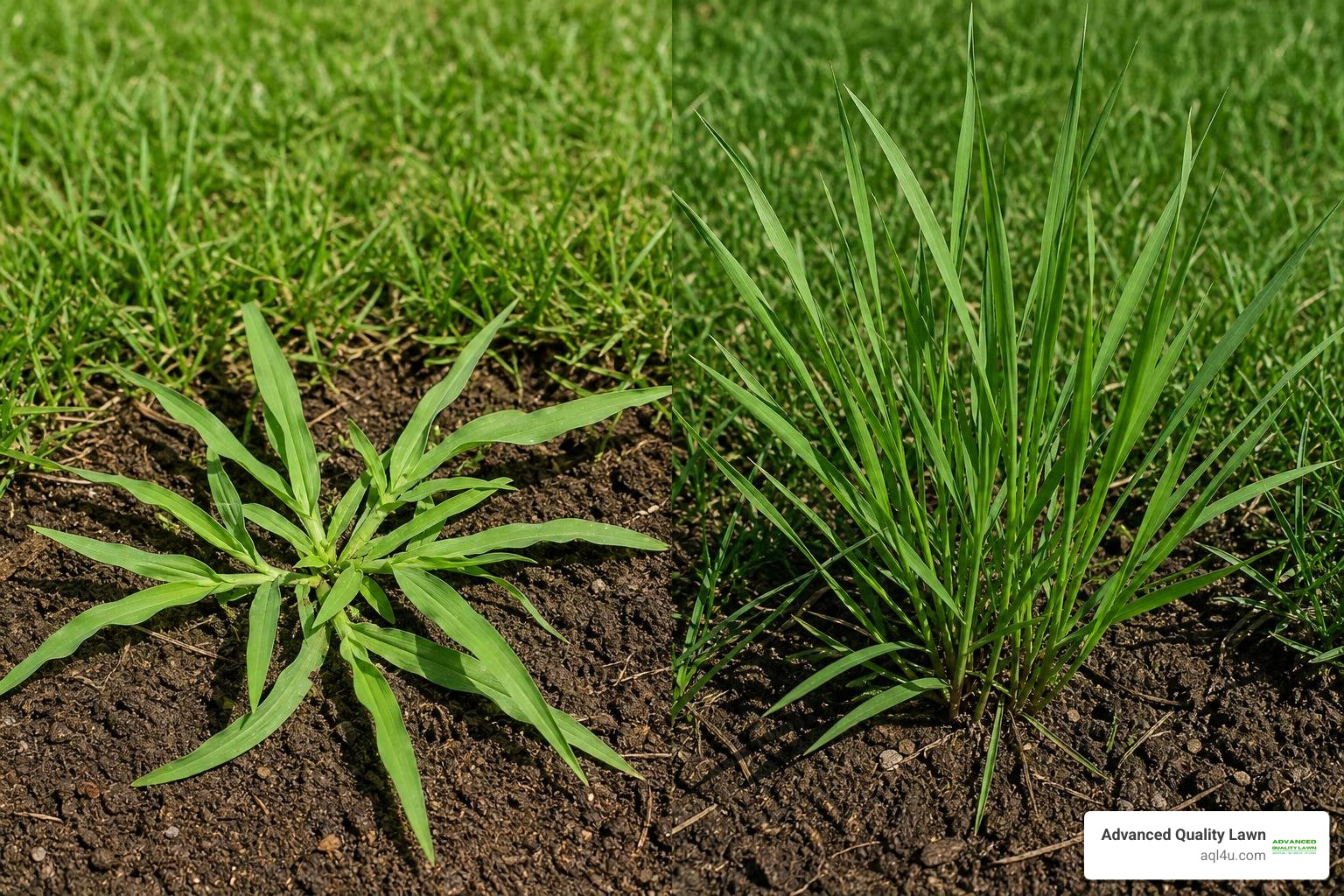
Crabgrass grows flat to the ground in a star-shaped pattern, radiating outward from a central root system. The leaves are coarse, lime-green, and much wider than your standard lawn grass.
There are two main species of crabgrass in Northeast Ohio:
- Large Crabgrass: This species has hairy leaves and sheaths. It is highly aggressive and commonly invades thin areas of your turf.
- Smooth Crabgrass: This species is mostly hairless and tends to grow slightly smaller, but it is just as invasive.
Homeowners frequently confuse crabgrass with other common grassy weeds:
- Quackgrass: This is a perennial weed with a deep, horizontal rhizome system. Unlike crabgrass, quackgrass is incredibly difficult to pull up. If you look closely where the leaf blade meets the stem, quackgrass has clasping auricles, which look like tiny fingers wrapping around the stem. Crabgrass has no auricles.
- Tall Fescue: This coarse-textured utility grass grows in upright clumps. While crabgrass spreads flat, tall fescue grows vertically and does not spread from a central point.
For a highly detailed breakdown of weed anatomy, you can read the academic guide on the Control of Crabgrass in Home Lawns.
The Best Way to Kill Crab Grass with Pre-Emergents
The absolute best way to kill crab grass is to prevent it from ever growing in the first place. Pre-emergent herbicides do not actually kill weed seeds. Instead, they create a thin chemical barrier in the top layer of your soil.
When a crabgrass seed germinating in spring sends out its first root and shoot, it contacts this chemical barrier and absorbs the herbicide, which halts cell division. The seedling dies before it can break through the surface of your soil.
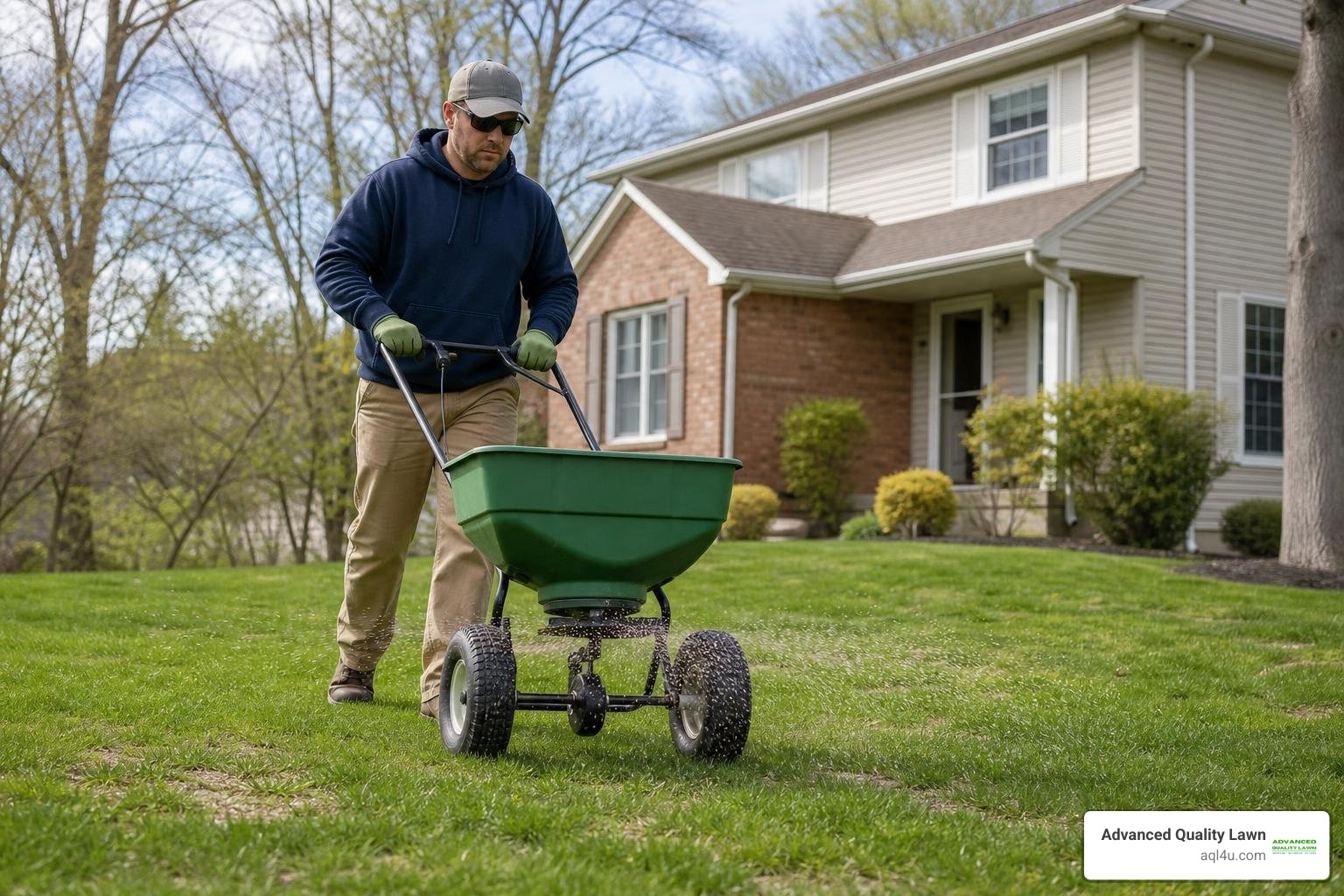
The two most popular and effective pre-emergent active ingredients are:
- Prodiamine: This is the gold standard for long-term control. It can provide up to eight months of residual protection, making it perfect for keeping your lawn clean all summer.
- Dithiopyr: This is a highly versatile option because it provides both pre-emergent control and early post-emergent control. If some crabgrass seeds have already sprouted but are still tiny, dithiopyr can still eliminate them.
For most homeowners, a split application is the most reliable strategy. Instead of applying one heavy dose in early spring, you apply a half-rate in early spring and another half-rate six to eight weeks later. This extends your protection window through the entire summer, preventing late-season breakthrough.
To learn more about choosing the right product for your yard, read our article on the Best Pre-Emergent Weed Killer for Lawns.
Timing Your Pre-Emergent for the Best Way to Kill Crab Grass
Timing is everything when it comes to pre-emergents. If you apply the barrier too late, the seeds have already sprouted, and the pre-emergent will be completely useless.
Crabgrass seeds begin to germinate when the soil temperature at a two-inch depth reaches 55 degrees Fahrenheit for four to five consecutive days. In Northeast Ohio, this window typically opens in mid-April.
You do not need an expensive soil thermometer to time this perfectly. Nature provides its own visual alarm. When the yellow-blooming forsythia bushes in your neighborhood reach full bloom and begin dropping their blossoms, the soil has reached the perfect temperature for application.
Choosing the Best Way to Kill Crab Grass with Chemical or Natural Options
If you prefer to avoid synthetic chemicals, you can look into organic alternatives. The most popular natural option is corn gluten meal.
| Feature | Synthetic Pre-Emergents (Prodiamine) | Corn Gluten Meal (Natural) |
|---|---|---|
| Efficacy Rate | 90% to 95% prevention | 70% to 80% prevention |
| How It Works | Creates a chemical barrier | Inhibits root development |
| Nutrient Value | None | Adds 10% nitrogen |
| Application Rate | Low (ounces per acre) | High (20 lbs per 1,000 sq ft) |
| Longevity | 3 to 6 months | Requires cumulative years |
Corn gluten meal is a byproduct of corn milling. It contains natural proteins that dry out the emerging radicle of germinating seeds. However, it is significantly less effective than synthetic options, and it must be applied at a high rate of 20 pounds per 1,000 square feet. Because it contains roughly 10% nitrogen, it will also fertilize your lawn.
To explore natural prevention strategies in depth, read our guide on Natural Pre-Emergent Weed Killer.
Post-Emergent Solutions for Active Summer Crabgrass
If spring has passed and your lawn is already dotted with crabgrass, you must transition to post-emergent herbicides.
The most effective active ingredient for killing emerged crabgrass is quinclorac. It is absorbed by the foliage and roots of the plant, disrupting its growth and causing it to turn red, yellow, and then die within one to two weeks.
However, crabgrass leaves have a natural waxy coating that acts like a freshly waxed car, causing water-based sprays to bead up and roll right off. To combat this, you must mix your liquid herbicide with a non-ionic surfactant or methylated seed oil. The surfactant breaks the surface tension, allowing the herbicide to stick to and penetrate the leaf.
Post-emergent success rates depend heavily on the growth stage of the weed:
- 1 to 4 Tillers: This is the seedling stage, before the plant has branched out. Quinclorac has a 90% to 95% success rate at this stage.
- 5+ Tillers: Once the plant matures and begins producing seed heads, it becomes incredibly tough. At this point, chemical efficacy drops significantly, and you may need multiple applications spaced 14 days apart.
For a side-by-side look at how different products perform in the field, check out the Best Crabgrass Killer 2026 Field Test Results. If you want to learn about chemical options that offer both pre and post-emergent control, read about Dithiopyr Post Emergent.
Treating Crabgrass by Grass Type
Before spraying any post-emergent herbicide, you must verify that the chemical is safe for your specific grass type. Cool-season grasses common in Northeast Ohio, such as Kentucky bluegrass, tall fescue, and perennial ryegrass, have excellent tolerance to quinclorac.
However, if you have warm-season grasses, you must be extremely cautious. For example, quinclorac is highly toxic to St. Augustine grass and centipedegrass. If you are dealing with a centipede lawn, you should consult our Crabgrass Control Centipede Lawns Guide to avoid destroying your turf.
Summer Triage and Manual Removal
If it is late summer and the crabgrass has fully matured, spraying heavy chemicals might not be the best choice. High summer temperatures can cause herbicides to evaporate or damage your stressed lawn grass.
In this scenario, physical removal is often the safest option. Here are the best methods for summer triage:
- Hand-Pulling: Moisten the soil first to loosen the roots. Use a weeding tool to get beneath the central crown and pull the entire root system out.
- Bag Your Clippings: If the crabgrass has developed seed heads, do not mulch your lawn. Bag your clippings and discard them to prevent spreading thousands of seeds across your soil.
- Boiling Water: For crabgrass growing in driveway cracks or patios, pouring boiling water directly over the crown will kill the plant and its seeds instantly.
For more tips on managing summer outbreaks, read the Ultimate Crabgrass Removal Guide Summer.
Cultural Practices to Prevent Crabgrass Permanently
No amount of chemical application can replace the defensive power of a thick, healthy lawn. Crabgrass is an opportunistic weed that thrives in thin, sun-drenched, compacted soils. By improving your cultural lawn care practices, you can shade out germinating seeds naturally.
- Mow High: Keep your mower deck set to 3.5 to 4 inches. Tall turf blades shade the soil surface, blocking the sunlight that dormant crabgrass seeds need to germinate.
- Water Deeply and Infrequently: Avoid watering your lawn for a few minutes every day. This keeps the top layer of soil wet, which helps shallow-rooted crabgrass thrive. Instead, apply one inch of water once or twice a week to encourage your lawn to grow deep, drought-resistant roots.
- Core Aeration and Overseeding: Aerating your lawn in the fall relieves soil compaction and improves drainage. Following up with high-quality grass seed fills in bare spots, leaving no room for weeds to establish next spring.
If you plan to plant new grass seed, you must carefully time your pre-emergent applications. Most pre-emergents will prevent your new grass seed from growing. To plan your schedule safely, read our Crabgrass Preventer Safe Seeding Guide.
Frequently Asked Questions about Crabgrass Control
Why does crabgrass keep coming back every year?
Crabgrass is an annual plant, meaning the individual weed you see in summer will die with the first hard frost of autumn. However, before it dies, a single healthy plant can produce up to 150,000 seeds. These seeds drop into the soil and can remain viable for three or more years. Every time you aerate, till, or disturb the soil, you pull dormant seeds to the surface where they can finally germinate.
What common mistakes ruin crabgrass treatment?
The most common mistake is applying pre-emergent too late in the spring after the seeds have already germinated. Another major mistake is failing to water in your pre-emergent. Most granular pre-emergents require at least a half-inch of rainfall or irrigation within three to five days of application to activate the chemical barrier. Finally, performing heavy raking or core aeration after applying a pre-emergent will break the chemical barrier, allowing weeds to break through.
Can I plant new grass seed and apply pre-emergent at the same time?
Most standard pre-emergents will kill germinating grass seed just as effectively as they kill weed seeds. The only major exception is mesotrione. This active ingredient can be applied at the time of seeding to block crabgrass without harming your emerging cool-season turfgrass. However, spring seeding is always risky because young grass seedlings must compete with aggressive summer weeds.
Conclusion
Eliminating crabgrass from your lawn is a multi-season process that requires patience, precise timing, and the right products. While retail weed killers like 2,4-D will not help, a strategic combination of spring pre-emergents, targeted summer post-emergents, and healthy cultural habits will give you back your beautiful green yard.
If you live in Northeast Ohio and want to take the guesswork out of lawn care, we are here to help. Advanced Quality Lawn provides professional lawn care, tree, and shrub services in Akron, Ohio, and surrounding communities like Hudson, Brecksville, Solon, and Medina. We offer excellent customer service, free service calls, and full-program guarantees across 99+ zip codes.
Let us handle the hard work for you. To get started on a weed-free lawn, visit our Advanced Quality Lawn Care Services page today.