Secrets to Maintaining a Crabgrass Free Lawn in Akron
Why a Crabgrass Free Lawn in Akron Is Harder Than It Looks
Achieving a crabgrass free lawn in Akron is one of the most common goals for suburban homeowners in Northeast Ohio, and one of the most frustrating to reach on your own.
Here is a quick answer to what it actually takes:
The fastest path to a crabgrass free Akron lawn:
- Apply pre-emergent herbicide when soil temperatures hit 50 to 55°F (typically early April in Akron)
- Use a split application for extended protection through early summer
- Mow high (3 to 3.5 inches) to shade soil and block germination
- Aerate and overseed in fall to thicken turf and crowd out weeds
- Hire a professional program if you want guaranteed results with less guesswork
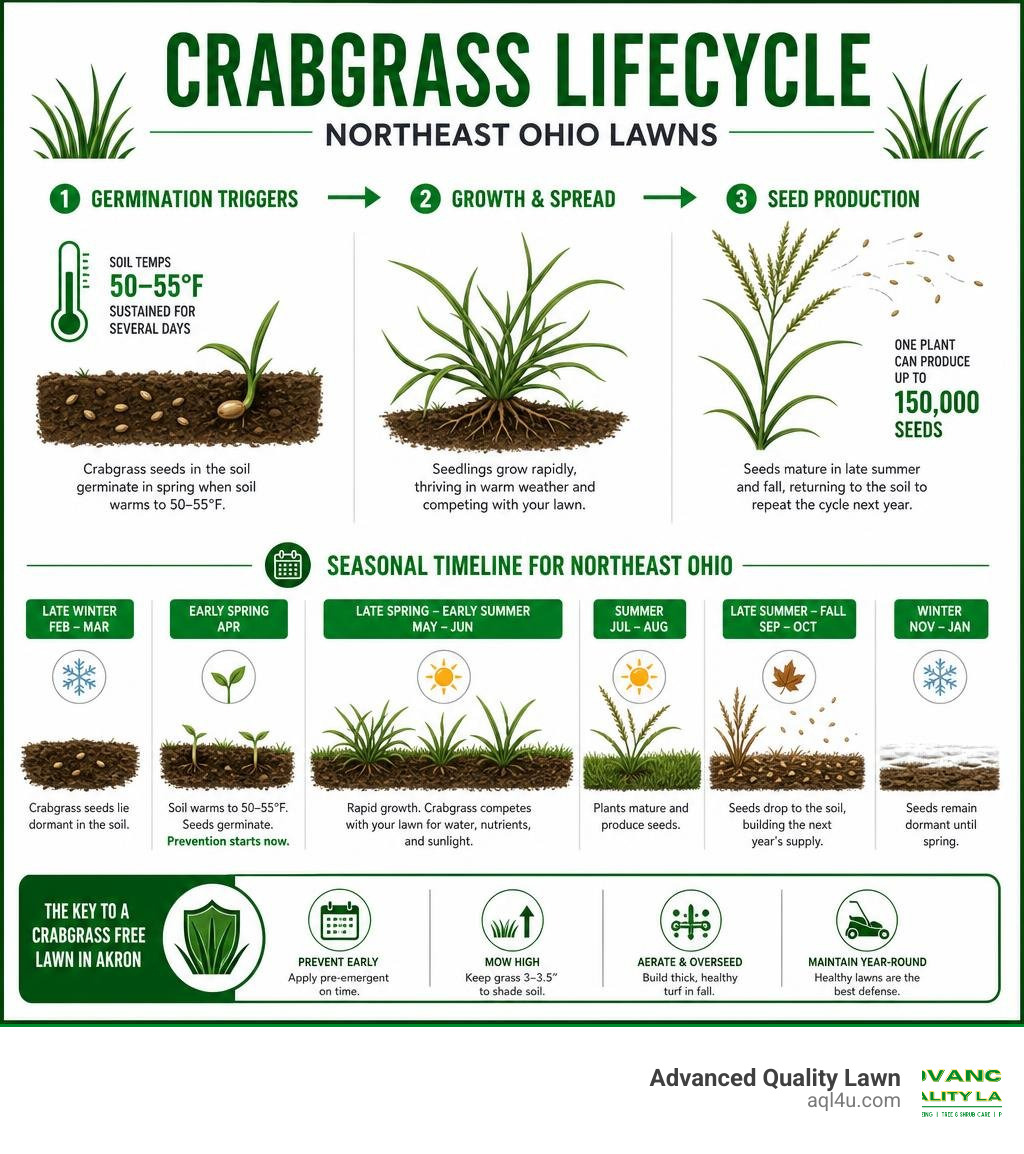
The core problem is timing. Miss your application window by even two weeks and you are no longer preventing crabgrass. You are reacting to it. And reaction is expensive. A single crabgrass plant produces up to 150,000 seeds before the season ends, meaning one missed spring can set your lawn back for years.
Akron's clay-heavy soil, cool springs, and unpredictable weather make this even harder. What works in a drier climate often fails here.
I'm Andrew Day, owner of Advanced Quality Lawn, and with more than 30 years of experience helping Northeast Ohio homeowners maintain a crabgrass free lawn in Akron and surrounding communities, I've seen every mistake and every solution firsthand. In this guide, I'll walk you through the strategies that actually work in our local conditions.
Understanding the Crabgrass Threat in Northeast Ohio

To defeat this stubborn weed, we must first understand how it behaves in our local climate. Crabgrass is a warm-season annual grass. This means it thrives in hot, dry summer weather, but its lifecycle actually begins much earlier in the spring. During the cold winter months in Northeast Ohio, the mature crabgrass plants from the previous year die off completely. However, they leave behind thousands of tiny, resilient seeds waiting in the soil.
As spring arrives, these seeds wait for the perfect environmental cues to wake up. The primary trigger is soil temperature. When the soil temperature at a depth of one to two inches reaches 50 to 55 degrees Fahrenheit for several consecutive days, the germination process begins.
Our local soil conditions in places like Copley, Cuyahoga Falls, and Stow make crabgrass management particularly challenging. Northeast Ohio is notorious for its heavy clay soil. Clay soil compacted by heavy foot traffic or winter snow holds water on the surface but prevents deep root growth for desirable cool-season grasses. Crabgrass thrives in compacted, poorly drained soils where your lawn is already weak and struggling.
Common cool-season grasses in Akron include Kentucky Bluegrass, Tall Fescue, and Perennial Ryegrass. These grasses grow beautifully in our mild springs and autumns, but they naturally slow down and enter a semi-dormant state during the hot, dry weeks of July and August. This is the exact moment when crabgrass hits its peak growth phase. If your cool-season turf is thin or stressed, crabgrass will quickly colonize the bare spots.
Understanding these local challenges is the first step toward a healthier yard. For a deeper dive into the specific weeds that plague our region, you can read our more info on local weed challenges. Additionally, managing this grassy weed often goes hand-in-hand with controlling other spring nuisances, which you can learn about in our guide to managing dandelions and crabgrass.
Establishing a Crabgrass Free Lawn in Akron Through Proper Timing
In the lawn care industry, timing is everything. If you apply your pre-emergent weed control too early, the product will break down before the late-season seeds germinate. If you apply it too late, the seeds will have already sprouted, rendering the pre-emergent completely useless.
To achieve a crabgrass free lawn in Akron, we rely on real-time soil temperature monitoring rather than a static calendar date. However, as a general rule of thumb for Northeast Ohio, the optimal application window falls between April 1 and April 15. In warmer springs, this window can open in late March, while cooler springs influenced by Lake Erie weather patterns might push the window back toward late April.
We use phenological indicators to help us time our applications without needing a soil thermometer every day. The most reliable natural indicator in Northeast Ohio is the brilliant yellow bloom of the Forsythia bush. When you see these bright yellow flowers reach full bloom in your neighborhood, it is your cue that the soil has reached the critical 50 to 55 degree range. You must complete your pre-emergent application before these yellow petals begin to drop.
For homeowners in Summit County and surrounding areas, the absolute treatment deadline is April 25. Applying standard pre-emergent products after this date rarely yields satisfactory results because a significant portion of the seed bank will have already germinated.
To provide season-long protection, we highly recommend a split-application strategy. A single heavy application in the spring will protect your lawn for about 8 to 12 weeks. By July, that chemical barrier will begin to thin, allowing late-germinating crabgrass to break through. A split-application strategy involves applying a half-rate of pre-emergent in early April, followed by a second half-rate application six to eight weeks later in mid-to-late May.
| Application Strategy | Protection Window | Breakthrough Reduction | Best Use Case |
|---|---|---|---|
| Single Application | 8 to 12 weeks | Baseline | Low-pressure lawns, late starts |
| Split Application | 16 to 20 weeks | 30% to 40% reduction | High-pressure lawns, clay soils, premium care |
This split approach extends your protection window to 16 to 20 weeks, keeping your lawn safe through the hottest parts of the summer. To learn more about setting up your seasonal timeline, refer to our comprehensive crabgrass prevention timing guide.
The Secret to a Crabgrass Free Lawn in Akron
The true secret to a crabgrass free lawn in Akron lies in how pre-emergent herbicides interact with the soil. Many homeowners believe that these products kill the weed seeds directly. In reality, the seeds still germinate.
When you apply a pre-emergent herbicide and water it in, it creates a thin, uniform chemical barrier in the top inch of your soil. When the crabgrass seed sprouts, its very first root and shoot emerge and come into contact with this barrier. The herbicide stops the young cells from dividing, preventing the tiny sprout from growing any further. The young plant dies before it ever breaks through the surface of your soil.
To make this barrier work, you must apply the first round when the soil temperature is consistently around 55 degrees. The second application of the split program should be timed when soil temperatures approach 65 degrees. This ensures the barrier remains active and strong when the soil is warmest and weed pressure is highest.
What to Do If You Miss the Spring Application Window
If busy spring schedules or unpredictable weather caused you to miss the April deadline, do not panic. While prevention is always the most effective strategy, you still have options to salvage your summer lawn.
Once crabgrass has germinated and emerged from the soil, pre-emergent products will no longer work. You must transition to post-emergent herbicides. These products are designed to target active weed growth without harming your desirable cool-season grass.
Post-emergent treatments are highly effective on young crabgrass plants that are less than an inch tall and have not yet branched out into multiple stems, which are called tillers. On these young plants, professional post-emergent applications boast a 40% to 60% success rate. However, once the plant matures and begins to spread, it becomes incredibly tough and resistant to most selective herbicides.
For small lawns or isolated patches, hand pulling is a highly effective, chemical-free option. The best time to pull crabgrass is after a heavy rain when the clay soil is soft and pliable. Make sure to pull from the base of the plant to extract the entire fibrous root system. If you leave the roots behind, the plant can regenerate. If you are dealing with a summer outbreak, you can find detailed treatment strategies in our summer crabgrass removal guide.
Effective Products and Cultural Practices for Crabgrass Control
A truly beautiful lawn cannot rely on chemical treatments alone. We must combine professional-grade products with proper cultural practices to build a thick, healthy turf that naturally resists weed invasions.
When it comes to chemical control, the most effective pre-emergent active ingredients for Northeast Ohio lawns are Prodiamine, Dithiopyr, and Pendimethalin. Prodiamine is highly regarded for its long-lasting residual control and excellent cost efficiency. Dithiopyr is unique because it offers both pre-emergent protection and early post-emergent control, meaning it can kill very young crabgrass plants that have already sprouted.
For homeowners who plan to plant new grass seed in the spring, Mesotrione is an invaluable tool. Standard pre-emergents will prevent your new grass seeds from growing, but Mesotrione is specially formulated to block weeds while allowing new grass seedlings to establish safely.
To supplement these products, you should implement the following cultural practices:
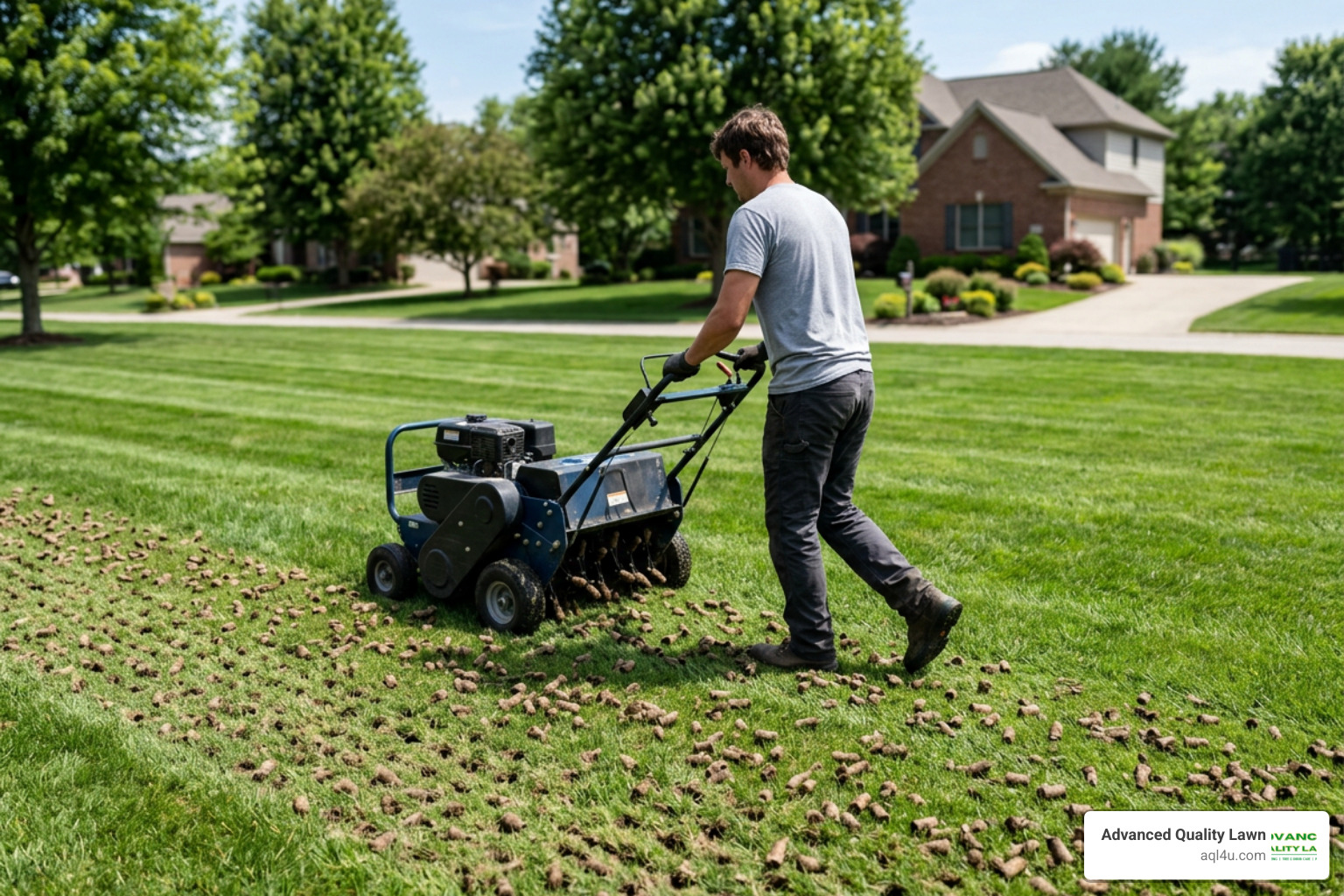
- Core Aeration: Our heavy clay soils in Northeast Ohio compact easily. Core aeration removes small plugs of soil from your lawn, allowing oxygen, water, and vital nutrients to reach the root zone of your grass. This process relieves compaction, making the soil less hospitable to weeds that prefer hard ground.
- Overseeding: The best natural defense against weeds is a thick, dense lawn. Overseeding introduces modern, disease-resistant varieties of cool-season grasses to fill in thin areas and bare spots.
- Mowing Height: Never scalp your lawn. We recommend mowing your cool-season grass at a height of 3 to 3.5 inches. Tall grass blades cast shade on the soil surface, blocking the sunlight that crabgrass seeds need to germinate.
- Deep Watering: Avoid light, daily watering. This practice keeps the surface of the soil wet, which is perfect for shallow-rooted weed seeds. Instead, water deeply and infrequently, applying about one inch of water per week in a single session. This encourages your grass roots to grow deep into the soil, making your lawn more drought-tolerant.
To explore your options for chemical control, check out our reviews on the best crabgrass killer options and the best herbicide for crabgrass control. For more general advice on maintaining your yard in Summit County, read our lawn maintenance tips for Akron. If you are planning to plant new seed soon, make sure to read our safe seeding and crabgrass preventer guide to avoid damaging your new grass.
Professional Lawn Care versus DIY Maintenance
Many homeowners in Copley, Bainbridge, and Chagrin Falls enjoy spending their weekends working in the yard. However, when it comes to effective weed control, there are significant differences between a DIY approach and hiring a professional service.
The first major hurdle for DIYers is equipment calibration. To apply pre-emergent herbicides effectively, the product must be spread with absolute uniformity. Residential walk-behind spreaders often lack precise calibration controls, leading to uneven application. This results in green stripes of healthy grass alternating with yellow stripes of breakthrough weeds.
Product potency is another key difference. The weed control products available at local home improvement centers are often diluted formulations designed for safety rather than maximum efficacy. Commercial-grade products used by licensed professionals typically last three to four weeks longer in the soil and offer superior resistance to breaking down under intense summer sunlight.
Finally, there is the issue of cost and convenience. By the time you purchase high-quality spreaders, personal protective equipment, multiple bags of fertilizer, and specialized weed control products, you have often spent more than the cost of a professional service.
If you are trying to decide which path is right for your home, our comprehensive crabgrass control guide offers a detailed breakdown of the pros and cons of each approach.
Professional Services for a Crabgrass Free Lawn in Akron
At Advanced Quality Lawn, we design our professional programs specifically for the unique climate and soil conditions of Northeast Ohio. We do not believe in one-size-fits-all solutions.
Our standard lawn care programs consist of 5 or 6 strategically timed applications throughout the growing season. This structured approach ensures your lawn receives a steady supply of premium, slow-release fertilizer to promote healthy growth, alongside targeted weed control treatments. Every program includes two dedicated applications of crabgrass control in the spring to establish and reinforce that vital soil barrier.
All of our treatments are applied by state-certified technicians who understand how to identify early signs of lawn diseases, insect infestations, and soil compaction. We stand behind our work with a full-program guarantee, which includes free service calls between scheduled visits if you ever notice a problem.
We proudly serve homeowners across a wide service area, including communities like Hudson, Brecksville, Solon, Broadview Heights, Parma, Medina, Macedonia, Cleveland, Richfield, Twinsburg, Streetsboro, Boston Heights, Peninsula, Independence, Seven Hills, North Royalton, and Sagamore Hills. Our coverage spans Summit County, Medina County, Cuyahoga County, Portage County, Wayne County, Geauga County, Lorain County, and Stark County.
Frequently Asked Questions about Akron Crabgrass Control
When is the absolute deadline to apply crabgrass preventer in Akron?
The absolute deadline to apply standard pre-emergent herbicide in Akron is April 25. After this date, soil temperatures are consistently warm enough to trigger widespread germination, meaning standard pre-emergents will no longer be effective. If you miss this date, you will need to rely on post-emergent spot treatments or specialized products like Dithiopyr, which can control very young, newly sprouted weeds.
Can I plant new grass seed after applying crabgrass preventer?
Standard pre-emergent herbicides are designed to block all grass seeds from growing, which creates a major conflict if you want to plant new grass. If you apply a standard pre-emergent, you must wait 8 to 12 weeks before planting new seed.
The only exception to this rule is the active ingredient Mesotrione, which can be applied at the time of seeding to block weeds without harming your new grass. For most homeowners in Northeast Ohio, we recommend saving your major seeding projects for the fall. The warm soil and cool air of September provide the perfect conditions for cool-season grass to grow without competing against aggressive spring weeds. You can learn more about managing this process in our new lawn crabgrass control guide.
Why does crabgrass keep coming back in my Akron lawn?
Crabgrass is an incredibly resilient survivor. Its seeds can remain dormant and viable in the soil for several years, waiting for the perfect conditions to wake up. If your lawn has thin spots, compacted clay soil, or areas damaged by insects or disease, dormant seeds will quickly seize the opportunity to grow.
Additionally, areas along concrete driveways, sidewalks, and south-facing slopes absorb more heat from the sun. This extra heat warms the surrounding soil much faster than the rest of your yard, causing early germination and breaking down your pre-emergent barrier prematurely.
Conclusion
Achieving a crabgrass free lawn in Akron does not have to be a source of endless weekend frustration. By understanding the critical importance of spring timing, utilizing the split-application strategy, and maintaining healthy cultural habits like high mowing and core aeration, you can enjoy a thick, green lawn all summer long.
At Advanced Quality Lawn, we are committed to taking the guesswork out of your yard care. With over 30 years of experience serving Northeast Ohio, our premium lawn care programs are designed to deliver beautiful, lasting results. We offer exceptional customer service, free service calls, and full-program guarantees across 99 plus zip codes in Summit, Medina, Cuyahoga, Portage, Wayne, Geauga, Lorain, and Stark counties.
Let us handle the heavy lifting so you can simply enjoy your backyard. Contact us to schedule your premium lawn care maintenance today and take the first step toward a healthier, weed-free home.